Most people assume that once you build a house, it stays put forever. You buy the land, pour the foundation, and that address is locked in for centuries. But back in September 2019, one Maryland family completely ignored that rule. They didn't just renovate an old building; they packed up a 255-year-old Georgian mansion and shipped it fifty miles across the Chesapeake Bay.
If you think moving a 4,000-square-foot brick structure sounds insane, you are right. It cost homeowner Christian Neeley nearly one million dollars and required months of brutal, high-stakes logistics. But when faced with the choice between watching a pristine piece of American history get bulldozed by suburban expansion or hauling it across open water, the family chose the water.
Here is how they actually pulled off one of the wildest structural relocations in recent memory.
The Backstory of Galloway House
Built between 1760 and 1764, Galloway House was originally constructed near Easton, Maryland, for newlyweds William Nicols and Henrietta Maria Chamberlaine Nicols. It sat proudly on a massive 600-acre plantation in Talbot County, standing as a textbook example of pre-Revolutionary War architecture.
Generations came and went. The brick walls absorbed more than two centuries of history. Eventually, the property slipped into neglect, sitting empty while modern developers eyed the land for subdivision. Instead of letting a piece of the 18th century turn into a cluster of cookie-cutter modern homes, the Neeley family stepped in. They bought the house with a single goal: transplant it to a new waterfront plot along the Wye River in Queenstown, Maryland.
Breaking Down a Four Hundred Ton Problem
You can't just hook a pickup truck to a two-story brick mansion. The entire building weighed roughly 400 tons.
Expert House Movers handled the initial land phase, lifting the massive brick frame onto specialized hydraulic dollies. The road trip took place over four grueling nights, inching through local routes and crossing paths like Route 50 and Route 322. Road closures were mandatory. Power lines had to be lifted out of the way.
The destination for phase one was Easton Point. That is where things got complicated.
When the Barge Started to Tip
Getting a house from dirt onto a floating barge is a physics nightmare. As heavy equipment maneuvered the structure onto the watercraft, the barge developed severe ballast issues and began to list dangerously to one side.
Crews had to scramble. They brought in a larger backup boat to stabilize the operation and built temporary ramps out of heavy lumber to safely bridge the gap between solid ground and the floating deck. The loading process alone dragged on for eight exhausting hours. One wrong calculation would have sent centuries of brick and mortar straight to the bottom of the river.
Sailing Across the Chesapeake Bay
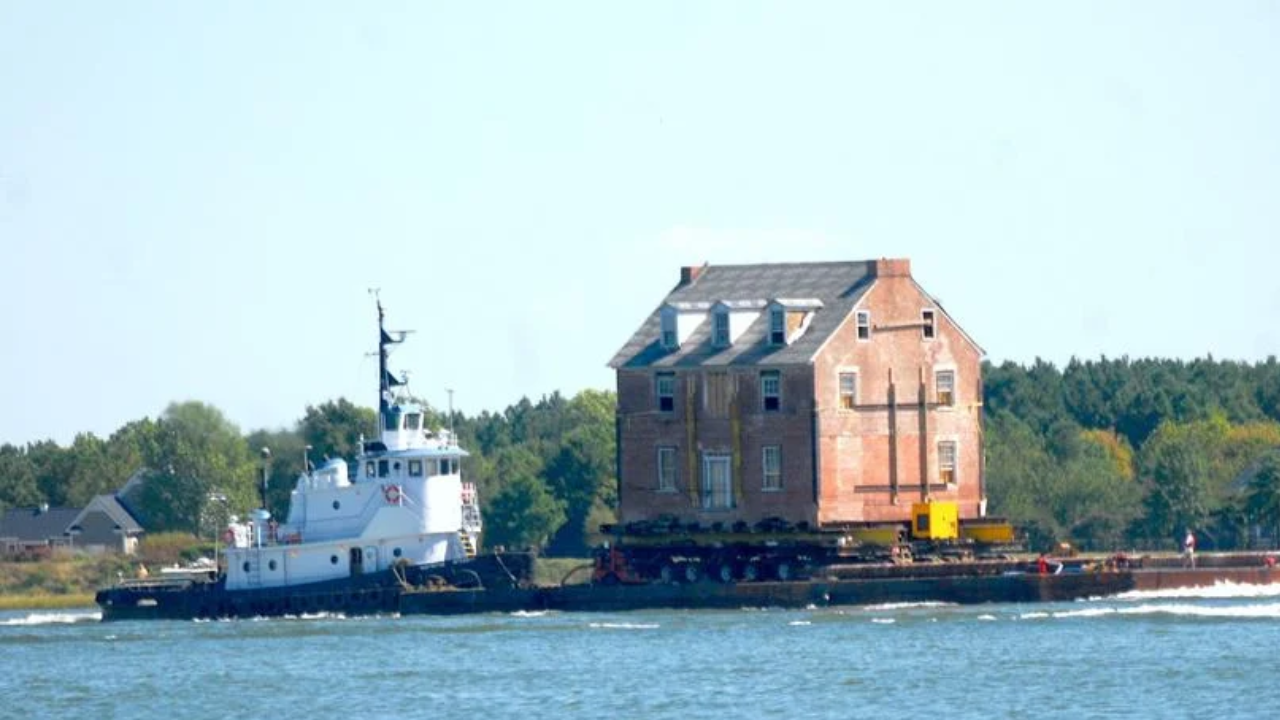
Once secured, the floating mansion began its historic water voyage. Tugs pulled the barge down the Tred Avon River, looping around Tilghman Island and cutting through Eastern Bay toward the Wye River.
The fifty-mile water route turned into a massive spectator event. Boaters and local residents lined the shores to watch a colonial-era home floating down the bay. Because the waters hide tricky sandbars and shallow channels, a TowBoat U.S. vessel escorted the convoy to provide local navigation expertise to the captain.
Landing and Restoration Realities
Reaching Queenstown didn't mean the hard work was over. Offloading a 400-ton brick building from a barge onto a new waterfront foundation required the same agonizing precision as loading it.
Once secured on its new site along the Wye River, the real preservation work began. The original double-pile core of the home was meticulously restored. Because an 1840s kitchen addition couldn't survive the brutal transit, the family designed and built two brand-new matching wings to complete the layout.
Protecting history isn't cheap, and it certainly isn't easy. But for anyone wondering if stubborn preservation efforts can outwit modern development, this project proved that with enough money, engineering muscle, and patience, even a 255-year-old house can find a brand-new horizon.