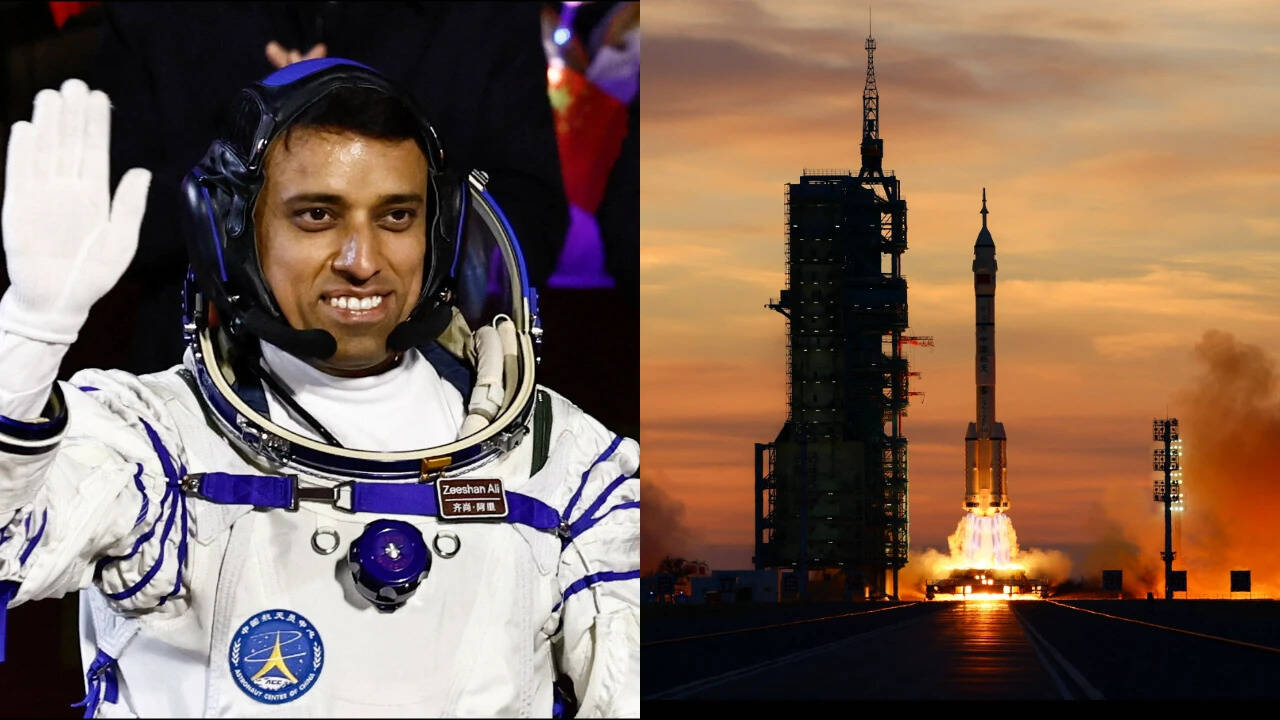
Pakistan has a new first in orbit. Muhammad Zeeshan Ali docked at China's Tiangong space station on November 25, 2026 aboard Shenzhou-24, becoming both the first Pakistani in space and the first foreign astronaut to visit Tiangong.
That headline sounds simple on paper. Honestly, the mechanics behind it are wild. A 40-year-old Pakistan Air Force pilot went from a bilateral agreement signed in February 2025 to riding a Long March-2F rocket out of the Jiuquan Satellite Launch Center in less than two years. By early morning in Islamabad, students and amateur astronomers at the Space and Upper Atmosphere Research Commission (SUPARCO) auditorium were watching the live feed before dawn, holding paper flags and waiting through a tense silence as the rocket shrank on screen.
Most coverage stops at the milestone itself—who launched, when docking happened, and how many days Ali stays up there. That misses the real story. Tiangong isn't just another orbital lab anymore. It has become a parallel diplomatic track in human spaceflight, built partly because geopolitical walls keep certain flags off the International Space Station.
How a Pilot Became Tiangong's First Foreign Visitor
Getting a foreign national onto a crewed Chinese mission takes more than goodwill. It takes tight timeline compression and intense training.
Following the February 2025 agreement between the China Manned Space Agency (CMSA) and SUPARCO, selection moved through three stages before narrowing down to two Pakistani pilots who trained in China—Muhammad Zeeshan Ali for the flight and Khurram Daud as backup. Ali spent seven months in Beijing preparing for launch alongside Chinese crewmates Tang Hongbo and Wu Yi. That wasn't just centrifuge runs and emergency drills. It meant learning Chinese language fundamentals, reading poetry, singing songs, practicing calligraphy, and playing table tennis to bridge daily life with his crew.
When you follow space programs closely, people often assume a short-stay payload specialist is mostly along for the view. Wrong. Short missions on a station are packed because every hour of crew time in low Earth orbit costs money and coordination. Ali's job centers on setting up joint China-Pakistan science experiments, installing hardware and samples, and verifying that sensitive payloads survived launch loads and vibration without damage.
- Payload installation: Deploying and starting four collaborative research projects spanning biotechnology and materials, including experiments with photosynthetic microalgae and quinoa seeds.
- Data verification: Recording initial telemetry and operational checks to confirm equipment functions properly in microgravity before handing long-term tracking over to onboard crews.
- Crew integration: Working alongside commander Tang Hongbo, flight engineer Wu Yi, and existing station residents while keeping a tight schedule.
After his brief stay aboard Tiangong, Ali is scheduled to return to Earth aboard Shenzhou-23 with crew members Zhang Zhiyuan and Li Jiaying. Meanwhile, Chinese astronaut Zhu Yangzhu remains in orbit for an extended stay experiment—China's first year-long orbital mission—while Tang and Wu stay on for roughly six months.
What Most People Miss About Tiangong's Foreign Crew Debut
There's a big misconception that Tiangong opening to a foreign astronaut automatically rivals the International Space Station's decades-old multinational model on day one. Not quite. One pilot on a short visit is an operational proof of concept, not a permanent international crew rotation system yet.
Still, the strategic signal is hard to ignore. China built Tiangong independently after being excluded from the ISS program, and Pakistan has long looked for deeper technical partnerships outside Western-led space tracks. As reported by Al Jazeera, analysts and officials point out that shutting doors on one orbital platform pushes other nations to build alternatives. For Beijing, hosting Ali shows Tiangong can handle foreign crew training, cross-language operations, and joint payloads. For Islamabad, it turns a decades-old satellite and aerospace relationship into actual human spaceflight experience.
- Real gain for Pakistan: Hands-on exposure to mission integration, microgravity payload handling, and space medicine lessons that can spill back into domestic engineering and healthcare research.
- Real limitation right now: A five-to-ten-day payload specialist flight builds institutional familiarity, though deep scientific returns on experiments like seed and microbial studies take six to twelve months to finish.
- Broader Chinese slate: CMSA has lined up over 90 scientific experiments and technology tests across space life sciences, materials, microgravity physics, and space medicine, proving this flight fits inside a much larger research tempo.
I've watched plenty of first-astronaut announcements turn into one-off publicity moments if there isn't a clear technical ladder behind them. That's why the follow-on milestones matter way more than the launch photo.
Where This Partnership Goes Next
SUPARCO chairman Muhammad Yousaf Khan framed the Shenzhou-24 flight as a stepping stone rather than a finish line, pointing toward a lunar rover planned around 2028 and a broader ambition to reach the Moon by 2035. Pakistan already tested lunar collaboration through its iCube-Qamar satellite carried on China's Chang'e-6 mission in 2024, and a SUPARCO-built rover is slated to fly with China's Chang'e-8 effort later this decade.
Even so, grand lunar targets deserve healthy skepticism until hardware flies and budgets hold steady. Going from a short low-Earth-orbit payload mission to lunar surface robotics and crewed deep space involves massive jumps in radiation shielding, communications latency, propulsion, and funding continuity. A lunar rover in 2028 is a concrete test of whether both agencies can sustain engineering delivery past the initial diplomatic spotlight.
If you're following this story from Pakistan or anywhere else in the region, don't stop at the celebratory clips. Track three specific things next:
- Follow the return manifest: Watch Ali's safe undocking and return on Shenzhou-23 alongside Zhang Zhiyuan and Li Jiaying, plus early notes on how the four joint experiments performed on day one.
- Watch the six-to-twelve-month science readout: Look for published results from the cyanobacteria and quinoa seed research rather than assuming instant breakthroughs during a week in orbit.
- Check the 2028 lunar rover updates: Pay attention to SUPARCO and CMSA technical milestones for the planned lunar rover ahead of the broader 2035 lunar goal.