Back in September 2022, humanity tried something entirely unprecedented. NASA slammed a 580-kilogram spacecraft named DART straight into Dimorphos, a small moonlet orbiting the larger asteroid Didymos. The goal was simple yet high-stakes: test whether we could physically nudge a space rock off a collision course with Earth. It worked. The impact shortened Dimorphos's orbit by a whopping 33 minutes, blowing past initial mission expectations.
Yet, DART's dramatic kamikaze dive left behind more questions than answers. When you punch an asteroid at six kilometers per second, what actually happens beneath the surface? Was Dimorphos a solid rock, or just a loose pile of rubble held together by faint gravity?
Enter Europe.
The European Space Agency's Hera spacecraft has finally arrived at the Didymos system, and its mission is to uncover the hidden wreckage.
Looking at the Other Side of the Cosmic Coin
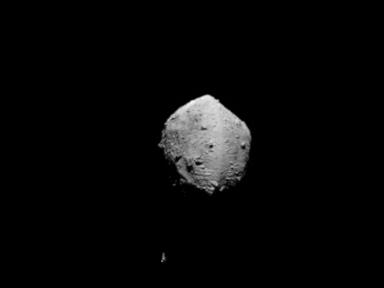
Hera didn't waste time making its presence known. Swooping to within roughly 60 kilometers of the target, the probe snapped its first high-resolution, monochrome images of the binary pair.
The view stunned researchers on Earth. Because DART hit Dimorphos from a specific angle, scientists only had high-detail imagery of one hemisphere. Hera caught the opposite side of the primary asteroid, Didymos.
Patrick Michel, lead scientist for the Hera mission at the French CNRS and Côte d'Azur Observatory, put it bluntly: "The first thing we said was 'wow!'"
It’s like staring at an entirely different world. The newly imaged hemisphere features a distinct equatorial ridge, stark craters, and sprawling groove patterns that tell a complex geological story. While Didymos looms large at roughly 780 meters across, tiny Dimorphos—measuring a modest 151 meters—hides partly in shadow, waiting for a much closer look.
Why DART Was Only Half the Job
A single impact experiment isn't enough to build a reliable planetary defense shield. DART proved we can hit a target, but it couldn't measure the aftermath in deep detail.
Think of DART as a proof-of-concept. Hera is the forensic audit.
Scientists need to know the exact mass, internal structure, and composition of Dimorphos. If an asteroid is a solid monolithic boulder, a kinetic impactor behaves one way. If it's a "rubble pile"—a loose agglomeration of boulders and dust bound by minimal gravity—the impact energy dissipates entirely differently.
Without knowing the internal makeup, calculating how to deflect a future city-killer asteroid is basically guessing. Hera aims to change that.
Inside Hera's Deep-Space Toolkit
Hera isn't operating alone. The mothership is carrying two briefcase-sized CubeSats named Milani and Juventas. These tiny satellites will drop directly into the low-gravity environment around the asteroids to perform unprecedented science.
Milani will handle spectral and dust analysis, mapping out the surface minerals and checking the surrounding dust cloud. Juventas will take things a step further by deploying a low-frequency radar system. It will beam radio waves straight through Dimorphos, conducting the first-ever internal radar scan of an asteroid. If the radar signals scatter wildly through internal voids, we'll finally have proof of its rubble-pile architecture.
Meanwhile, the Hera mothership will use precise optical tracking to measure the microscopic wobble that Dimorphos induces on the larger Didymos. That gravitational dance allows scientists to calculate the exact mass of the moonlet with surgical precision.
Turning Science Fiction Into Standard Operating Procedure
Planetary defense used to belong exclusively to science fiction novels. Today, it's an active branch of aerospace engineering.
By wrapping up this comprehensive survey, Hera will transform kinetic impact technology from a one-off gamble into a predictable, repeatable technique. When the detailed data and high-definition maps drop, we will finally understand the physical cost of punching a rock in deep space.
Space is full of hazards. Knowing how to push them away is no longer optional.


