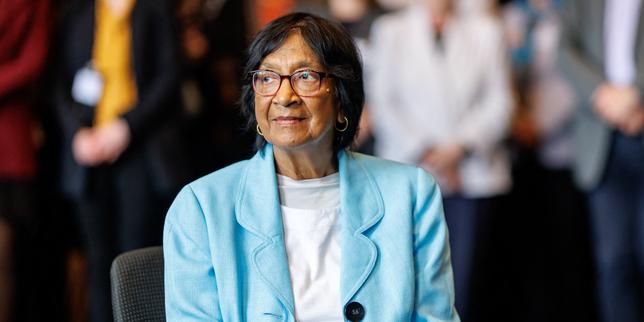
International law doesn't usually win medals. Most people see it as a toothless tiger, a set of polite suggestions written by diplomats who never have to dodge bullets. But the Norwegian Nobel Committee just flipped that script. By awarding the 2026 Nobel Peace Prize to Navanethem Pillay, they sent a loud, unmistakable message: holding war criminals accountable isn't optional background noise. It's the entire foundation of peace.
At eighty-five years old, Navi Pillay isn't a charismatic politician or a rebel marching in the streets. She's a jurist, a fighter, and an unyielding engine of international justice. From defending anti-apartheid activists in segregated South African courts to serving as the United Nations High Commissioner for Human Rights, her life has been a masterclass in proving that the law can bite back against tyrants.
From Durban Courtrooms to Global Tribunals
You can't understand Pillay's fire without looking at where she started. Born in Durban in 1941, she grew up under the brutal boot of apartheid. As a young woman of Indian descent, she faced structural walls at every turn. But she carved a path through the law anyway, becoming the first non-white woman to open a law practice in the province of Natal.
She didn't just practice law; she used it as a weapon against oppression. She represented anti-apartheid activists, fought for the rights of political prisoners on Robben Island, and exposed police brutality when the state wanted nothing more than silence.
When apartheid fell, Pillay didn't slow down. She took her courtroom battles onto the world stage. She served as a judge on the International Criminal Tribunal for Rwanda, confronting the horrific legacy of the 1994 genocide head-on. She later sat on the International Criminal Court and spent years heading the UN Human Rights Office. Her career has consistently intersected with the worst atrocities of our time, not as a passive observer, but as the person holding the gavel.
Why This Nobel Prize Stings the Powerful
The Norwegian Nobel Committee didn't pick Pillay just to hand out a retirement trophy. They picked her because international justice is currently facing an existential crisis. Powerful nations increasingly ignore global courts, brush off war crime investigations, and treat legal frameworks as inconvenient obstacles to realpolitik.
Pillay's recent work as chair of the UN commission investigating the occupied Palestinian territories put her right back in the global crosshairs. Her team's findings—including accusations of severe human rights violations and genocide—drew furious pushback and intense geopolitical backlash. Critics accused her of bias, while political pressure mounted from capitals determined to shield their allies.
Yet Pillay has always shrugged off the noise with the cold logic of a judge. When asked about accusations of courage, she cuts straight to the point: "You interpret the law, you look at all the facts, so it's an impartial decision you make. Why would you need courage to speak the truth?"
That unflinching stance is precisely why the Nobel Committee honored her. In an era where international institutions are battered by powerful actors trying to dismantle accountability, honoring Pillay is a stark reminder that legal standards are an absolute necessity for survival.
The Real Message Behind the Gold Medal
When world leaders look at Navi Pillay receiving the prize in Oslo, they aren't just seeing an elderly South African jurist. They're seeing a living embodiment of accountability.
Too many peace prizes go to diplomatic compromises that crumble within a decade. Pillay's win honors a different path: the grueling, unglamorous work of documenting atrocities, protecting victims, and dragging perpetrators into courtrooms. It's a statement that you cannot build a lasting peace on a foundation of unpunished mass crimes.
The road ahead for global justice is rough. Powerful states will keep trying to undermine courts, sanction investigators, and look the other way when it suits them. But Navi Pillay spent over half a century showing that institutional persistence outlives bullies.
Read up on the history of international tribunals and understand how bodies like the ICC and ICJ actually function. Knowing how the machinery of global justice operates is the best defense against cynicism when power tries to crush the rule of law.