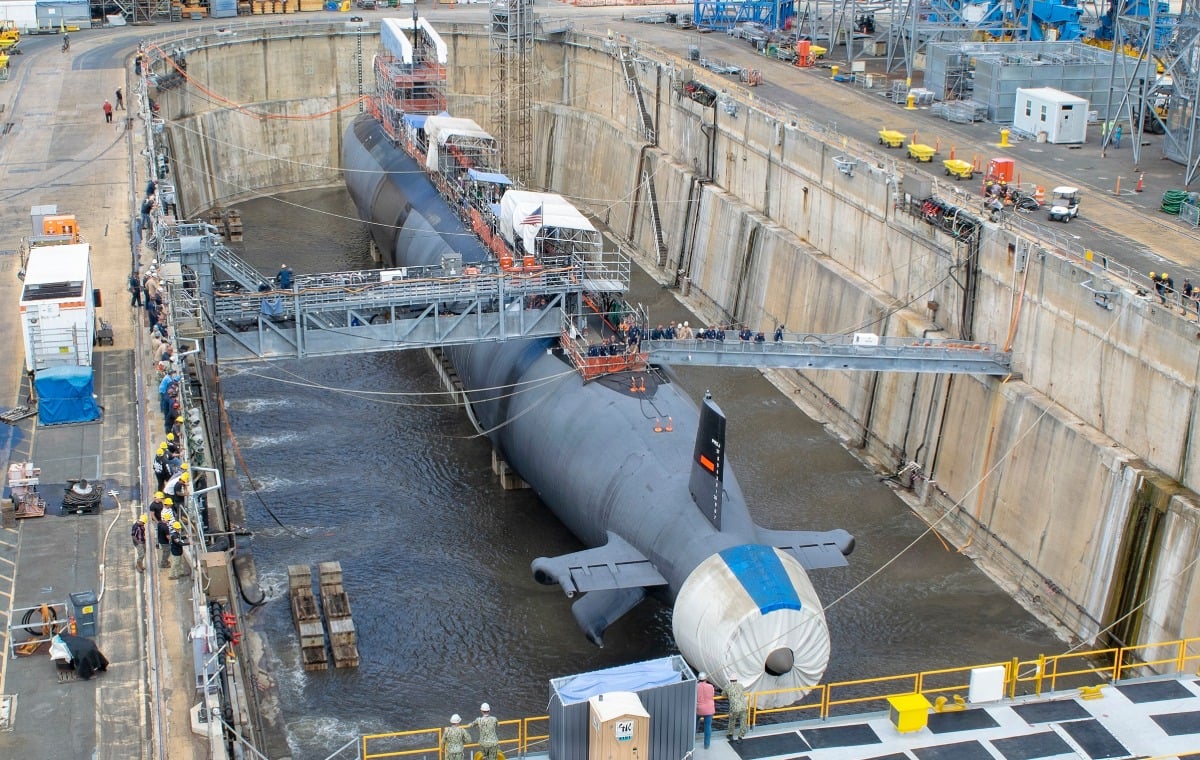
Submarines are only as good as their ears. If you can't hear the enemy coming before they hear you, your multi-billion-dollar stealth machine is basically a blind target. That's why the US Navy is quietly upgrading its underwater sensing tech, and the second ship of the Block V Virginia-class sub line is about to carry something entirely new.
We aren't talking about a minor software patch. This is a massive hardware shift aimed squarely at keeping an acoustic advantage over rapidly modernizing Chinese and Russian submarine fleets.
The core of this upgrade centers on the Large Vertical Array (LVA) flank sonars. For decades, submarines relied heavily on massive bow spheres and standard flat panel arrays along the hull sides. The LVA changes that geometry. By mounting massive vertical acoustic sensors along the submarine's sides, the Navy can catch faint low-frequency signals that previous sensor layouts missed entirely.
The Problem With Traditional Underwater Listening
To understand why this matters, look at how submarines traditionally process sound. A standard fast-attack sub uses a mix of a massive bow array, side-mounted wide aperture panels, and long towed arrays reeled out on a cable behind the boat.
Each has a glaring limitation:
- Bow Arrays: Excellent for looking forward, but blocked by the submarine's own massive hull from hearing what is behind it.
- Towed Arrays: Brilliant for long-range, low-frequency tracking, but they restrict how fast and hard a submarine can maneuver without tangling or distorting the line.
- Standard Flank Arrays: Good for side coverage, but traditionally lack the vertical dimension needed to isolate deep-ocean sounds from surface noise.
The LVA addresses these gaps. Developed through collaboration between the Navy, General Dynamics Electric Boat, and specialized polymer divisions, these arrays use advanced polyurethane acoustic modules. They handle the punishing pressures of deep ocean dives while isolating vibrations from the submarine's own internal machinery.
Tracking the Block V Evolution
The Virginia-class has always evolved in distinct blocks. Block I and II focused on getting the platform operational and improving modular manufacturing. Block III introduced the Large Aperture Bow (LAB) array, swapping out the old water-backed sonar sphere for a lighter, cheaper, passive-active system.
Block V represents a massive leap in physical size and purpose.
The second boat of this block, alongside its siblings, gets a massive 84-foot hull extension known as the Virginia Payload Module (VPM). This extension boosts the submarine's displacement from 7,800 tons to over 10,200 tons. It turns a standard fast-attack sub into a strike platform capable of carrying 40 vertically launched missiles instead of just 12.
But adding all that physical length and machinery creates a secondary issue: noise. More hull means more surface area for water to rush past, creating hydrodynamic flow noise. It also means more internal space where equipment can create tiny vibrations.
The LVA flank sonars are specifically engineered to counter this reality. They work in tandem with the existing six Light Weight Wide Aperture Arrays (LWWAA) already lining the hull. By combining these systems, sonar operators get a highly detailed tactical picture, allowing them to sort through ocean clutter, biologics, and shipping noise to spot the quietest adversary hulls.
The Real Underwater Threat Matrix
The timing of this upgrade isn't an accident. For years, Western naval analysts pointed to a comfortable American lead in acoustic silencing. That gap is shrinking.
Russia's Yasen-M class nuclear-powered attack submarines are exceptionally quiet and carry a massive load of cruise missiles. At the same time, China's submarine force is expanding its manufacturing capacity, turning out increasingly stealthy hulls at a rapid pace.
In a real scenario, the victory goes to whoever secures the initial detection. Detecting a target five minutes earlier means you can set up the perfect intercept vector, launch a Mark 48 Advanced Capability torpedo, and slip away before the enemy even realizes a weapon has been fired. The LVA is about buying those five minutes.
Testing, Noise Concerns, and The Path Forward
It hasn't been completely smooth sailing. Navy budget documents show ongoing research dedicated specifically to addressing noise concerns within the LVA assemblies themselves. Because these arrays are large and mounted directly to the exterior pressure hull, isolating them from the sub's own structural vibrations is incredibly complex. Engineers are continually gathering longevity data from the first test units to refine software filtering and hardware mounting fixtures.
This isn't an experimental luxury. It's a necessity for a fleet expected to serve well into the 2070s. The open system architecture used across the Virginia class means these outboard components can easily feed raw acoustic data into rapid, bi-annual software updates, keeping pace with foreign countermeasures.
If you track naval procurement or defense technology, watch the upcoming sea trials for the early Block V hulls. The focus will naturally be on the massive new missile tubes, but the real story of undersea dominance is happening silently on the side of the hull.
Defense industrial base suppliers are currently executing component deliveries to support these builds. For those interested in the deep mechanics of naval engineering, the next logical step is monitoring the Navy's Advanced Processing Build (APB) software updates, which dictate how sonar operators actually translate these new LVA hardware signals into target tracks.