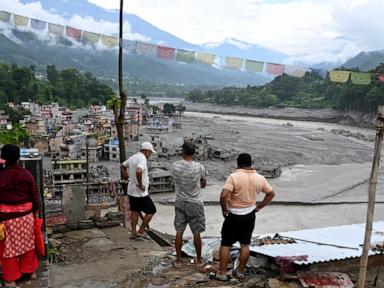
Himalayan mountain ranges aren't just scenic postcards. Right now, they're ground zero for a devastating climate catastrophe. The death toll from the catastrophic Nepal and Tibet flash floods has climbed past 900 people. Over 4,700 individuals remain unaccounted for, leaving families in agonizing limbo.
If you look at the raw statistics alone, you miss the true horror of what happened along the border. Let's break down why this specific disaster shocked experts and why recovery efforts face impossible odds.
What Triggered the Catastrophe
The disaster didn't happen because of standard seasonal monsoon rains. It began with an extreme glacial collapse high on a cliff about 16,000 feet up near the frontier.
A massive wall of ice, rock, mud, and water tore down a 6,000-foot slope. The force was so immense that the U.S. Geological Survey registered it as a 5.2-magnitude landslide.
When that debris avalanche hit river systems like the Trishuli River, it didn't just rise slowly. It formed a violent tsunami of sludge that surged over 62 miles downriver into Nepal. Buildings vanished. Bridges snapped like toothpicks. Hydroelectric projects became lethal traps.
The Brutal Reality of Search and Rescue
Rescue teams are fighting against sheer geography. The affected areas are intensely remote, making heavy machinery deployment nearly impossible in the early stages.
Authorities have scrambled to reach over 900 people trapped inside tunnels and underground chambers across six different hydroelectric projects. Debris blocks entrances entirely. Workers are clearing tons of rock by hand while the threat of secondary landslides looms large.
Officials report that over 90,000 people are affected. International aid, including emergency food packages from the U.S. State Department, is rolling in. Yet, ground operations remain painfully slow.
The Human Cost You Don't See on TV
Hundreds of unidentified bodies are being buried in shallow graves across the plains. Morgues overflow. Mass burials have become a grim necessity to prevent disease outbreaks.
Foreign nationals, tourists, and locals are mixed into the thousands of missing reports. Families are combing through muddy debris fields with bare hands. They aren't waiting for official crews.
When rivers swallow entire communities overnight, bureaucratic counts lag behind reality. Stay alert to official warnings if you have travel plans to the Himalayan region. Avoid zones facing active search-and-recovery operations and severe transit disruptions.
Nepal-Tibet Flood Crisis Update
This video provides an on-the-ground look at the rescue operations and the scale of destruction following the Nepal and Tibet flash floods.


