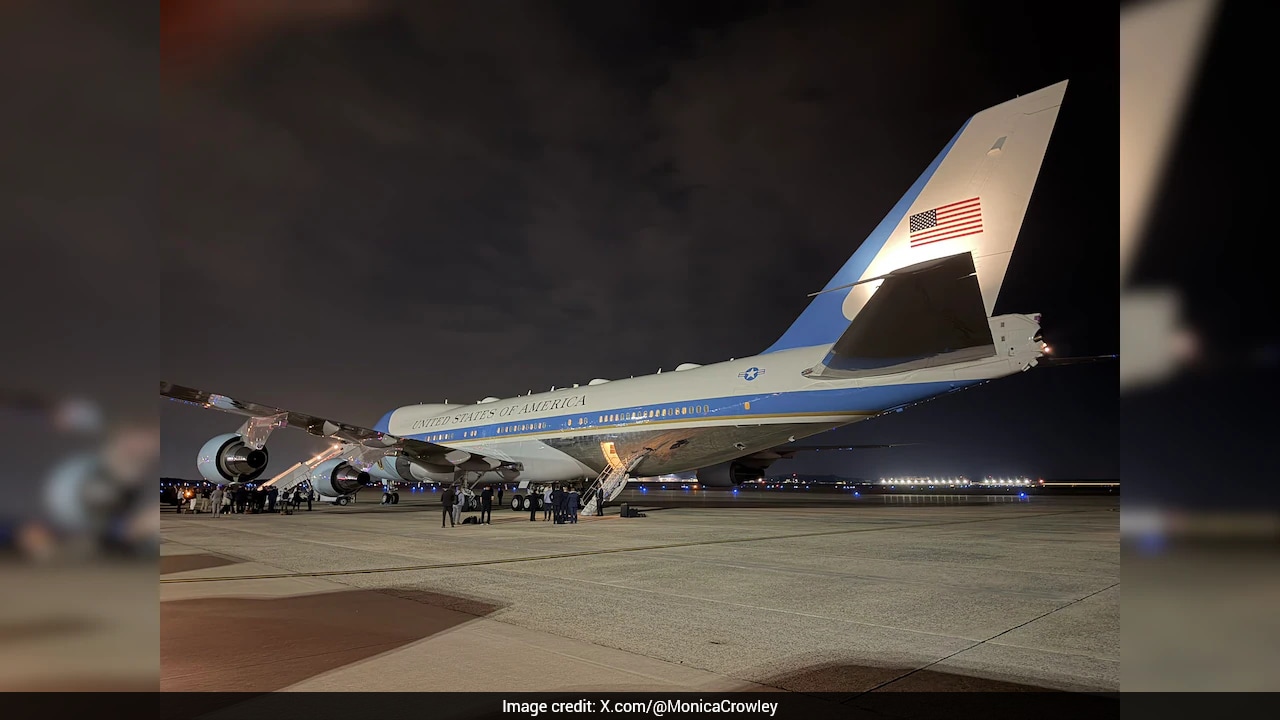
White House officials just gave a highly sentimental send-off to one of the two Boeing 747s that has flown American presidents for over three decades. Communications Director Steven Cheung called it "The Last Ride" in a social media post featuring the iconic blue-and-white aircraft. Chief of Protocol Monica Crowley followed up, noting she was on its final flight after it carried every commander-in-chief since George H.W. Bush.
But if you think the Air Force is immediately replacing these aging Cold War relics with those shiny, purpose-built new jets you've heard about, you're wrong.
Instead, the next plane taking to the skies as Air Force One is a used commercial jumbo jet originally custom-built for Middle Eastern royalty. Specifically, the House of Thani, the ruling family of Qatar.
This stopgap fix tells a messy story of defense budget blunders, diplomatic friction, and an emergency scramble to keep the president airborne.
The Air Force One Mess
The US military has a massive problem with its presidential fleet. The two current aircraft—technically called VC-25As—are modified Boeing 747-200Bs. They're old. They debuted in 1990 when cassette tapes were still high technology. Maintaining them is an absolute nightmare. Parts have to be custom-fabricated because Boeing hasn't built a 747-200 in decades.
The Air Force tried to fix this years ago by ordering two brand-new, heavily upgraded 747-8s under a fixed-price contract with Boeing. That program has completely fallen apart. It's plagued by severe labor shortages, supply chain bottlenecks, and massive delays. Boeing has already swallowed over $2 billion in losses on the project. Those permanent replacements, initially promised years ago, won't show up until 2028 at the earliest.
Meanwhile, the old planes are running out of hours.
Enter the "VC-25B Bridge" aircraft. It's a single Boeing 747-8 Intercontinental originally delivered to the Qatar Amiri Flight in 2012. After sitting largely idle or serving Qatari royals, it was handed over to the US in 2025. This isn't just a backup plane. It's the interim solution that will carry the president while Boeing keeps fumbling the main program. Rumor has it the administration is aiming to debut this new jet on July 4, 2026, to mark the nation's 250th anniversary.
Trading Kennedy Blue for Trump Crimson
If you're expecting the classic, elegant sky-blue livery designed by Raymond Loewy and Jacqueline Kennedy in the 1960s, prepare for a shock. The Qatari jet has already emerged from a modification facility in Waco, Texas, sporting a radically different look.
It features a stark white top, a deep, dark blue underbelly, and a sharp red stripe slicing through the center of the fuselage. The tail doesn't have the traditional, static American flag graphic either. Instead, it features a massive, hyper-stylized image of a waving, billowing Stars and Stripes.
This design reflects the personal aesthetic choices of President Trump, who ordered a fleet-wide paint overhaul during his first term. Love it or hate it, the old aesthetic is officially being phased out as the rest of the executive transport fleet gets repainted to match.
Inside a Flying Qatari Palace
Before the US military got its hands on this aircraft, it was essentially an ultra-luxury flying mansion. The interior was originally crafted by Cabinet Alberto Pinto, an elite French design firm known for catering to billionaires and royal families.
The original layout was staggering. It featured hand-woven Tai Ping carpets, rare sycamore and wacapou wood fixtures, and custom artwork by Alexander Calder. It included a massive master bedroom, a dedicated guest bedroom, two luxury bathrooms, nine additional lavatories, and multiple high-end lounges. It was configured to comfortably seat 89 VIP passengers in absolute opulence.
The defense contractor L3Harris has spent the last year ripping out much of that royal luxury to make the plane functional for a commander-in-chief.
Military technicians had to strike a balance. They didn't completely rebuild the airframe from scratch—doing so would take years and defeat the purpose of an emergency bridge aircraft. Instead, they focused heavily on installing secure military communications, high-encryption data networks, and satellite tracking systems.
Because of these compromises, this bridge aircraft actually lacks some capabilities the final, permanent VC-25Bs will have. It has fewer built-in airstairs, significantly less refrigerated galley space, and cannot perform the specific military protocol used to transport the remains of a deceased former president.
The Bilateral Drama and Security Risks
You don't just accept a massive, multi-hundred-million-dollar widebody jet from a foreign government without triggering a political mudfight. The acquisition has drawn sharp criticism from congressional lawmakers who argue that accepting an unprecedentedly massive gift from Qatar raises serious ethical and legal questions.
There's also the glaring issue of operational security.
Aviation experts and defense critics immediately raised flags about the wisdom of putting the American president in a plane previously owned, maintained, and operated by a foreign power. The fear is obvious. How do you ensure that foreign intelligence agencies didn't plant deeply hidden listening devices, hardware bugs, or tracking sensors in the airframe years ago?
The Air Force insists it has handled the threat. A specialized, highly vetted team of counter-surveillance experts spent months meticulously auditing every single square inch of the aircraft, stripping out legacy wiring and scanning the structure for any technical hazards before installing the new American systems.
Then there's the cost. While early estimates suggested the conversion could hit a billion dollars, the modification work itself came in at around $400 million. But a closer look at the Pentagon's accounting reveals a highly controversial move. To fund the retrofitting, defense officials quietly shifted $934 million into the project, hiding the funds inside the completely unrelated, over-budget LGM-35 Sentinel nuclear missile program.
Even the ground infrastructure required a massive, expensive overhaul. The 747-8 platform is physically larger than the old 747-200s. It's 18 feet longer and nearly 30 feet wider. It literally couldn't fit into the existing Air Force One hangars at Joint Base Andrews.
To fix this, the military had to build a brand-new, $320 million high-tech hangar complex. The project was so sprawling that base officials had to permanently shrink the Andrews military golf course, reducing it from 54 holes down to 45 just to clear enough land for the new presidential hangar.
What Happens Next
The old era is winding down, but it isn't entirely over. Despite the dramatic farewell posts from White House staff, the Air Force clarified that both legacy VC-25A jets will technically remain in the active executive fleet for the immediate future as the new Qatari-derived bridge plane is integrated.
Expect to see the newly painted red, white, and blue 747-8 take over primary flight duties this summer. It will serve as America's temporary flying Oval Office for at least the next two years, holding the line until Boeing finally delivers the long-delayed, purpose-built presidential fleet at the end of the decade.