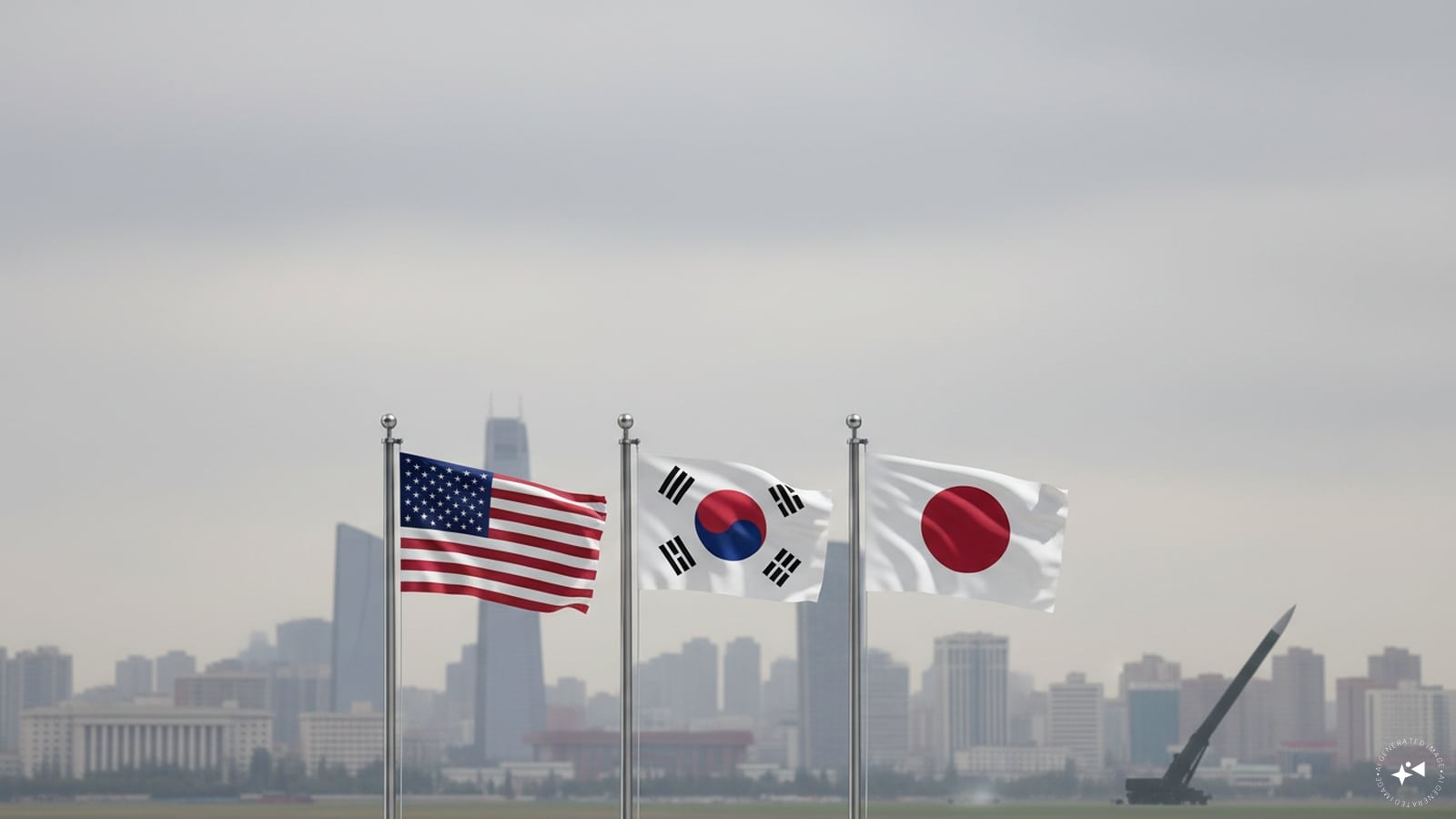
Another summit, another joint statement, and another round of diplomatic posturing. Washington, Seoul, and Tokyo just reaffirmed their ironclad vow to achieve the complete denuclearization of North Korea. If you've paid attention to East Asian geopolitics for more than five minutes, you already know the drill.
The latest trilateral pledge sounds strong on paper. In reality, it clashes hard with the messy facts on the ground. Pyongyang has enshrined its nuclear status directly into its constitution and domestic law, backed quietly by Beijing and Moscow, and isn't listening.
So why do the US, South Korea, and Japan keep issuing these exact same vows? And more importantly, does this diplomatic routine actually move the needle, or is it just political theater? Let's look at what's really happening behind closed doors.
The Reality Check Behind the Trilateral Pact
Diplomacy relies heavily on shared vocabulary, but the gap between rhetoric and reality has never been wider. When officials from the US, South Korea, and Japan stand up to demand complete denuclearization, they're upholding a decades-long policy standard. They have to say it. Dropping the phrase would signal an implicit surrender to a nuclear-armed North Korea, shaking the entire alliance structure in the Indo-Pacific.
Yet, Pyongyang's official stance is crystal clear. North Korea recently denounced a multi-nation monitoring group tracking sanctions, calling the Western pressure a tired racket that fails to change its permanent status as a nuclear weapons state.
Kim Jong Un isn't trading away his arsenal. His regime views nuclear weapons as its ultimate insurance policy against regime change. Every missile test and military exhibition in Wonsan points to a country doubling down on its atomic capabilities, not packing them up.
Diverging Strategies Inside the Alliance
The real friction isn't just between Pyongyang and the allies; it's also happening among the allies themselves. Seoul's political landscape introduces distinct complications. South Korean leadership has previously floated ideas about pursuing a nuclear freeze rather than immediate, total elimination in exchange for sanctions relief.
Critics argue that settling for a freeze accidentally rewards bad behavior. It effectively grants North Korea de facto nuclear state status while letting them off the hook economically. On the other side, Washington and Tokyo remain publicly tethered to the all-or-nothing approach. This strategic mismatch creates openings that Pyongyang exploits with ease.
China and Russia complicate the equation further. Beijing's recent diplomatic readouts have quietly omitted traditional language about North Korean denuclearization following high-level meetings between Kim and Chinese President Xi Jinping. When Beijing and Moscow look the other way, international sanctions lose their bite. Smuggling continues, oil flows across the border, and UN restrictions become little more than expensive suggestions.
What Happens When Superpower Dialogue Stalls
Speculation about renewed high-level direct talks always floats around international summits. Past overtures proved that leaders love the idea of a breakthrough photo-op. But photo-ops don't equal structural disarmament. Without a realistic roadmap that accounts for North Korea's refusal to surrender its primary deterrence tool, traditional demands for complete denuclearization remain dead on arrival.
If you are tracking security trends in East Asia, stop looking for sudden breakthroughs. Watch the supply lines, monitor the trilateral defense exercises, and pay attention to how strictly Beijing enforces border controls. Those metrics tell the true story of regional stability long before any press release hits the wire.