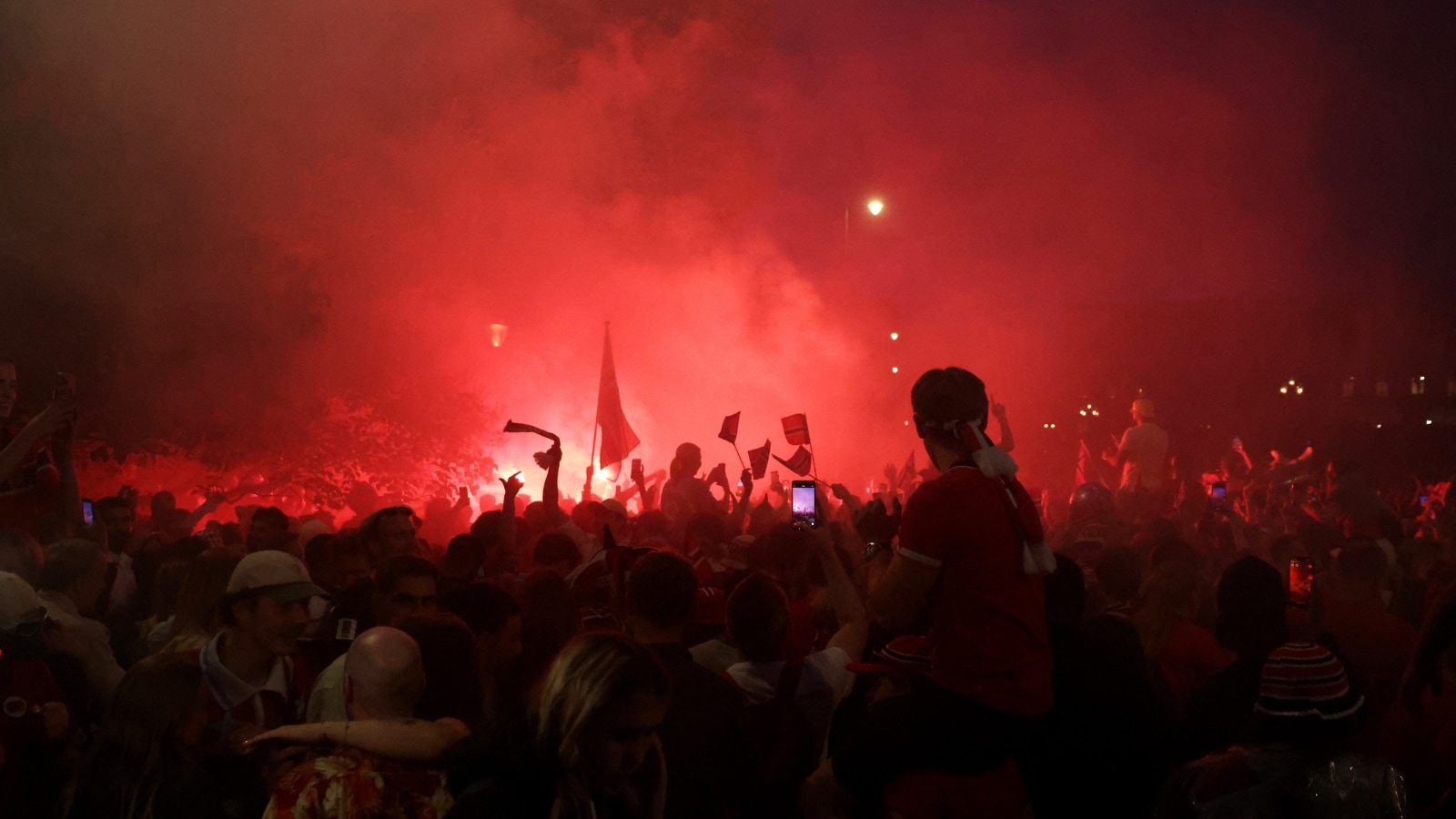
Imagine losing a massive World Cup quarterfinal in extra time, packing your bags, flying home, and being greeted by 90,000 screaming people sitting on the asphalt mimicking a Viking longship.
That is exactly what just happened in Oslo.
Norway’s national football team is out of the 2026 World Cup. England sent them packing with a tight 2-1 extra-time win in Miami. Normally, a defeat like that brings a quiet, somber return. Not this time. Instead of mourning a missed semifinal spot, nearly 100,000 fans packed the square outside the Royal Palace to perform the "Viking Row," shouting a deafening roar of "Ro! Ro!" in unison.
The scene was pure, unadulterated sports joy. Crown Prince Haakon, the heir apparent to the throne, did not just watch from a balcony. He was right there in the thick of it, beating a drum to keep the pace of the rowing.
This is not just a trend. It is a complete shift in how we think about sports fandom.
The Defeat that Felt Like a Victory
Norway has not been to a men's World Cup since 1998. To say expectations were managed would be an understatement. But this group, anchored by Erling Haaland and captained by Arsenal's Martin Ødegaard, defied every expectation.
They fought their way through Group I, surviving battles against France and Senegal. They edged out Ivory Coast in a tense match to progress, and then pulled off an incredible 2-1 win over Brazil. That victory over Brazil sparked a national celebration that felt like a collective fever dream.
Then came England in the quarterfinals. It was a grueling, physical match in the Miami heat. Norway fought to the bitter end, only to fall short in extra time.
But back home, nobody cared about the loss. They cared about the run. This was Norway's best-ever finish in a World Cup. By the time the team’s plane touched down on Monday, the capital was ready to party.
A Stuffed Raccoon and a Royal Drummer
The homecoming was delightfully weird.
Erling Haaland landed earlier in the day and immediately turned heads on social media. He was pictured walking off the plane clutching a bizarre American souvenir: a taxidermied raccoon holding a glass bottle of alcohol. It was the perfect, eccentric representation of a team that refused to take themselves too seriously despite making history.
Meanwhile, the crowd was building outside the Royal Palace.
When the players finally arrived, the sheer scale of the crowd was staggering. A sea of red, white, and blue stretched down Karl Johans gate.
"It's simply incredible to see all the support we receive and to see how much the country is behind us," captain Martin Ødegaard told Norwegian public broadcaster NRK, visibly moved by the turnout. "It's really fantastic."
Then, the crowd sat down.
In perfect unison, ninety thousand people leaned forward and back, pulling back imaginary oars. Crown Prince Haakon stood before them, setting the rhythm with a massive drumbeat. With every stroke, the crowd bellowed "Ro!"—the Norwegian word for row.
The Surprising Origin of the Viking Row
Watching a crowd of 90,000 row on dry land looks like a ancient tradition passed down through generations of seafarers. It isn't.
In fact, the entire phenomenon is less than a year old.
The brain behind the trend is a regular football supporter from Sunnmøre named Ole Frøystad, now widely known as "Mr. Row Row." In late 2025, Frøystad pitched the concept of a synchronized rowing chant to Oljeberget, the official Norwegian supporters' club. He wanted something that felt uniquely Norwegian but simple enough for anyone to join.
He actually drew some inspiration from the heavy metal scene. Fans of the Swedish Viking metal band Amon Amarth have been sitting on concert floors to "row" to the song Put Your Back Into the Oar for years. Frøystad realized this high-energy ritual would translate perfectly to stadium terraces.
The supporters' club loved the idea. They polished the concept, recorded a song called Viking Blood featuring the rhythmic rowing sounds, and prepared a giant Norse blowing horn—the gjallarhorn—to signal the start of the ritual.
The first test run happened during a friendly against Switzerland in March 2026.
"Some people loved it, while others thought it looked a bit silly," recalled Torstein Hamran, a board member of Oljeberget.
But they kept at it. By the time Norway played Sweden on June 1, the chant was gaining traction. When the World Cup kicked off, the Viking Row exploded.
Why the Chant Shook the Earth
This celebration went viral for a reason. It is deeply physical, highly visual, and intensely collaborative.
During the World Cup group stage match against Ivory Coast on July 1, the collective jumping and synchronized rowing of fans gathered at public viewings in Oslo and Bergen actually registered as minor earthquakes on local seismographs. That is not a metaphor. It literally shook the ground.
The trend quickly slipped past the boundaries of the football stadium.
It spread to almost every corner of Norwegian life. The Storting, Norway's parliament, paused to collectively row. Royal Norwegian Air Force pilots filmed themselves performing the row from the tight cockpits of F-35 fighter jets. Schools, hospitals, and retirement homes posted their own versions.
Even American sports fans got a taste. Norwegian fans took over Times Square in New York to row, and they brought the celebration to Citi Field during a New York Mets baseball game, teaching the team’s mascots how to row along with them.
The Historical Connection running through Norwegian Blood
The Viking Row works so well because it taps into a deep, cultural identity.
Norway is a nation carved by water. Its coastline is a labyrinth of deep fjords, islands, and rocky skerries. For centuries, water was not an obstacle to overcome; it was the primary highway. Long before railways or paved roads existed, Norwegians rowed to trade, to fish, to attend church, and to visit neighbors.
In the Viking Age, these rowing skills allowed seafarers to travel massive distances. They crossed the Atlantic to reach Vinland in North America, relying on pure muscle power when the wind failed them.
Rowing was not a hobby. It was survival.
When a modern crowd sits down to row, they are mimicking the exact coordination required to keep a longship moving straight through rough seas. In a boat, if one person rows out of rhythm, the ship falters. It requires absolute synchronization.
That is why it serves as the ultimate metaphor for a football team and its supporters. Everyone is pulling in the exact same direction.
How to Do the Viking Row Yourself
You do not need a ticket to Oslo or a spot on the national team to take part. The beauty of the Viking Row lies in its simplicity. Here is how you can bring it to your own local supporters' club or next match:
- Wait for the Horn: The ritual always starts with a single, long blast of a horn (or a loud whistle). This is the cue for everyone to sit or crouch down on the ground.
- Form the Lines: Sit closely behind the person in front of you, forming long, parallel files.
- Listen for the Drum: The drumbeat sets the pace.
- The First Strike: The leader strikes the drum twice. On the second beat, lean forward and reach out your arms, grabbing your imaginary oars.
- Row and Shout: As the drum beats, pull your arms back dynamically, leaning your torso backward. At the exact moment of the pull, shout "Ro!" (pronounced like "roo").
- Accelerate: The drumbeat will start slow, building tension. Gradually, the beats will get faster. Keep your movements in perfect sync with the acceleration until the rhythm becomes a rapid, joyous frenzy, ending in a massive cheer.
Norway may not have won the 2026 World Cup, but they won the hearts of sports fans globally. They proved that you do not need a gold medal to have the best celebration on earth. Grab an imaginary oar, find your rhythm, and start rowing.