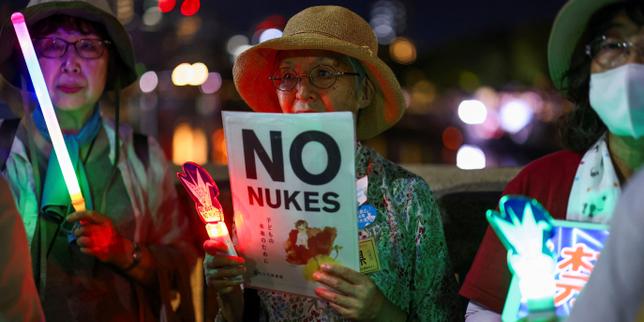
August brings a heavy silence to Japan. Every year on the sixth and ninth of the month, the country pauses to mark the atomic devastation of Hiroshima and Nagasaki. Sirens wail. Heads bow. People remember the estimated 140,000 lives lost in Hiroshima and the tens of thousands more in Nagasaki.
For decades, this ritual served as an annual reaffirmation of Japan's pacifist identity. But the atmosphere has shifted. Beneath the solemn speeches and wreaths of paper cranes, a sharp, deeply uncomfortable political clash is unfolding over the nation's nuclear future. For another view, consider: this related article.
If you think Tokyo’s strict anti-nuclear stance is set in stone, you haven't been paying attention to the shifting fault lines in East Asia.
The Fracturing of the Three Non-Nuclear Principles
For over fifty years, Japanese foreign policy stood on a seemingly unbreakable pillar known as the Three Non-Nuclear Principles: not possessing, not producing, and not permitting the introduction of nuclear weapons onto Japanese soil. It was the moral baseline of a nation scarred by history. Related reporting regarding this has been shared by USA Today.
Yet, during recent memorial ceremonies, political fractures became impossible to ignore. Prime Minister Sanae Takaichi noticeably declined to explicitly reaffirm the traditional three non-nuclear principles when pressed by reporters. Instead, her administration offered carefully measured pledges to pursue realistic security steps.
That omission wasn't an accident. It was a calculated signal.
Why Regional Threats are Driving the Shift
Japan isn't having these tense internal arguments in a vacuum. Look at a map, and you will understand the existential panic driving Tokyo's security establishment.
- China's rapid nuclear arsenal expansion is outpacing historical projections.
- North Korea continues its steady march as an entrenched regional nuclear power.
- Russia's belligerent posture in the north has destroyed decades of cautious diplomatic baseline stability.
For years, Japan relied entirely on the American nuclear umbrella—the concept of extended deterrence. But cracks in Washington's perceived reliability have fueled hard-nosed realism among Japanese defense planners. When neighboring states routinely engage in nuclear sabre-rattling, Tokyo’s politicians are forced to ask questions that were once completely taboo.
Breaking Taboos Behind Closed Doors
Publicly, government officials still claim that acquiring an independent nuclear deterrent is off the table. Privately, defense circles and ruling party lawmakers are actively debating concepts that would have ended a political career twenty years ago.
Take the recurring whispers around nuclear sharing agreements modeled after NATO. Under this arrangement, Japanese fighter jets could theoretically be integrated into joint nuclear strike plans with the United States. While officials reject it officially, the topic keeps creeping back into parliamentary committees.
Then there is the naval question. The strategic utility of nuclear-powered submarines is gaining traction among defense hawks who argue that diesel-electric fleets can no longer match the endurance required to counter Chinese naval expansion. Yet, this runs headfirst into domestic legal frameworks and deep-seated public aversion.
The Generation Losing its Living Memory
There is another sobering reality shaping these debates. The survivors of 1945, known as the hibakusha, are vanishing.
For decades, these aging witnesses served as an emotional and moral anchor, holding politicians accountable to the horrors of atomic warfare. As that direct, lived connection fades into history books, politics takes over. A younger generation of lawmakers, unburdened by the immediate post-war trauma, views national security through a lens of cold geometric survival rather than pacifist dogma.
Hiroshima Mayor Kazumi Matsui used his memorial address to warn world leaders against using nuclear weapons as tools of intimidation. His warning wasn't just directed at foreign capitals like Beijing, Moscow, or Pyongyang. It was a direct message aimed inward, cautioning his own government against normalizing the unthinkable.
What Happens Next
Japan stands at a dangerous historical crossroads. The country cannot easily abandon its anti-nuclear identity without tearing its own social fabric apart. At the same time, it cannot ignore an increasingly hostile neighborhood by clinging blindly to outdated security assumptions.
The debate over the bomb is no longer a historical exercise confined to August anniversaries. It is a live wire, and how Tokyo resolves these internal tensions will reshape the balance of power across the entire Indo-Pacific region.