One day after adding nearly a trillion dollars in market value, Nvidia stock slipped roughly 4% to 5% in Tuesday morning premarket trading. Relief rallies do that. Markets surge on sudden reversals, then reality shows up with a clipboard.
Nvidia’s board unanimously reinstated co-founder Jensen Huang as president, CEO, and director on Monday, November 23, 2026. Shares had closed at $125.53 the prior Friday after a brutal sell-off, and then rocketed roughly 31% to close near $165 on Monday—marking one of the biggest single-day jumps in the stock's history. By Tuesday morning, traders were already taking profits and asking harder questions about what comes next.
Honestly, the premarket pullback shouldn't shock anyone who watches how momentum trades behave. When a stock spikes more than 30% in a single session, even a modest wave of profit-taking looks dramatic on a screen. Yet there's more behind the dip than simple chart fatigue. Washington scrutiny, ongoing board investigations, export-control crackdowns, and lingering doubts about AI spending returns are all colliding right now.
Why Nvidia Stock Pulled Back After the Reinstatement Rally
A massive one-day spike rarely settles cleanly on day two. Traders who bought the dip late last week—or rode the initial reinstatement surge—locked in gains on Tuesday morning, dragging broader semiconductor names like Micron, Marvell, AMD, and Arm lower alongside Nvidia.
Still, profit-taking is only half the story. Reinstating a CEO doesn't erase the underlying controversies that forced him out in the first place. Huang had stepped down earlier in November amid scrutiny over personal conduct and his connection to Alice Huang, a former executive at Singapore-based data center firm Megaspeed whom US authorities have reportedly suspected of ties to Chinese intelligence and potential chip diversion.
Even though the board said it was satisfied with Huang's candor and leadership, Nvidia's independent director committee is still investigating those allegations. Wall Street hates open-ended probes on a trillion-dollar-plus company. Investors can cheer a familiar face in the corner office while still worrying about what new facts might surface during an active inquiry.
The Political Pressure and Export-Control Shadow
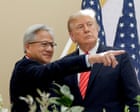
You can't separate Monday's rally—or Tuesday's hesitation—from politics. President Donald Trump told CNBC on Monday that he spoke directly and indirectly with board members and convinced them to bring Huang back, arguing that losing Huang's leadership would hurt US competitiveness in the AI race and stating that administration officials saw no national security bar to his return.
That intervention immediately sparked pushback from lawmakers in Congress, with critics questioning the White House's role in corporate governance and vowing to examine Huang's China-related ties and the administration's input. For long-term shareholders, political backing can look like a shield in the short run and a lightning rod in the long run. If political winds shift—or if congressional hearings turn contentious—headline risk returns fast.
Right around the same time, the US Commerce Department's Bureau of Industry and Security added Megaspeed and six associated Southeast Asian entities to its export-control Entity List, tightening restrictions on companies scrutinized over potential AI chip routing to China. Reports of state-level scrutiny in California over whether chips reached China have added another layer of regulatory noise.
Let's be real: having Huang back helps calm fears around product roadmaps, customer relationships, and key supplier ecosystems across Asia—where markets from Taiwan to South Korea rallied sharply on Monday's news. What Huang can't single-handedly rewrite is US export enforcement or skeptical questions from lawmakers.
What Actually Matters Beneath the Headlines
When a stock swings 20% down one week and 30% up the next, it's easy to lose sight of the business math.
On pure fundamentals, Nvidia has still been posting massive top-line numbers, including reported quarterly revenue of $115.8 billion (up 103% year over year) and fourth-quarter guidance around $130 billion. That kind of scale explains why institutional investors were desperate for leadership clarity around data center rollouts and neocloud partnerships.
Yet strategists and analysts have repeatedly pointed out a tougher question for the broader AI trade: Will hyperscalers and AI buyers generate enough software and service revenue to justify eye-watering capital expenditures over time? A CEO comeback restores operational momentum, not automatic return on investment for every customer buying racks of GPUs.
In my experience watching mega-cap tech through boom-and-bust cycles, founder comebacks create two distinct waves of trading. Wave one is pure relief and short-covering—fast, loud, and emotional. Wave two is repricing—slower, messier, and driven by governance, margins, and policy rules. Tuesday morning looks like the start of wave two.
Common Mistakes Investors Make During Volatility Spikes
Chasing a 30% single-day surge right at the open is one of the fastest ways to buy near a short-term peak. When headlines scream "comeback," retail and momentum money often pile in after the biggest percentage move has already happened.
The opposite mistake is treating a 4% or 5% premarket dip as proof the story is broken. After a ~31% run-up, a pullback of that size barely dents the prior day's gain.
Investors also tend to overread single-day political or legal headlines without checking position sizing. A concentrated bet in a high-beta semiconductor stock behaves very differently inside a diversified index fund than it does as 25% of an individual portfolio.
Practical Next Steps If You Hold or Watch NVDA
- Check your actual exposure first. Look at how much Nvidia you own directly and indirectly through S&P 500 or semiconductor ETFs so you know how a 5% to 10% swing hits your net worth.
- Separate short-term trades from long-term theses. Decide ahead of time whether you're trading momentum around headlines or holding for multi-year AI infrastructure demand, and avoid mixing the two on emotional days.
- Watch concrete catalysts, not just cable news. Track the independent board committee's updates, any new Commerce Department export rules, and upcoming quarterly earnings rather than reacting to every premarket tick.
- Use staged entries or trims if rebalancing. If your position grew oversized during Monday's jump—or if you want to build a position gradually—scaling in or out in tranches reduces timing regret when volatility is running hot.