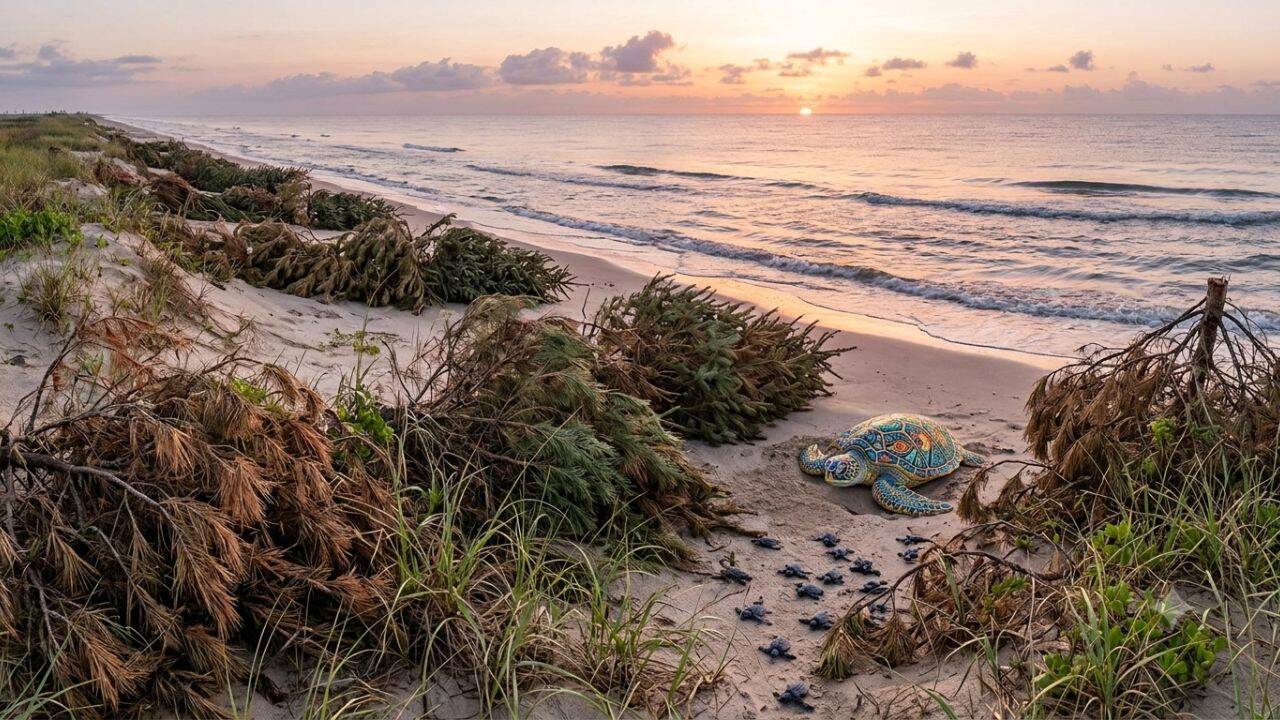
Long after holiday lights come down and needles turn brown, old pine trees get a second act on the Texas coast. Instead of crowding local landfills, hundreds of discarded evergreens are hauled down to South Padre Island. Conservation staff and volunteers place these bare trunks directly into the sand. It looks strange, but this low-tech trick is saving vulnerable marine life.
If you think environmental restoration always requires expensive machinery and heavy engineering, you're missing how nature actually works. Coastal managers use simple physics to solve major erosion problems.
The Wind Trap Mechanics
Dunes don't appear overnight. They need something to interrupt the relentless coastal breeze long enough for blowing sand to drop its weight. That is where the trees come in.
When organizations like Sea Turtle Inc. collect roughly 250 donated trees from residents and the surrounding Rio Grande Valley, they position them carefully along the dunes. Conservation Technician Lindsey Czopek explains that the goal is letting coastal winds blow sand particles to fill in between the branches layer by layer.
Instead of burying a tree all at once, the stacked branches act as a porous wall. Wind passes through, but it slows down just enough to dump its payload of sand. Within a few months, the needles and branches vanish entirely beneath a fresh, natural blanket of sediment.
Protecting the Kemp's Ridley Habitat
Why go through the trouble of building impromptu dunes for holiday pines? The answer involves the rarest sea turtle species on the planet.
Kemp's ridley sea turtles crawl ashore along the Gulf of Mexico to lay their eggs. Organizations patrolling these beaches often relocate vulnerable eggs into protected hatcheries to keep them safe from predators and tidal surges. But those hatcheries still face a massive threat from severe weather.
Storm surges and high water can flood a hatchery overnight, drowning developing eggs before they ever hatch. Higher, wider natural dunes serve as an essential buffer against the tides. By strengthening the dunes with recycled timber, conservationists create a physical shield that protects the hatchery corral.
A Tradition Spanning Decades
Using evergreen trees for shoreline defense isn't a brand-new fad. Research from the U.S. Army Engineer Research and Development Center shows that coastal managers have relied on this strategy for more than seventy years. From North Carolina to New Jersey, communities have repeatedly turned to holiday recycling programs to stabilize fragile coastal barriers.
Of course, the method demands precision. Critics point out that poorly planned placement can fail if storms tear the loose timber back out into the surf. Success depends entirely on local experts who understand wind patterns, tidal reaches, and the specific geography of the shoreline.
What You Can Do
You don't need to live on the Gulf Coast to appreciate how small local habits ripple outward. If you buy a real tree for the holidays, check with local conservation groups or municipal sanitation departments before tossing it to the curb. Many coastal regions host dedicated tree-recycling drives every January.
Strip off all tinsel, lights, and plastic ornaments completely. Donate the bare timber to a recognized community program. Those few weeks of festive cheer can translate directly into a stronger shoreline and a safer hatching season for endangered marine wildlife.