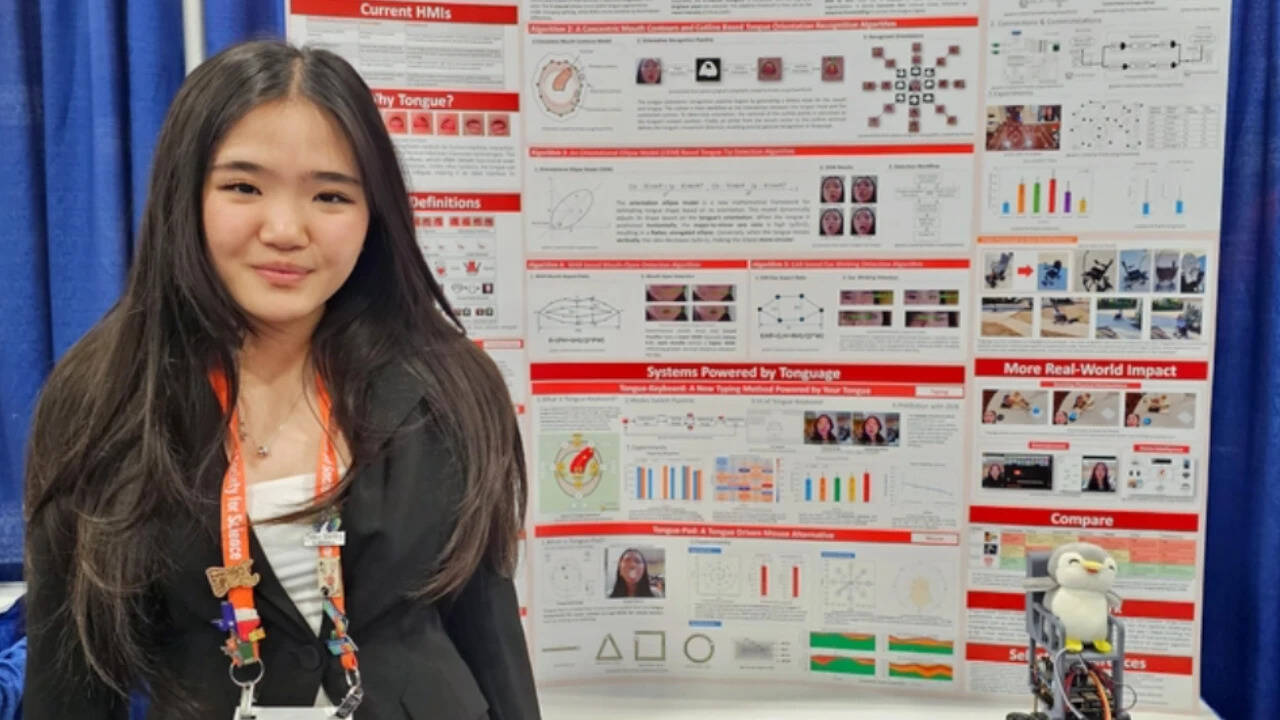
Technology is supposed to make life easier, but for more than one billion people worldwide living with disabilities, standard computer accessories remain a brick wall. Keyboards and mice demand fine motor control that many individuals simply don't have. Enter Hollie Tang, a California high school student who looked at this massive accessibility gap and decided to build something better.
Her project, known as Tonguage, won the top $10,000 IEEE Presidents' Scholarship at the Regeneron International Science and Engineering Fair in Phoenix. Instead of relying on expensive hardware or invasive medical implants, Tang built an affordable, camera-based system that allows users to operate computers using only tongue movements and eye blinks.
Why Traditional Accessibility Hardware Fails Users
If you walk into most assistive tech laboratories, you will find expensive eye-trackers, specialized headgear, and custom sip-and-puff switches. They work, but they carry a massive price tag. They also often require complex setups that isolate users rather than empowering them.
Tang realized that the key to true accessibility isn't building a more expensive gadget. It's using the hardware people already own.
By designing her system to run on standard, commonly available laptop webcams, she slashed the financial barrier to entry. Mobility challenges don't care about income levels or socioeconomic status, meaning assistive technology shouldn't either.
How Tonguage Actually Works
The core of the system relies on computer vision—the same branch of artificial intelligence that allows machines to interpret visual data.
Instead of forcing users to adapt to rigid hardware, Tang's software tracks subtle facial cues. By mapping specific tongue movements alongside deliberate eye blinks, the system translates physical gestures into precise digital commands.
According to project documentation, the framework isn't limited to basic cursor movement. It handles several intensive applications:
- Typing documents and sending messages
- Precise on-screen cursor control
- Navigating powered wheelchairs
- Directing robotic arms
The genius of the design lies in its unified recognition framework. It processes inputs across different devices smoothly, meaning a user can transition from typing an email to controlling a motorized chair using the exact same underlying logic.
The Role of Empathy in Engineering
Too many young engineers build technology just to see if they can solve a complex puzzle. Tang took a different route. She spent time talking directly to the people whose lives might be impacted by her work.
In interviews following her win at ISEF, presented by 2026 IEEE President Mary Ellen Randall, Tang emphasized that empathy is difficult to teach inside a standard classroom. It comes from direct exposure and listening to users.
She pointed out a glaring oversight in modern entertainment: people with severe mobility issues are frequently left out of gaming spaces. By designing a low-cost control scheme, her software opens up digital recreation for individuals who have historically been sidelined by mainstream developers.
What This Means for the Future of Assistive Tech
The $10,000 IEEE Presidents' Scholarship isn't just a shiny accolade for a high school resume. It signals a shift in how the engineering community views grassroots innovation.
We are moving away from proprietary, walled-garden medical devices. The future belongs to open, adaptable software that scales across existing consumer hardware. When a student can build a clinical-grade input device using a standard laptop camera in her bedroom, major hardware manufacturers need to rethink their pricing models.
Accessibility should be a baseline feature, not an expensive luxury upgrade. Hollie Tang just proved how it is done.