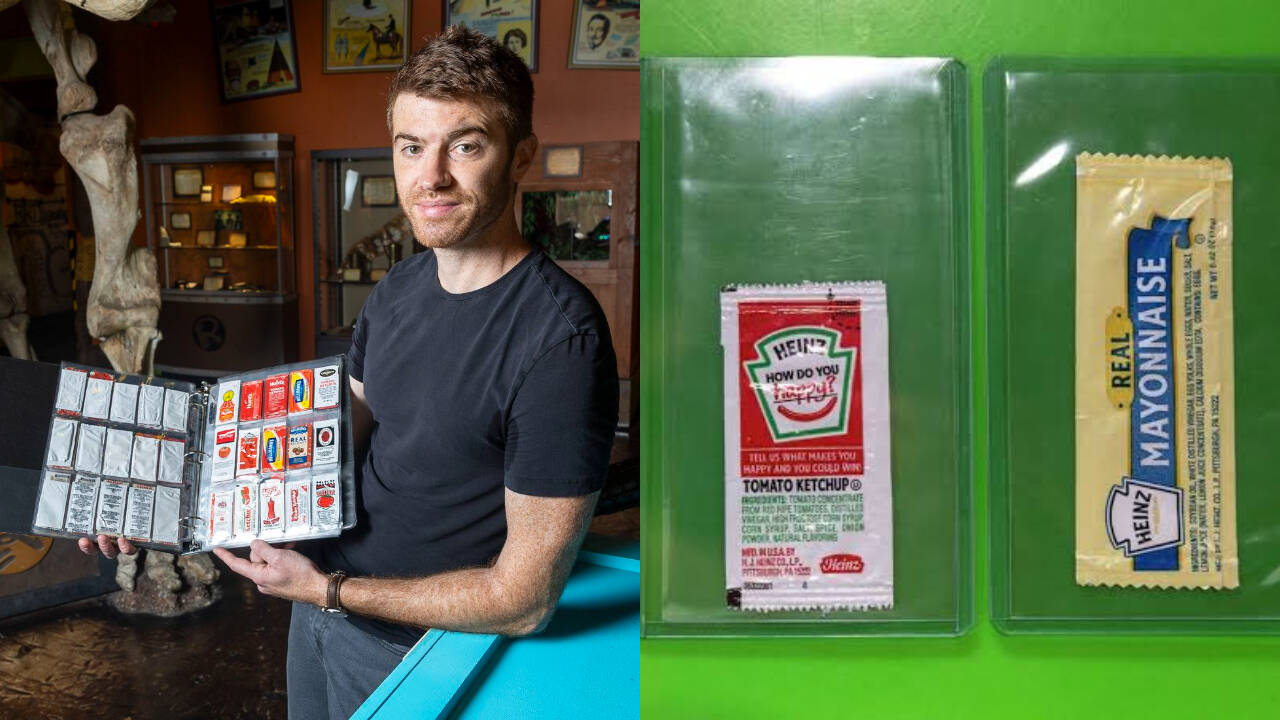
Most people rip open a ketchup packet, dump it on fries, and toss the trash without blinking. Eric Thompson looks at that same piece of crinkled plastic and sees a tiny canvas of global history.
He isn't just hoarding trash. The 39-year-old computer engineer from Helotes, Texas, has turned an ordinary fast-food habit into a precise archive containing roughly 5,000 single-serving sauce packets.
If you think collecting trash packets sounds bizarre, you're missing the point. Thompson's archive tells a massive story about graphic design, corporate branding, and how society consumes food on the go.
From a College Rainbow to a Massive Archive
Every obsession starts somewhere random. For Thompson, it sparked back in 2007 while he was a student at Penn State. A bright, colorful arrangement of condiment packets caught his eye in a communal dining space, looking like a miniature rainbow made of mustard and hot sauce.
When a vendor change wiped the display out, Thompson pocketed a few survivors. That small spark grew into a full-blown mission to document how single-serving packaging has evolved over decades.
Today, his numbers are staggering. His online Condiment Packet Archive catalogs about 3,100 individual designs sorted by brand, hue, date, and flavor profile. Hot sauce leads the pack with roughly 760 unique designs, fueled largely by quirky chain variants like Taco Bell's nearly 400 distinct wrappers. Even Whataburger's chunky box-shaped tubs have a secure spot in his collection.
The Grind Behind the Collection
Don't mistake this for mindless hoarding. Archiving thousands of sauce packets requires actual discipline.
Thompson doesn't just scoop up crumpled wrappers off the street. He purposefully opens packets, squeezes the contents out—frequently eating them with his meals—and meticulously washes and dries the empty plastic sleeves.
Once clean, each wrapper slides into a protective plastic trading card sleeve. They find homes in color-coded containers scattered across his Texas home. He averages about five packets a night just processing the backlog, keeping three copies of every new design when possible so he can trade or preserve duplicates.
A Time Capsule of Packaging History
While modern fast-food packets make up the bulk of the stash, the real gems sit in his vintage drawer. Thompson houses hundreds of historical relics from the 1970s, 1980s, and 1990s.
The crown jewel of his archive? A squeezable Fuller Brush Company toothpaste sachet dating all the way back to 1950. It proves that flexible, single-serving packaging predates the modern fast-food boom by decades, serving entirely different domestic needs before restaurants adopted the model.
His archive even features 309 distinct Heinz packets collected across the United States, Europe, and the United Kingdom. Studying them reveals how corporations manipulate human psychology through color and typography. Red sets your brain up for ketchup and yellow triggers mustard expectations before you even pierce the plastic.
Moving Beyond the Kitchen Drawer
Thompson's unusual hobby isn't staying hidden in a closet. He showcases his favorite discoveries and bizarre packaging finds on TikTok, and his collection recently secured a feature in Ripley's Believe It or Not! Wired into Weird, cementing his status in the global oddities hall of fame.
Take a closer look at your next takeout bag. That throwaway sauce wrapper might just be a collector's item in the making.