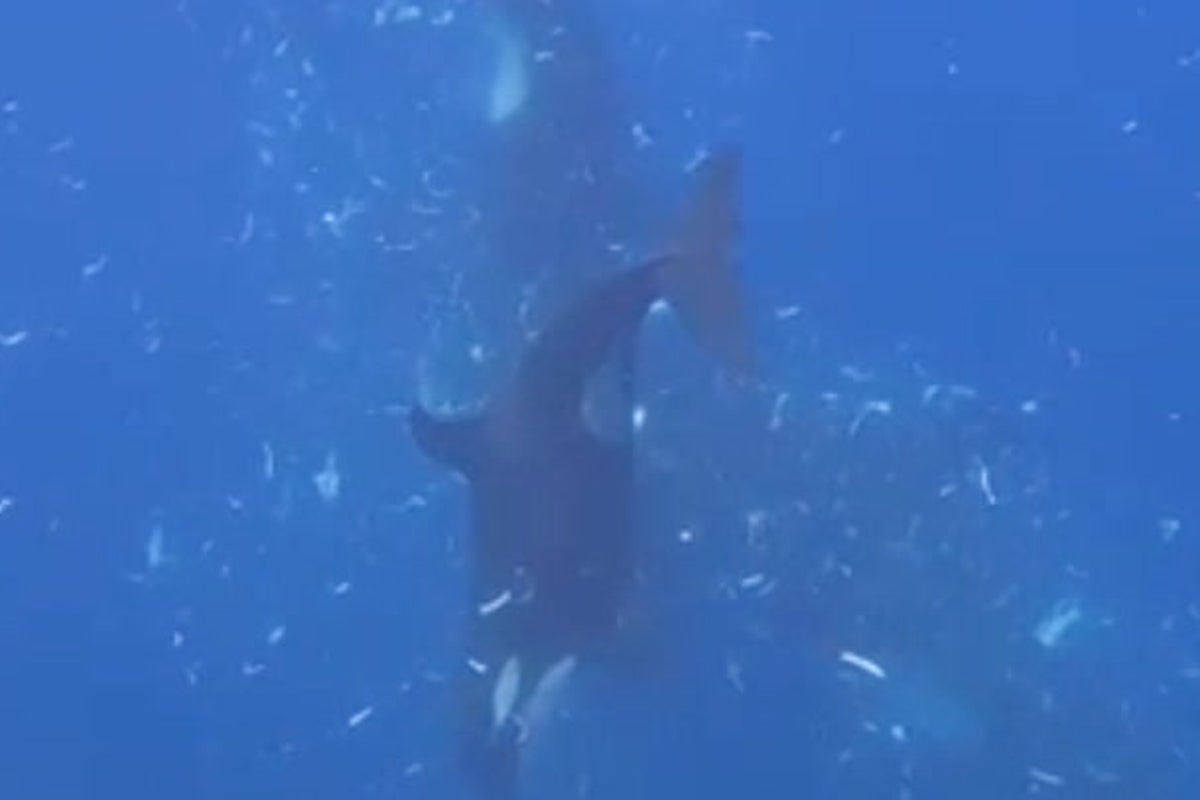
A female killer whale grips a massive sharp-tail sunfish by its tail. She holds it still in the sunlit water off Mexico. Seconds later, a male orca accelerates from the deep, flipping upside down like a living torpedo. He slams directly into the fish with a bone-jarring thud.
The sunfish doesn't just tear apart. It explodes into thousands of drifting pieces. Recently making news lately: Why Andy Burnham Rewrote The Uk Cabinet Rules To Put Ai First.
Scientists watching from boats above shouted in shock. Video cameras captured the entire sequence underwater, revealing a marine behavior never recorded before. Published in the journal Frontiers in Ethology, research reveals that orcas in the Gulf of California are using a precise team tactic called "hold-to-ram" to shatter prey into bits.
People originally thought killer whales were just messing around or killing for sport. But the reality is far more interesting. These apex predators are demonstrating high-level physics, complex tactical planning, and perhaps a whole new way of feeding their young. Additional details regarding the matter are detailed by The Guardian.
The Unexpected Mechanics of the Hold to Ram Strategy
Orcas are famous for their hunting techniques. They create wave washes to knock seals off ice floes. They beach themselves to snag sea lions off shallow shores. They even flip great white sharks upside down to induce tonic immobility.
This new behavior is different. It doesn't kill the animal.
In both recorded events—one in July 2024 by marine scientist Kathryn Ayres and another in September 2025 by Héctor Franz—the sharp-tail sunfish (Masturus lanceolatus) was already dead before the collision took place.
The sequence happens with eerie precision:
- Stabilization: An adult female orca grabs the sunfish by its stiff tail fin, acting as an anchor in the water column.
- Acceleration: A second adult orca backs up, builds high speed, and lines up its target.
- Release and Strike: Right before impact, the female lets go so she doesn't catch the blast wave. The second orca rams the carcass headfirst.
- Fragmentation: The heavy impact turns the firm body into a cloud of bite-sized floating shards.
Erick Higuera, a marine biologist and director at Orcas México, first spotted a glimpse of this back in December 2021. He spent years analyzing footage frame by frame to figure out what was actually happening. It wasn't a messy feeding frenzy. It was a calculated, multi-step execution.
"This requires acute spatial awareness, acoustic communication and a shared understanding of physics," Higuera noted during his analysis of the footage. "It shows that orcas can mentally map out a multistep tactical plan and execute it with military precision."
Why Orcas Blow Up Already Dead Sunfish
Why waste so much kinetic energy on a target that's already dead?
Orcas don't have hands. They don't have claws. And unlike sharks, they don't have rows of serrated teeth designed to saw through thick hide. Orcas rely on peg-like teeth built for gripping, holding, and tearing.
Sharp-tail sunfish are among the heaviest bony fish on Earth, easily tipping the scales at over 4,000 pounds. Their bodies aren't made of soft, tender meat. Instead, they are wrapped in a dense, rubbery outer shell called a capsule. This layer is rich in collagen and acts like thick body armor.
When an adult orca hunts a sunfish, it usually targets the pectoral fins first to disable it. It then tears open the soft abdomen to eat the rich internal organs. But once those organs are gone, the tough collagen exterior remains.
For an adult, biting off chunks of this tough skin is doable. For a young calf or juvenile, it's almost impossible.
That's where the ramming comes in. By using momentum and heavy mass, the adult orcas shatter the rigid skin, converting a tough carcass into easily digestible, finger-food-sized bites for younger pod members.
Parental Investment or Pure Underwater Entertainment
In both fully documented events, a young calf was present in the pod. Immediately after the sunfish exploded into floating confetti, the juvenile swam right into the cloud to eat the floating pieces. The adults largely ignored the tiny fragments, choosing instead to share the main core of the carcass.
This strongly points toward parental investment. Parents do the heavy physical work so their calves can eat without struggling. It's the killer whale equivalent of cutting up a thick steak for a toddler.
Still, you can't rule out fun.
Orcas are wicked smart. They play with their food constantly. They swat stingrays around like soccer balls. They throw harbor porpoises 30 feet into the air with their tail flukes. Sometimes they do this without ever taking a single bite.
Playing isn't just mindless amusement for these cetaceans. It serves vital social functions:
- Skill Building: Young orcas watch the adults execute high-speed runs, learning how to gauge distances and timing.
- Social Bonding: Cooperative maneuvers strengthen the cultural ties between pod members.
- Low Risk Training: Slow, defenseless sunfish offer zero threat of injury, making them perfect training targets for subadults practicing precision strikes.
Whether it's a dedicated feeding strategy or just high-velocity play, the behavior highlights how flexible orca culture really is. Different pods around the globe develop unique traditions. What one pod learns, it teaches to its offspring.
The Collagen Capsule and the Microbial Smoothie Theory
There's another wild theory gaining traction among oceanographers. It involves microscopic biology and marine nutrition.
The thick capsule beneath a sunfish's skin isn't just tough; it's mostly water and collagen. It also harbors a very distinct microbiome of bacteria and microorganisms living on its surface.
When an orca smashes the sunfish to pieces, it scatters those microbial communities straight into the water column. Some marine biologists speculate that ingesting these fragmented tissues gives the orcas an extra dose of nutrients or helps regulate their immune systems.
Orcas get almost all their fresh hydration directly from the prey they consume. Sunfish bodies hold an immense amount of water in their tissues. Pregnant or lactating female orcas have massive hydration needs, and breaking down a sunfish might function like an oceanic energy drink or a high-moisture snack.
While the microbial link needs more field testing to be proven conclusively, it shows just how many layers exist in predator-prey relationships.
How to Spot Orca Hunting Innovations on Your Next Expedition
If you're heading out on a marine wildlife expedition off Baja California Sur, keep your eyes peeled. You might witness animal behavior that hasn't even made it into textbook literature yet.
Here is what you should do if you witness orcas interacting with sunfish or other large marine life:
- Keep Your Distance: Federal regulations in Mexico require eco-tourists and boats to maintain a safe distance from killer whales. Respect their space so you don't disrupt their hunt or social dynamics.
- Photograph the Dorsal Fins: Every orca has a unique dorsal fin shape along with distinct white saddle patches behind the fin. High-resolution photos allow scientists to identify individual whales and track which pods are using specific strategies.
- Record Clear Video: If you see a pod circling a sunfish, start filming underwater or at the surface. Frame-by-frame analysis is often the only way researchers can tell the difference between an attack and a post-mortem food preparation technique.
- Report to Local Conservation Groups: Share your footage and location coordinates with organizations like Orcas México or Beneath the Waves. Citizen science plays a massive role in mapping out these behaviors across different seasons.
Researchers still don't know whether this "ram-to-fragment" technique is isolated to a single family unit or if it's spreading across the entire Eastern Tropical Pacific orca population. As more boaters and divers capture clear footage, we'll get a clearer picture of just how far this explosive trend reaches.