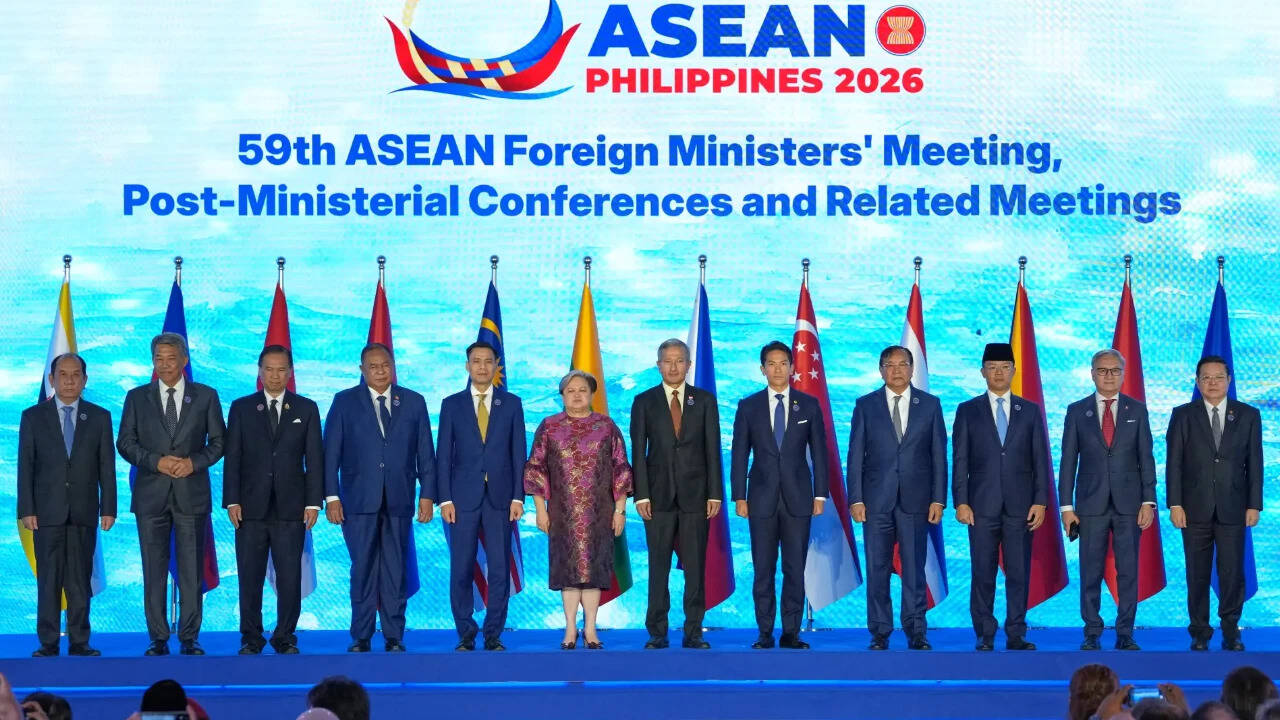
When Southeast Asian foreign ministers gathered in Manila this week, they wanted to talk about regional integration and economic growth. Instead, they found themselves staring at a twin nightmare: spiraling conflict thousands of miles away in the Middle East and a violent confrontation right in their backyard at Second Thomas Shoal.
It isn't every day that a Southeast Asian bloc has to issue an urgent warning about fuel shipments through the Strait of Hormuz. But the geopolitical crisis unfolding in 2026 has left them with no choice.
Between direct U.S.-Iran hostilities choking critical shipping lanes and Chinese coast guard personnel wielding batons against Filipino sailors, ASEAN diplomats are caught in a massive vise. The region's attempt to remain neutral is getting harder by the hour.
The Oil Shock Hitting Southeast Asian Kitchen Tables
You might wonder why foreign ministers from nations like Indonesia, Thailand, and Singapore care so deeply about hostilities in the Persian Gulf. The answer comes down to pure survival.
Southeast Asia is a region of 680 million people, and it runs on imported energy. About 20% of global petroleum moves through the Strait of Hormuz. When U.S.-Iran skirmishes closed off or threatened transit through those narrow waters, crude prices surged almost immediately.
The fallout across Southeast Asia was swift:
- Energy Emergencies: Philippine President Ferdinand Marcos Jr. already had to declare a national energy emergency to halt panic buying, hoarding, and wild fuel prices.
- Agricultural Chaos: Middle Eastern energy disruptions directly hit global nitrogen and fertilizer production. Farmers in Vietnam and Thailand face skyrocketing fertilizer costs, threatening rice yields.
- Inflation Spikes: Transporting basic goods across archipelagos costs significantly more when diesel prices skyrocket overnight.
In a joint statement drafted behind closed doors at the Philippine International Convention Center, ASEAN foreign ministers took the unusual step of calling for a complete and immediate end to all hostilities in the Middle East. They demanded the unrestricted reopening of the Strait of Hormuz.
When a regional block known for slow consensus and cautious words starts issuing blunt statements on Middle Eastern military actions, you know the economic pain has hit a tipping point.
A Brutal Flashpoint at Second Thomas Shoal
While energy shockwaves were travelling across the Indian Ocean, physical violence erupted in the South China Sea just hours before diplomats sat down in Manila.
On July 20, 2026, a confrontation flared up near Second Thomas Shoal. According to Philippine military officials, Chinese Coast Guard personnel aboard a motorboat intercepted a Philippine supply vessel. In the chaos that followed, a Chinese officer reportedly struck a Filipino sailor on the head with a wooden baton, causing serious injury and damaging the boat.
Beijing quickly turned the blame around, claiming Philippine personnel provoked the encounter. By Tuesday afternoon, Manila had summoned China’s ambassador, while Beijing summoned Manila's envoy.
This isn't just another minor shouting match over uninhabited rocks. It represents a sharp escalation in physical force in disputed waters.
Why the Timetable Matters
For almost twenty years, ASEAN and China have promised to finalize a binding Code of Conduct (CoC) to govern behavior in the South China Sea. Both sides keep claiming they want to conclude negotiations within the year.
Yet, every time a draft gets pushed forward, encounters on the water get more aggressive. The diplomatic talk in air-conditioned conference rooms in Manila feels completely disconnected from the steel and batons at sea.
Beijing maintains that ASEAN shouldn't be used as a forum for bilateral maritime squabbles. Philippine officials, however, argue that when sailors suffer injuries inside their exclusive economic zone, keeping quiet is no longer an option.
Marco Rubio, Wang Yi, and the Battle for Influence
Adding fuel to the diplomatic fire is the arrival of major global powers in Manila.
U.S. Secretary of State Marco Rubio touched down in the Philippines with a clear mission: convince Southeast Asian leaders that Washington isn't too distracted by the Middle East to defend its Pacific allies.
In an op-ed published in Philippine newspapers right as he arrived, Rubio delivered a direct warning. He stated that freedom of navigation in Southeast Asian waters is far from guaranteed, arguing that if these critical trade lanes fall under the control of a power willing to weaponize commerce, both the U.S. and ASEAN face severe threats to their sovereignty.
Rubio also reiterated that the 2016 international arbitral ruling—which dismissed Beijing’s vast territorial claims in the South China Sea—remains final and legally binding.
Meanwhile, Chinese Foreign Minister Wang Yi and Russian Foreign Minister Sergey Lavrov are also on the ground in Manila for the broader ASEAN Regional Forum and East Asia Summit gatherings.
The presence of top envoys from Washington, Beijing, and Moscow in the same city underscores what is at stake. The U.S. wants to rally the Quad (the U.S., India, Japan, and Australia) and strengthen regional defense pacts. China wants to keep Western military power away from its perimeter and handle disputes one-on-one. ASEAN is stuck trying to manage both superpowers without getting crushed.
Myanmar Remains an Open Wound
Amid the international drama surrounding energy routes and naval standoffs, ASEAN’s long-running internal crisis continues to bleed out.
It has been five years since the military coup in Myanmar, and the civil war there has claimed an estimated 100,000 lives. ASEAN's five-point peace plan has accomplished almost nothing. The junta ignores regional calls for restraint, while resistance forces control large swaths of the countryside.
Permanent Secretary Hau Khan Sum represented Myanmar at the Manila gathering, but the bloc remains deeply divided on how to handle the military regime. Some members advocate for tougher stances, while others worry that pushing too hard will drive Myanmar completely into Beijing's orbit.
The failure to resolve an internal conflict right on their doorstep severely undercuts ASEAN's credibility when trying to weigh in on global crises like the Middle East.
What Real Regional Stability Requires Next
The meetings in Manila prove that Southeast Asia can no longer treat global crises as distant problems. The world is far too interconnected, and the region's vulnerabilities are wide open.
If ASEAN wants to protect its economic growth and maintain its central role in Asian diplomacy, key action steps must be taken immediately:
- Activate the Regional Energy Sharing Mechanism: ASEAN countries must fast-track emergency oil-sharing agreements to buffer smaller member states against extreme price spikes caused by Middle East blockades.
- Set Hard Deadlines on the Code of Conduct: Negotiating a South China Sea pact for two decades without enforcement mechanisms invites further clashes. The bloc needs clear guidelines on what constitutes illegal aggression at sea.
- Establish Direct Crisis Hotlines: Manila and Beijing must implement operational, high-level communications between naval commanders to de-escalate physical clashes before someone gets killed.
- Diversify Agriculture and Inputs: To lessen vulnerability to Persian Gulf supply chains, regional governments need to secure alternative sources for fertilizers and critical raw materials.
Neutrality is only a useful policy if you can protect your own backyard. As long as energy supplies depend on volatile foreign straits and local patrol boats trade blows over reefs, Southeast Asia will remain at the mercy of global conflict.