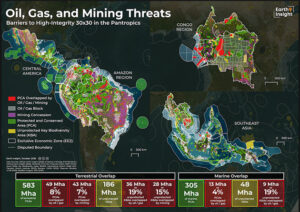
We love drawing lines on maps. Governments roll out grand declarations, promise to safeguard thirty percent of the planet by 2030, and pop champagne. Meanwhile, bulldozers tear right through the boundary lines.
If you look past the political speeches at upcoming international climate summits, a dirty secret emerges. Millions of hectares of supposedly protected land are actually riddled with oil rigs, mining shafts, and logging roads. We are running a global shell game where nature wins on paper and loses in the dirt.
The Illusion of Protection
Let's look at the numbers because they are staggering. Recent analyses tracking tropical and global ecosystems reveal that oil and gas concessions overlap with nearly sixty-one million hectares of designated protected areas. Mining operations claim another forty-three million.
That is not a minor oversight. That is a systemic failure.
Take Senegal. On paper, the country is hurtling toward that thirty percent conservation milestone. In reality, oil and gas blocks blanket ninety-nine percent of its protected zones and vital biodiversity regions. Cambodia tells a similar story. The nation's remaining pristine forests sit neatly inside legal boundaries, yet a massive chunk faces active mining concessions, while fossil fuel companies eye the rest.
Even wealthy nations play this game. In the United States, public lands designated as national monuments face renewed mining pressures, and drilling rights constantly threaten fragile wilderness. We keep treating conservation as a real estate negotiation where industry gets the final veto.
Why the Transition Trap is Dangerous
Here is where things get messy. A huge driver of this sudden push into protected ecosystems is the green energy transition.
We need critical minerals to build electric vehicle batteries, wind turbines, and solar grids. Governments rush to secure supply chains for lithium, cobalt, and copper. But destroying critical habitats to mine the materials needed to save the climate makes zero logical sense. If you clear-cut an ancient carbon sink and wipe out endemic species to mine transition metals, you are robbing Peter to pay Paul.
We are sacrificing tomorrow's biodiversity for today's economic expediency.
Fixing the Broken System
Honesty is missing from most environmental policy debates. You cannot have unbridled industrial growth and true ecological preservation in the exact same footprint. Governments must stop writing blank checks for industrial extraction inside zones designated for wildlife and indigenous stewardship.
Real conservation demands four non-negotiable shifts.
First, enforce a strict mitigation hierarchy. Some places must simply be designated absolute no-go zones for heavy industry. If an area has irreplaceable biodiversity value, you keep the heavy machinery out. Period.
Second, fix government tunnel vision. Right now, an environmental ministry declares a forest protected while a mining ministry hands out drilling permits down the hall. Until every arm of government aligns its economic planning around ecological reality, these contradictions will continue to tear ecosystems apart.
Third, use intelligent spatial planning. We need transparent maps that clearly dictate where development can happen safely without ruining vital watersheds and wildlife corridors.
Finally, hand the reins back to the people who actually protect the land. Indigenous communities and local populations steward some of the most biodiverse regions on earth. They don't need corporate management consultants or distant bureaucrats telling them how to manage their ancestral homes. They need legal title, political backing, and autonomy.
We have four years left until the 2030 deadline. Counting maps filled with oil wells and mining claims as victories is a betrayal of future generations. Stop drawing fake boundaries and start defending real nature.