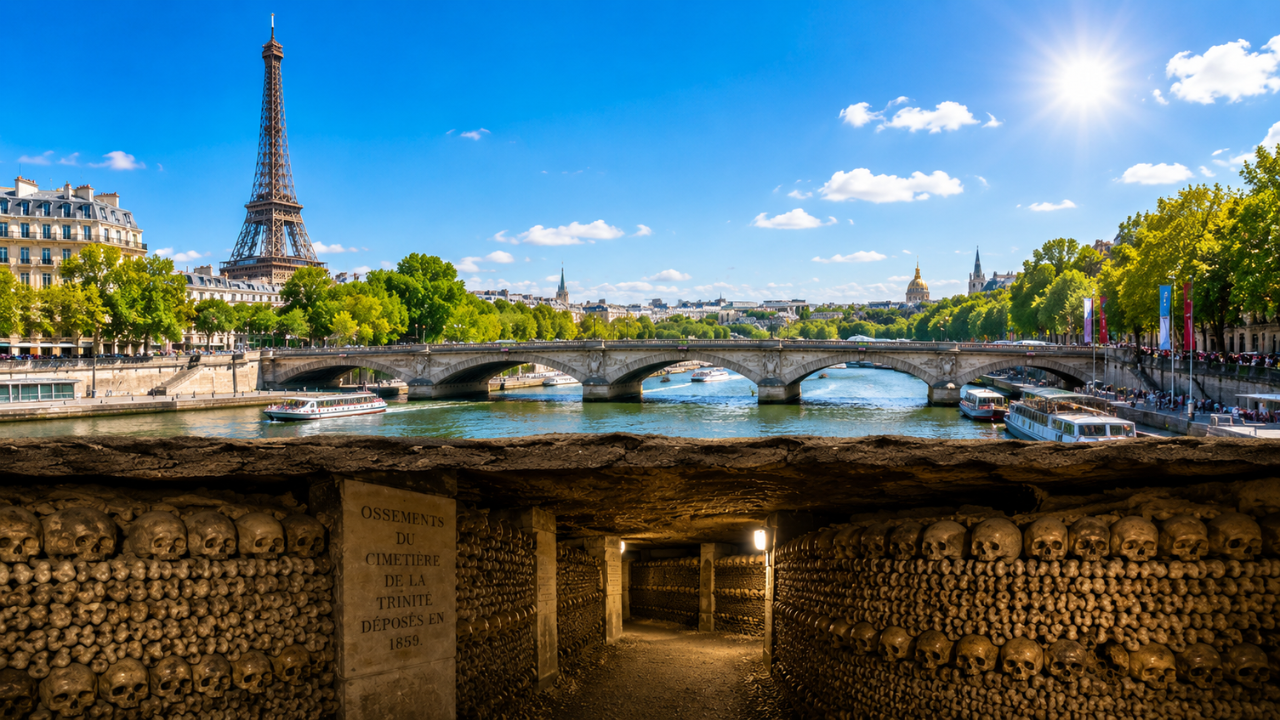
Most people think of Paris as a city of romance, light, and pastries. They don't think about the six million bodies stacked right beneath their feet. If you walk down the rue de la Lingerie today, you are walking over an old catastrophe. The city sits on a massive, hollow maze of ancient stone quarries, and a huge chunk of it is packed tight with human remains.
If you are looking for a spooky tourist stop, you will find it here. But the real story is much weirder than a simple ghost story. It is a story of urban planning gone totally wrong, rotting basements, and a secret underground subculture that still rules the dark today.
The Day the Graveyards Literally Burst
Paris in the late 1700s smelled terrible. The biggest problem wasn't the lack of plumbing. It was the dead.
For nearly a thousand years, the Cimetière des Innocents served as the main burial ground for the city center. It took bodies from twenty different parishes, plus the local hospital and the morgue. It was totally packed. Because the church made money on burials, they just kept stacking the bodies.
By 1780, the cemetery ground had risen more than two meters above the surrounding street level. The dirt was just a loose mound of soil and decaying flesh.
Then came the spring rains of 1780. A restaurant owner named Gravelot on the rue de la Lingerie went down to his cellar and found a horror movie waiting for him. The sheer weight of the mass graves next door had pushed through his basement wall. Half-decomposed bodies and filth spilled directly into his wine cellar.
The stench was toxic. Nearby residents reported that milk soured within hours and laundry hung out to dry caught a permanent, sweet, putrid scent. King Louis XVI’s Council of State had no choice. They shut the cemetery down.
Moving Millions of Bodies by Moonlight
Shutting down the graveyard didn't fix the millions of bones already there. The city needed a radical solution. They looked down.
For centuries, miners had dug limestone out from under the city to build structures like the Louvre and Notre-Dame. This left behind about 200 kilometers of empty tunnels. In 1777, the crown had already set up the Inspection Générale des Carrières to fix these tunnels because parts of Paris were literally collapsing into the earth.
In April 1786, the city began moving the bones. They didn't want to cause a mass panic. To keep people from freaking out, workers only moved the remains at night.
Imagine standing on a cobblestone street in 1786. It is midnight. A line of carts draped in heavy black cloth rolls past. Priests walk alongside them, chanting prayers for the dead. The carts carried the stripped bones of generations of Parisians to an old quarry shaft near what is now the Place Denfert-Rochereau.
The workers didn't arrange them neatly at first. They just dumped them down the shafts. The early visitors to the tunnels described chaotic, shapeless piles of skulls and leg bones scattered everywhere in the dark.
Turning a Bone Dump into Art
The neat, orderly walls of bones you see in photos today didn't happen by accident. They were the idea of a man named Louis-Étienne Héricart de Thury. He took over the Paris mines in 1810 and decided the site should be a proper monument.
He didn't just want a dump. He wanted a museum of mortality.
Héricart de Thury had his workers stack the long leg bones and arm bones into solid, decorative walls. They placed the skulls in rows, forming crosses, hearts, and geometric bands.
But here is the trick most tourists miss. Those bone walls are just a facade. They are stone-faced curtains. Behind the neat rows of smiling skulls lie loose, messy mounds of vertebrae, ribs, and tiny foot bones. They threw the unphotogenic parts in the back where nobody could see them.
He also added stone plaques with gloomy quotes about life and death. When you walk through the official gates today, you pass under a famous inscription: Arrête, c'est ici l'empire de la Mort. Stop, this is the empire of death.
The Secret World of the Cataphiles
Only a tiny fraction of the tunnel network is open to the public. You can tour about 1.5 kilometers of well-lit, signposted paths. The remaining 99% of the labyrinth is dark, flooded, completely illegal to enter, and fiercely protected by a group of people called cataphiles.
Cataphiles are urban explorers who live for the underground. They find hidden entry points through manholes, old subway tunnels, or basement grates. They don't care about the fines. They care about the freedom.
In 2004, Paris police stumbled on something crazy while exploring a restricted area beneath the Palais de Chaillot. They found a fully functioning underground cinema.
The setup was elaborate:
- A 3,000-square-foot network of galleries
- A professional projection screen and a wide variety of films
- Terraced seating carved directly into the limestone rock
- A fully stocked bar and a small restaurant area
- A PA system playing recorded sounds of barking guard dogs to scare off intruders
When the police returned a few days later with a team to track the power lines, the entire room had been cleared out. The electricity was gone. The projector was gone. The only thing left behind was a note on the floor: Ne cherchez pas. Don't search.
This underground world has its own mapmakers, artists, and rules. If you go into the illegal sections without an experienced guide, you can get lost for days or die. In 2017, three teenagers got lost in the restricted tunnels. It took rescue crews and search dogs three days to pull them out, shivering and terrified, deep from the maze.
Separating Fact From Chilling Fiction
When you put six million bodies in a dark hole beneath a major city, you get a lot of urban legends. Some are true. Some are totally fake.
The Lost Camera Footage
In the early 1990s, a story spread about a video camera found in the dark tunnels. The tape inside supposedly showed a man walking through the bones, getting increasingly disoriented, and eventually running in terror as his flashlight failed. The video ends with the camera dropping to the muddy floor. Nobody ever found the body. While the footage inspired modern horror movies, local authorities have never confirmed the identity of the person or if the tape was just an elaborate prank by cataphiles.
The Ghost of Philibert Aspairt
This one has real historical roots. During the chaos of the French Revolution, Philibert Aspairt worked as a doorman at the Val-de-Grâce hospital. In 1793, he ventured down into the limestone quarries via a staircase in the hospital cellar. He was supposedly looking for a stash of famous liqueur kept by monks.
He had only a single candle. It went out.
Aspairt spent his final hours in absolute, pitch-black silence, unable to find the stairs. Searchers found his body eleven years later in 1804. They identified him by the hospital keys hanging from his belt. They buried him exactly where he fell, and you can still find his tombstone deep in the restricted zone today.
How to Actually Experience the Tunnels Without Getting Lost
If you want to see this place yourself, do not go looking for open manholes. That is an easy way to get a massive fine from the cataflics—the special police unit that patrols the tunnels—or get stuck in a flooded trench.
Do it the right way. Plan ahead because tickets disappear instantly.
Book Your Entry Directly
Do not buy from random street ticket scalpers. Use the official Les Catacombes de Paris website. Tickets drop exactly seven days in advance at a specific local time. Set an alarm. If you don't buy them immediately, you won't go.
Prepare for the Climate Shift
Paris might be hot in July, but the tunnels stay at a constant 14°C (57°F) year-round. Bring a jacket. The air is damp, and water constantly drips from the stone ceilings.
Wear Proper Footwear
You will walk down 131 steep stone steps to get in, and you have to climb 112 steps to get out. The ground is uneven limestone and can be incredibly slick from the moisture. Leave the flip-flops at your hotel.
Don't Touch the History
People have tried to steal skulls as souvenirs. Don't be that person. Security checks your bags on the way out. More importantly, the oil from human skin degrades the bones. Respect the fact that you are walking through a massive mass grave.
Get your tickets a week before your trip, pack a light sweater, and look closely at the walls when you get down there. You are looking at the actual people who built historic Paris.