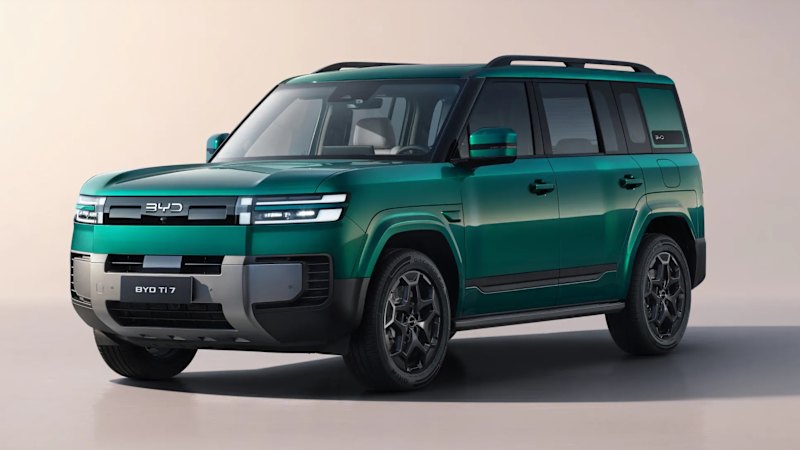
A Dutch court just barred BYD from selling its Ti7 SUV across the European Union over claims it copies the Land Rover Defender. Yet if you live in Britain or already put down a deposit, don't cancel your plans just yet.
On November 20, 2026, a preliminary relief judge at the district court in The Hague granted Jaguar Land Rover an injunction stopping BYD from importing, manufacturing, selling, storing, or delivering the Ti7 across all 27 EU member states. The catch is huge. That order applies to the EU, not the United Kingdom, where BYD plans to start customer deliveries in January 2027.
Honestly, headlines shouting "BYD banned in Europe" miss half the story and get the legal mechanics backwards. A summary ruling in The Hague isn't a final verdict after a full trial. It's a fast-track interim move, and it exposes a fascinating tug-of-war between aggressive Chinese expansion and old-school European intellectual property law.
Why the BYD Ti7 Triggered an EU Court Ban
When you look at a rugged, boxy SUV with rounded wheel arches and upright proportions, your brain naturally groups it into a familiar bucket. For the judge in The Hague, the BYD Ti7 (launched in China under BYD's off-road Fangchengbao brand) crossed the line from "inspired by" into infringing Jaguar Land Rover's registered EU design rights for the Defender.
Under European Union design law, the test isn't whether two cars are identical down to the last bolt. It asks whether the rival vehicle produces a different overall impression on an informed user. BYD argued that its SUV has its own headlights, grille, bonnet, windows, and rear bodywork. The court wasn't convinced those tweaks changed the big picture.
Six specific visual traits in the Defender's registered design carried weight in the judgment:
- Bulging shoulders with rounded corners
- The signature side panel
- Wheel-arch cut-outs with rounded corners
- A continuous glasshouse
- Overall proportions
- The resulting silhouette
To me, that's the real lesson for car designers watching this case. You can change the grille pattern and tweak the lamps, yet still get tripped up if the stance, shoulder line, and greenhouse read like a twin at a glance. And because the Defender is Jaguar Land Rover's top seller—moving more than 100,000 units globally in 2025—protecting that silhouette isn't vanity. It's core revenue.
Registered Design Rights Finally Worked Where Trademarks Failed
Here's something most quick news recaps gloss over. Jaguar Land Rover had tried—and failed—to lock down iconic vehicle shapes under trademark law before.
Back in 2015, the EU General Court refused a trademark for the Range Rover Evoque's body. Then in August 2020, the High Court in London upheld a refusal to register the classic Defender 90 and 110 shapes as trademarks, following opposition from Ineos as it prepared the Grenadier.
Why did trademark law stall out while registered design rights worked here? Trademark protection requires proving a shape functions as a badge of origin that points consumers to one specific maker. Registered EU design protection looks at visual similarity to an informed user and can be renewed in five-year blocks for up to 25 years from filing. With the current Defender arriving in September 2019, design filings around that launch can run into the 2040s.
That distinction matters. A lot. If you're an automaker or product designer, relying solely on trademark claims for industrial shapes is a risky bet in Europe. Registered design portfolios do the heavy lifting early in a product's life.
Why the UK Launch Isn't Blocked Right Now
If you're a UK buyer eyeing the Ti7—or someone who already placed a refundable £500 deposit after pre-orders opened in May 2026—this ruling doesn't halt British deliveries.
The Hague judge ruled that the Dutch court lacks jurisdiction over BYD's UK subsidiary. Furthermore, the court found Jaguar Land Rover hadn't made it plausible that BYD's Dutch entities were behind offering the Ti7 in Britain, noting that BYD's UK arm is a subsidiary of the broader BYD Group rather than BYD Europe.
Price is a massive part of why this fight is so heated in Britain. In the UK, the Ti7 is listed around £47,995 on the road, undercutting a Defender 110 plug-in hybrid priced around £71,840 by roughly £24,000. Even against the entry seven-seat Defender 110, the price gap is dramatic.
A rugged-looking seven-seater at roughly two-thirds the price of a Defender 110 changes buyer math fast—even if the badge on the nose is unfamiliar to traditional off-road fans.
Unless Jaguar Land Rover brings a separate action in a British court and wins an injunction there, January 2027 UK deliveries remain on track on paper. And in the EU itself, BYD told the court it didn't have concrete plans to bring the Ti7 into the bloc right now anyway. Still, the injunction covers ten BYD entities across Europe—including BYD Auto Hungary, given potential future manufacturing at BYD's planned Szeged plant—and carries steep penalties of €100,000 per day, or €25,000 per vehicle if JLR elects that option, capped at €10 million.
Messy Courtroom Twists Behind the Headlines
Anyone who follows IP litigation knows preliminary injunctions are rarely clean or final. This dispute has already had sharp twists in both directions.
Earlier in November 2026, following August bailiff evidence seizures at BYD's Dutch offices in Hoofddorp and Schiedam, a Hague ruling ordered JLR to destroy digital records copied during those seizures. In the November 20 order, the judge also turned down JLR's requests for seized documents, distribution records, and a public correction notice, concluding JLR didn't need those remedies to stop pre-launch sales.
Even the paperwork got trimmed along the way: BYD's initial 110-page defense filing was rejected for being too long, with the court capping submissions at 70 pages.
There's also a ticking clock. Because this is a summary order (kort geding), JLR has six months—until May 20, 2027—to start full substantive proceedings, or the preliminary ban risks losing force. BYD, meanwhile, insists the Ti7 is its own independent design and says it plans to appeal. And a separate JLR case in the District Court of Rotterdam alleging copyright infringement and "slavish imitation" has a hearing scheduled for November 25, 2026.
What This Means for BYD's European Push and Legacy Automakers
Stepping back, this isn't just about one SUV. BYD entered European car sales in late 2022 and has scaled at breakneck speed. According to ACEA figures, BYD's European sales more than doubled to over 280,000 vehicles in the first nine months of 2026 compared to the same period a year earlier, outpacing brands like Ford, Tesla, and Nissan.
When a challenger grows that fast, rivals scrutinize every detail—not just battery chemistry and price tags, but styling too. Historically, legacy automakers have often grumbled about lookalike designs from China, yet formal court wins over styling in Europe haven't been routine. In 2005, General Motors and Chery settled a dispute over the Chery QQ and Chevrolet Spark, while a Munich court in Germany previously upheld a sales ban on the Shuanghuan SCEO over its resemblance to the BMW X5.
From an industry perspective, two truths can exist at once:
- Chinese automakers have earned their market share on engineering, vertical integration, and pricing. You don't sell over 280,000 cars across Europe in nine months by accident.
- Borrowing too heavily from an iconic silhouette invites expensive legal friction. In luxury and lifestyle segments, how a vehicle looks is half the product.
There's also a fair counter-argument worth keeping in mind. Critics of strict design enforcement sometimes worry that broad "overall impression" rulings can fence in boxy utility styling, making rugged off-roaders look overly uniform. Courts try to balance that by focusing on distinctive non-functional features rather than basic utilitarian geometry. Where that line sits will be tested further as full proceedings and appeals play out.
Practical Next Steps If You're Buying, Selling, or Watching This Case
If you're following the story as a prospective buyer, auto analyst, or IP practitioner, here is how to handle it right now:
- If you're in the UK and considering a Ti7: Watch for any separate British court filings by Jaguar Land Rover, and review your reservation terms carefully so you know how deposit refunds or delivery delays are handled if legal action expands to the UK.
- If you're in the EU: Don't expect the Ti7 through official EU dealership channels under this injunction, and keep an eye on the May 20, 2027 deadline for JLR to launch substantive proceedings.
- If you manage brand or product IP: Audit your registered design filings early in a product's lifecycle across key export regions, rather than assuming trademark law or unfair-competition claims alone will stop lookalikes.
- Track the upcoming court milestones: Watch the November 25, 2026 Rotterdam hearing on copyright and slavish imitation, along with BYD's announced appeal, to see whether the dispute widens or narrows.