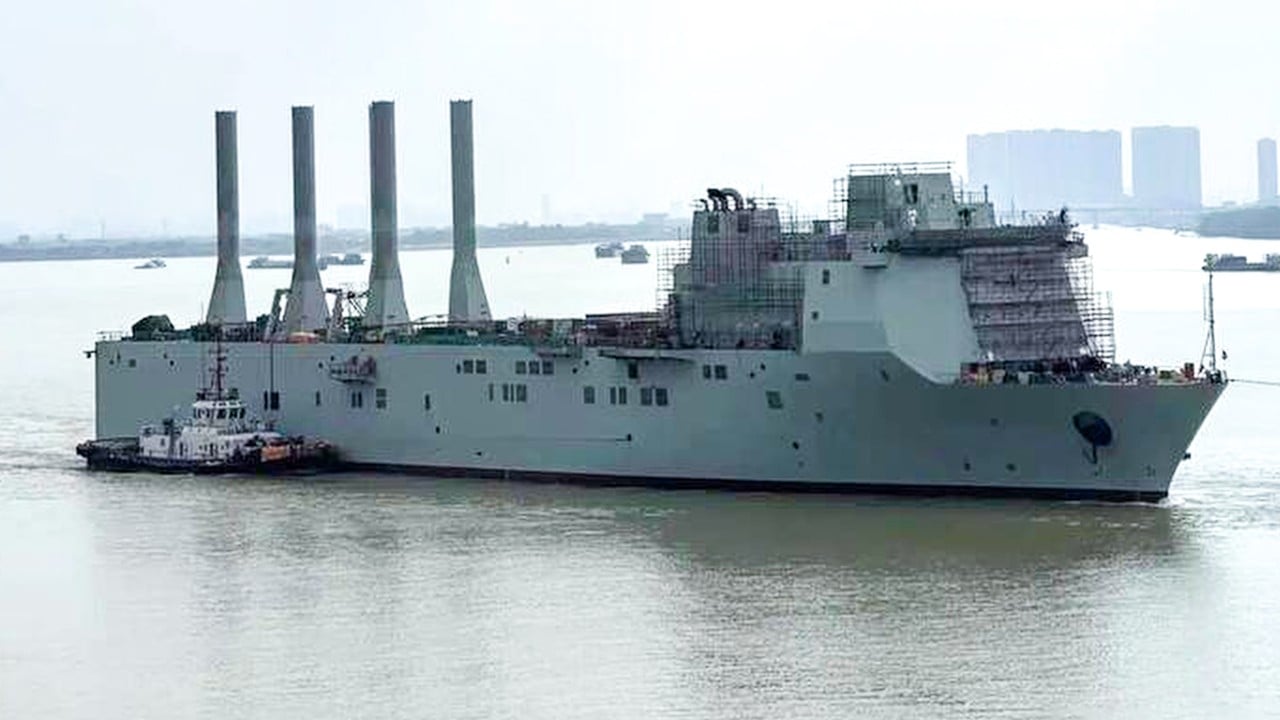
Recent satellite imagery has exposed a major shift in naval architecture. China is constructing specialized support vessels designed to handle extra-large underwater drones. Open-source intelligence analysts spotted a 200-metre red ship at a shipyard in Shanghai, followed by a second vessel built in southern China. These ships aren't standard cargo carriers. They feature distinct rear openings and internal cradles built to launch, recover, and service massive uncrewed submarines far from home ports.
For years, military watchers assumed that big underwater drones would operate directly from fixed naval bases or rely on temporary floating docks. That strategy has a massive flaw. Autonomous underwater vehicles burn through precious battery power and range just getting to their operating areas. If you want an underwater drone to conduct long-term surveillance or mine warfare thousands of miles away, you need a mobile platform to ferry it there. That is exactly what these new drone motherships are designed to achieve.
Why Size Changes the Underwater Equation
Most Western navies focus on smaller, modular autonomous systems that fit inside standard torpedo tubes or launch off the side of destroyers. China is taking a radically different path. Reports indicate that Beijing has been testing extra-large underwater drone prototypes measuring between 35 and 45 metres long in Hainan.
These aren't simple gadgets. They are massive submersibles that rival the size of diesel-electric attack submarines. Operating them requires dedicated infrastructure. By building dedicated surface ships equipped with stern launch-and-recovery systems, China is bypassing the geographical constraints of the first island chain. You don't have to sail a massive drone for three weeks to reach the Indian Ocean when you can cradle it inside a 200-metre mothership and drop it precisely where you need it.
The Strategic Reality Behind the Ships
People often look at these ships and assume they're invulnerable weapons. They aren't. A 200-metre surface vessel is a massive target. If a conflict breaks out, a floating platform carrying multi-million-dollar underwater drones becomes a high-priority target for opposing naval forces. Critics point out that these motherships could be vulnerable to long-range anti-ship missiles or hostile submarines.
Yet, dismissing them as floating liabilities ignores how naval tactics evolve. Aircraft carriers are massive targets too, yet they dictate modern power projection. These motherships allow the People's Liberation Army Navy to project influence into critical choke points without risking crewed submarines in heavily mined or shallow waters. They handle the heavy lifting, maintenance, and data retrieval on station, keeping the operational tempo high.
What This Means for Global Naval Competition
The rapid prototyping and construction of these vessels signal a shift in how autonomous warfare will be fought. While the United States and European allies are investing heavily in uncrewed systems, dedicated long-range expeditionary support ships of this scale are virtually non-existent elsewhere.
If these ships successfully integrate with extra-large uncrewed underwater vehicles, the balance of undersea intelligence collection, mine warfare, and surveillance will shift. It forces rival defense planners to rethink anti-submarine warfare strategies entirely. You aren't just hunting a hidden drone anymore; you are hunting an entire ecosystem designed to support it.
Watch how these vessels perform during sea trials over the coming months. The real test won't be whether China can build them, but whether they can establish a reliable doctrine to operate them effectively under real-world conditions.
Satellite pics reveal China's new submarine drone mothership
This video provides a visual breakdown of the satellite imagery and structural capabilities associated with China's emerging submarine drone motherships.
http://googleusercontent.com/youtube_content/1