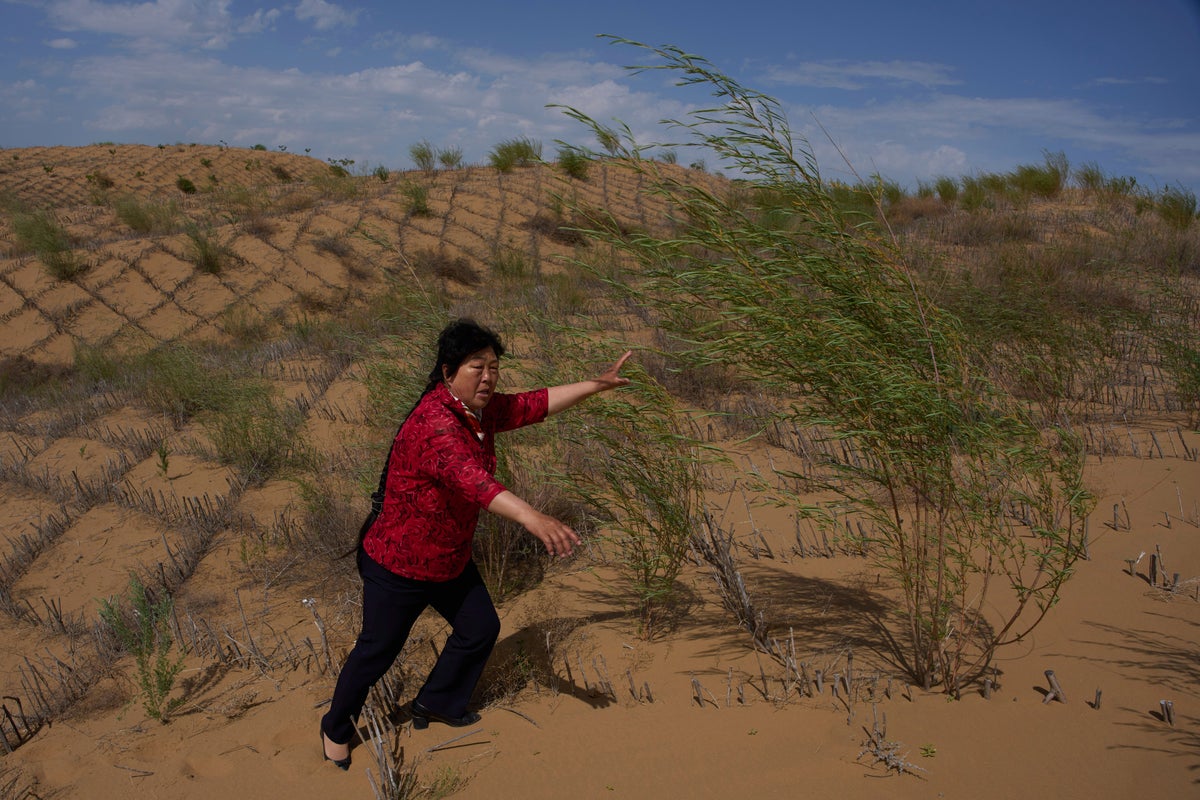
For nearly fifty years, millions of workers have spent their mornings burying straw grids into the shifting sands of northern China. They push forearm-length wheat stalks into the dunes, weaving a massive lattice that locks the earth in place before dropping saplings into the center. This is the backbone of China's Green Great Wall, formally known as the Three-North Shelter Forest Program. It sounds like the ultimate environmental victory. Western headlines often paint it as a flawless blueprint for stopping climate change. The truth is far more complicated, and scientists are growing increasingly worried about what happens next.
We need to look past the official victory laps. The project started in 1978 and aims to plant around 88 million acres of forest by 2050. On paper, the progress looks stunning. State media reports show that desertified land has shrunk by roughly 10% since 2000. Severely degraded areas dropped by more than 40%. Dust storms that used to choke Beijing have plummeted. But planting billions of trees in a region that was never meant to support them creates a whole new set of ecological headaches.
The Hidden Costs of Chinas Green Great Wall
Trees need water. That simple fact is the core flaw in massive afforestation drives. Northern China is naturally arid. By forcing fast-growing monocultures like poplar and willow into dry soils, the project has drained precious underground aquifers.
Local water tables are dropping. When you plant millions of identical trees closely together, they suck up every drop of moisture before it can recharge the soil. Many of these artificial forests are essentially ecological deserts. They lack the biodiversity of a natural ecosystem. They don't support local wildlife. Even worse, these single-species plantations are highly vulnerable to disease. A single pest can wipe out thousands of hectares overnight, leaving behind nothing but tinder for wildfires.
A recent study published in Geophysical Research Letters revealed a strange phenomenon. These man-made forests are growing their leafy canopies roughly 66% faster than natural forests. While that sounds like great news for carbon absorption, researchers say it is a temporary trick of youth. Young trees grow fast. They expand aggressively under rising atmospheric carbon levels, but they hit a hard limit after thirty or forty years. Natural forests grow slowly but store carbon reliably for centuries. Artificial walls don't.
Hard Labor and Climate Luck
The project relies on an army of human beings. Over 300 million rural laborers have participated, often patching up crumbling straw checkerboards from dawn until noon. People like Yin Yuzhen have spent decades keeping the dunes at bay near Ordos in Inner Mongolia. It is brutal, endless work.
We also have to acknowledge a factor that rarely makes the official reports. Luck.
Northern China has experienced a natural increase in rainfall over the last two decades. This climate shift made it much easier for new saplings to take root. If the weather cycles turn dry again, those gains could vanish. Scientists like Zhu Zhaohua openly question how these ecosystems will survive if government funding slows down or if human intervention drops. The entire system is on life support. It requires constant replanting, constant maintenance, and massive financial investments to avoid collapsing back into the sand.
Moving Beyond Simple Tree Planting
Fighting desertification successfully requires a change in strategy. You can't just throw trees at a desert and expect a permanent forest to appear. Real ecological protection means working with the local environment, not trying to bully it into compliance.
Prioritize Native Grasses and Shrubs
Shrubs use a fraction of the water that a poplar tree demands. They stabilize the topsoil without draining the deep aquifers that local communities rely on for drinking water and agriculture.
Connect Conservation to Local Economies
Ecosystem restoration fails when it ignores human survival. Groups like Green Camel Bell in Gansu province are trying to change this by working directly with herders. If local communities don't see an economic benefit from protecting the vegetation, they will naturally return to overgrazing to pay their bills. Environmental policies must support livelihoods, or they won't last.
Accept Natural Desert Borders
Some areas are meant to be deserts. Trying to turn every sand dune green is an expensive exercise in futility. True sustainability means protecting the edges of existing green zones rather than trying to colonize the deep sands of the Gobi.
The next phase of global land restoration needs to learn from these mistakes. Stop measuring success solely by the number of trees planted or the speed of canopy growth. Focus on water security, biodiversity, and community survival. Otherwise, we are just building a fragile green wall that will eventually crumble when the water runs out.
Check out this update on desertification control in North China to see how these newly created green zones look on the ground and learn more about the current phase of the project.