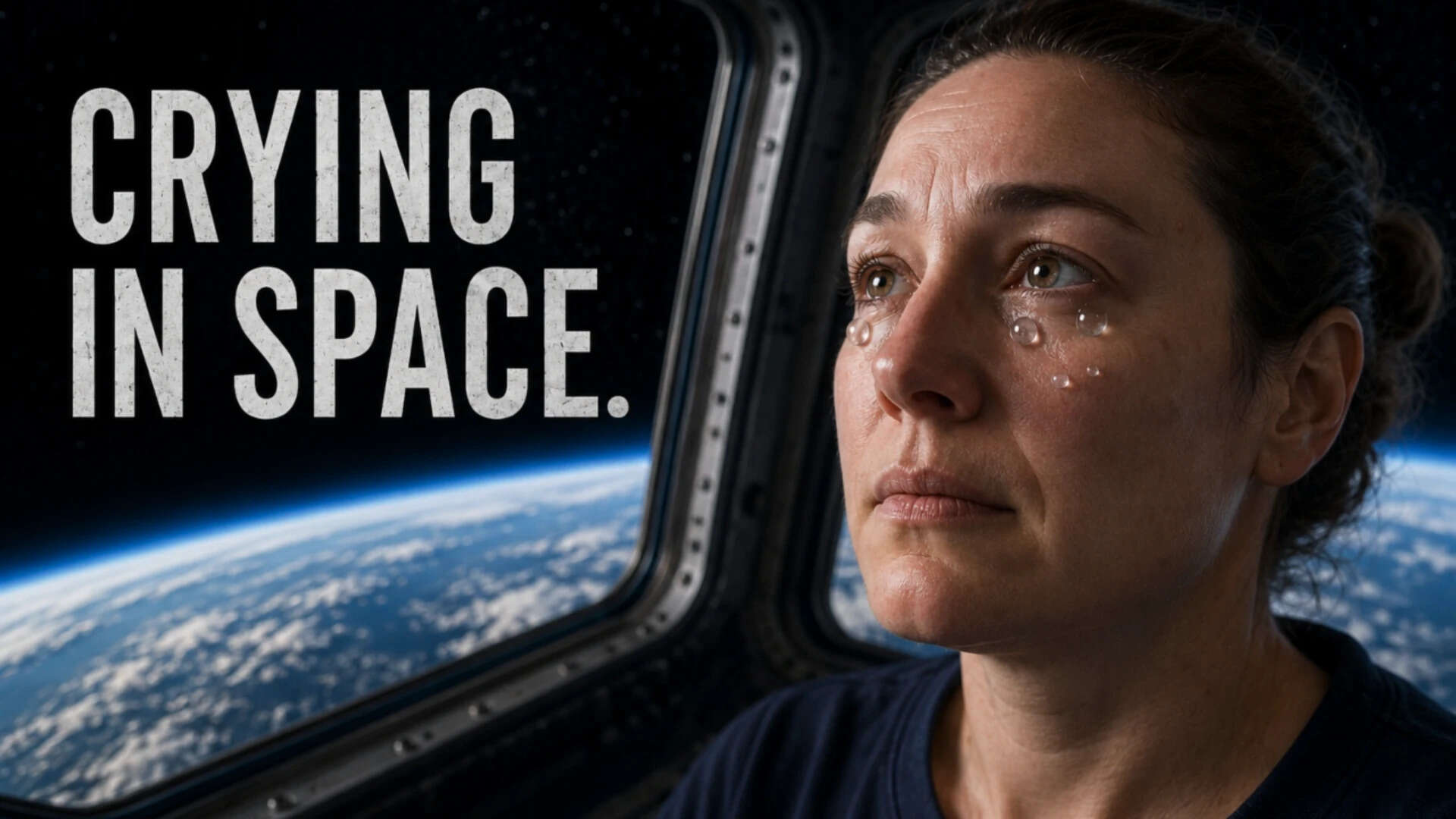
You’ve seen the movies. A tearful astronaut looks back at Earth through a thick glass port, a single tear rolling gracefully down a flushed cheek before dropping onto a flight suit.
It’s iconic cinema. It’s emotional. It’s also physically impossible.
If you ever wondered can astronauts cry in space, the short answer is yes, human tear ducts function just fine in orbit. The long answer is much stranger. Your body produces tears normally, but without gravity to tug liquid downward, those tears don't fall. They don't stream down your face. Instead, they build up around your eyeball in a growing, watery blob that stings like crazy, clings to your skin, and eventually creeps across your nose toward your other eye.
Hollywood lied to you. Crying in microgravity isn't romantic. It's a messy, blinding hazard.
What Happens When Tears Form Without Gravity
On Earth, gravity does all the heavy lifting for your lacrimal system. When you chop an onion, feel overwhelmed, or get a speck of dust in your eye, lacrimal glands under your upper eyelids secrete fluid. Gravity immediately pulls that fluid down your cheeks. Excess moisture drains into your nasolacrimal ducts—the tiny channels in the corners of your eyes that lead into your nose—which is why your nose runs when you sob.
In orbit, that entire drainage and falling system breaks down.
When an astronaut cries, the lacrimal glands produce fluid just like they would on Earth. Pain receptors respond to irritation, and emotional triggers fire off signals in the brain. The body creates liquid tears right on schedule. But the moment those tears leave the duct, physics takes over in a way nobody on Earth ever experiences.
Without gravity pulling the liquid down, surface tension becomes the dominant force. Surface tension is the attractive force between liquid molecules that makes fluids want to pull themselves into the smallest possible surface area. On Earth, gravity easily overcomes surface tension once a tear gets heavy enough. In microgravity, surface tension wins every single time.
The tear clings to the eyeball and surrounding skin. As more fluid comes out, the tear doesn't split or drop off. It grows into a expanding dome of water over the eye.
Canadian astronaut Chris Hadfield famously demonstrated this aboard the International Space Station by squirting drinking water directly into his eye to simulate crying. The result wasn't a stream of tears. It was a massive, quivering sphere of liquid trapped against his face, growing bigger with every blink. He described it as a liquid ball that just sits there, sticking to your face because of cohesive water forces.
If you keep crying, that ball keeps expanding. Eventually, it bridges the bridge of your nose and engulfs your other eye. You end up with a giant, visor-like bubble of tear fluid blindfolding you in floating liquid.
The Physical Pain of Space Tears
Movies make space crying look like a quiet, peaceful moment of reflection. Real astronauts describe something far less poetic.
Space tears burn.
On Earth, fresh tears flow away quickly, constantly flushing the eye clean while fresh basal tears lubricate the cornea. In microgravity, the salty tear fluid sits motionless on the surface of your eye. Because air circulation inside spacecraft relies on forced ventilation systems—there's no natural convection in orbit—the air on the ISS is notoriously dry and breezy.
When a ball of tear fluid sits stagnant over your cornea, the liquid at the outer edge begins to evaporate rapidly. This concentrates the salt content of the remaining liquid. The result is a sharp, burning sensation that triggers your body to produce more tears to flush out the stinging sensation.
You end up in a self-perpetuating loop. The eye stings, so it makes more tears. The new tears join the floating blob on your eye, which makes the ball bigger, causing more stinging and more irritation.
NASA astronaut Clayton Anderson wrote about his emotional moments aboard the space station, confirming that while the feelings were identical to those on Earth, the physical experience was completely different. He noted that the emotional weight of crying in orbit is real, but managing the physical liquid requires immediate action before it renders you temporarily blind.
When Tears Become a Dangerous Hazard in Spacesuits
Stinging eyes on the space station are an annoyance. You grab a towel, wipe your face, and move on.
Inside an Extravehicular Activity suit during a spacewalk, however, a ball of tears is a genuine emergency.
Spacesuit helmets sit tightly around an astronaut's head. You can't reach inside to scratch your nose, wipe your forehead, or dab away a tear. If an astronaut starts tearing up—whether from emotion, physical strain, or severe eye irritation—that tear blob forms directly on the eyeball with nowhere to go.
This isn't a theoretical threat. It almost cost Italian astronaut Luca Parmitano his life in 2013, though not from emotional tears.
During Extravehicular Activity 23 outside the ISS, water from the suit's liquid cooling garment leaked into Parmitano's helmet. Because of microgravity fluid dynamics, the leaked water didn't pool at the bottom of his helmet. It clung to his scalp, crept into his ears, and completely covered his eyes and nose.
The water formed a thick sheet across his face, held in place by surface tension. Parmitano couldn't wipe it away. He was blinded, unable to hear over the water in his ears, and struggling to breathe without inhaling liquid. He had to navigate back to the airlock blind, relying entirely on memory and his tether.
While Parmitano's crisis was caused by a mechanical failure, emotional tears or severe irritation inside a helmet produce the exact same physical fluid behavior. A large bubble of tears inside a spacesuit can blind an astronaut during critical operations. If the tear ball drifts over the nose, it creates an immediate choking risk.
To deal with minor face-wiping needs inside a helmet, NASA installs a tiny piece of foam called a ValSalva device on the inner rim of the neck ring. Its main job is to help astronauts pinch their nose to equalize ear pressure. Some astronauts try to rub their eyes against it if they get fluid in their eyes, but it's a clunky solution for liquid buildup.
Why Liquid Mechanics Act So Differently in Microgravity
To understand why tears stick to your face, you have to look at the battle between adhesion and cohesion in fluid dynamics.
Cohesion is the attraction between like molecules—water clinging to water. Adhesion is the attraction between different molecules—water clinging to human skin or an eyeball.
On Earth, gravity is a massive external force pulling down at 9.8 meters per second squared. Gravity easily snaps the adhesive bond between liquid and skin once a droplet reaches a certain mass. The weight of the water droplet exceeds the surface tension holding it to your skin, and it falls.
In microgravity, that pulling force disappears. Adhesion and cohesion dominate completely.
- Adhesion keeps the tear stuck to your skin and cornea.
- Cohesion holds the tear fluid together in a tight, spherical shape instead of letting it scatter.
- Surface tension acts like an elastic skin around the liquid bubble, keeping it intact as it grows.
Because human skin is somewhat hydrophobic compared to the corneal surface, the tear tends to spread across the eye first, then migrate along the skin of the eyelid and cheekbone as a thick liquid layer. It won't detach and float away into the cabin unless an outside force—like a sudden jerk of the head or a swipe of a towel—breaks the surface contact.
If an astronaut shakes their head violently, the tear ball can detach. It then becomes a free-floating sphere of liquid drifting through the microgravity environment of the station.
Floating liquid inside a space station is bad news. Water droplets can drift into electronics, ruin scientific experiments, or get inhaled by crew members while sleeping. So letting tears drift off into the cabin is strictly discouraged.
How Space Agencies Train Astronauts to Handle Emotional and Physical Tears
Space agencies like NASA, ESA, and Roscosmos don't have a specific "crying class" in astronaut training, but they spend hundreds of hours training astronauts on microgravity fluid management and psychological health.
Astronauts live in high-stress, isolated environments for months at a time. They miss family milestones, cope with extreme workloads, and face genuine peril daily. Emotion is natural. Pretending astronauts don't feel overwhelming grief, joy, or homesickness in space is unrealistic.
When astronauts feel tears coming on, they rely on practical techniques developed over decades of spaceflight.
1. The Towel Strategy
The simplest method is always available inside the station habitat: keep a micro-fiber cloth or towel handy. Astronauts velcro small towels to walls in key areas. When tears form, they immediately press the cloth directly into the eye socket to absorb the liquid before the bubble grows large enough to cause severe burning.
2. The Forced Blink Technique
If a towel isn't immediately reachable, astronauts use hard, deliberate blinks to push liquid toward the outer corners of their eyes, squeezing the fluid onto their temples where it can spread thin and evaporate without covering the cornea.
3. Eye Drop Flushing
Space station cabins have very dry air, around 40 percent humidity or lower, with continuous airflow. Dry eye syndrome is widespread among long-duration crew members. Astronauts frequently use lubricating eye drops. These drops create the same fluid blobs as tears, so astronauts practice absorbing excess drops immediately with cotton wipes.
4. Psychological Mitigation
Preventing emotional distress from spiraling is part of mission support. Astronauts have scheduled, private video calls with family members and psychological support teams every week. Keeping emotional equilibrium helps prevent the intense, overwhelming crying fits that pose physical challenges in orbit.
Common Myths About Crying in Orbit
Because space science sounds exotic, pop culture has filled the internet with weird myths about what happens to body fluids in space. Let's clear up the biggest misunderstandings.
Myth: Your tear ducts burst or stop working
False. Tear production is driven by hormones, nerve impulses, and autonomic nervous system responses. Gravity plays zero role in producing tears inside the lacrimal gland. Your body makes tears in space exactly as it does on Earth.
Myth: Tears float away instantly like tiny bubbles
False. Unless you swat at your face or violently snap your head, surface tension keeps tears firmly glued to your eyeball and cheek. They don't jump off your face the moment they form.
Myth: Astronauts aren't allowed to cry
False. Space agencies don't ban emotion. Long-duration missions require high emotional intelligence and authenticity. Expressing grief or relief is healthy, and flight surgeons encourage astronauts to process emotions normally—just with a towel ready.
Practical Steps for Managing Eye Health in Extreme Environments
Understanding microgravity fluid mechanics isn't just an abstract physics exercise. It offers practical lessons for anyone managing dry eyes, fluid exposure, or extreme environments on Earth.
- Control indoor airflow: Rapid air movement accelerates liquid evaporation on the cornea, leaving behind concentrated salts that irritate the eye. If you work in high-airflow or low-humidity environments, adjust ventilation to prevent dry-eye cycles.
- Absorb, don't rub: When clearing excess fluid or debris from your eyes, press an absorbent cloth gently against the inner corner of the eye rather than dragging liquid across the delicate corneal tissue.
- Prioritize hydration in low humidity: Dry environments draw moisture out of mucous membranes fast. Keep baseline hydration high to ensure your eye fluids retain proper salt-to-water balances.
Space changes almost every basic biological function we take for granted, right down to the way we express sadness or joy. The next time you watch a sci-fi blockbuster with dramatic tears streaming down an actor's face in zero gravity, remember that real spaceflight is a lot wetter, a lot stickier, and held together by surface tension.


