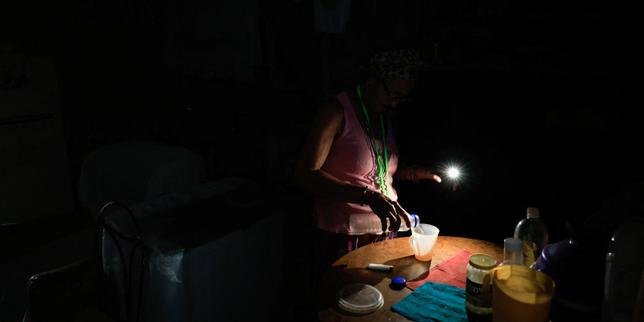
Cuba just went entirely dark. On Monday, July 6, 2026, at precisely midday, the island's national electrical grid suffered a total, catastrophic disconnection. Ten million people were instantly cut off from power. For anyone watching from the outside, it looks like just another headline about a failing state. But if you think this is simply a story of bad management or old machinery, you're missing the real picture.
This isn't an accidental blackout. It's the inevitable result of an intense energy siege combined with structural decay that has been building for decades. While the state-run Electric Union keeps investigating the immediate technical trigger, the real drivers are broad daylight geopolitics and empty fuel tanks.
Right now, families across Havana are hunting for charcoal just to cook rice before their food rots. Hospitals are postponing tens of thousands of surgeries. The streets are pitch black except for the occasional flashlight or passing electric motorcycle. To understand how a nation of nearly ten million people reaches a point where the entire country turns off at once, you have to look at the numbers, the history, and the severe diplomatic squeeze playing out in the Caribbean.
The January blockade changed everything
Let's clear up a major misconception. Cuba has dealt with rolling blackouts for years, but the current crisis entered unprecedented territory at the start of 2026. In late January, U.S. President Donald Trump imposed a aggressive oil blockade. The policy threatened massive tariffs on any country or company supplying oil to the island.
The impact was immediate. Mexico’s state-owned Pemex suspended its planned exports under pressure. Shipments from Venezuela, Cuba's historical lifeline, slowed to a crawl. By February, oil imports to the island dropped to effectively zero for the first time in over a decade.
The island produces only about 40% of the fuel it needs to run its economy. The rest must be imported. When you suddenly cut off 60% of an economy's energy input, a total collapse isn't a possibility, it's a mathematical certainty.
There have been tiny patches of relief. In late March, a sanctioned Russian oil tanker, the Anatoly Kolodkin, was permitted to deliver 730,000 barrels of crude to the port of Matanzas. It felt like a massive event at the time. But do the math. That delivery yielded roughly 180,000 barrels of diesel. For Cuba's daily consumption needs, that's about ten days of fuel. By the end of April, that Russian oil was completely gone. Since then, the island's fuel reserves have dwindled to almost nothing.
A grid built for a world that no longer exists
Even if oil tankers were lining up at the port of Matanzas today, Cuba's infrastructure is too broken to handle it smoothly. Over 90% of the country's electricity relies on oil-fired thermoelectric plants. Most of these massive facilities were built between the 1960s and 1980s using Soviet, Czech, and Japanese technology.
Engineers design these plants for a maximum operational lifespan of roughly 100,000 hours. Walk into any major Cuban plant today, like the Antonio Guiteras facility, and you'll find machinery that has run for double or triple that limit. They are running on borrowed time, patch jobs, and sheer luck.
The domestic crude Cuba does manage to extract presents its own set of problems. It's heavy and packed with sulfur. When you burn high-sulfur heavy crude in plants that weren't specifically designed for it, the chemical corrosion eats away at the boilers and turbines from the inside out. Maintenance requires specialized parts that Cuba cannot buy on the open market due to long-standing financial restrictions.
It's a vicious cycle. A plant breaks down because it's burning bad fuel. Workers patch it up with whatever scrap metal they can find. The plant goes back online, runs at half capacity, and breaks again three weeks later. This explains why nearly two-thirds of the country was already sitting in darkness on Monday morning before the entire system finally gave up and disconnected at noon.
Why solar energy won't save the island anytime soon
The Cuban government isn't completely blind to this vulnerability. They've launched a highly publicized program backed by China to build 92 solar parks by 2028. The goal sounds impressive, aiming for a combined capacity of over 2,000 megawatts. As of this summer, 34 of these solar parks are synchronized with the grid, adding about 560 megawatts during peak daylight hours.
But solar power reveals a fundamental misunderstanding of how an electrical grid works when it lacks storage. Solar panels help during a sunny afternoon. They allow the government to turn off a few oil-guzzling generators for a couple of hours.
The real crisis hits at 9:00 PM. That's when residential demand peaks. It's when families come home, turn on fans to cope with the brutal Caribbean summer heat, and try to run refrigerators. Solar panels don't generate electricity at night, and Cuba does not possess the industrial-scale battery systems needed to store daytime solar energy for evening use.
Transitioning the island to a truly reliable renewable grid would require an investment of eight billion to ten billion dollars over the next ten years. In an economy where foreign reserves are completely depleted, that money simply doesn't exist. The solar project is a drop in an ocean of darkness.
The true human cost of a dying economy
Statistics don't capture what it actually feels like to live through this collapse. In Havana, rolling blackouts routinely last for 30 consecutive hours. Go out into the rural provinces, and you'll find towns that haven't seen a steady current of electricity for four or five days straight.
This level of instability destroys everyday life. Public transportation has ground to a near-halt because there's no fuel for buses. Cold-storage warehouses lose power, which means the limited food supplies available to the population spoil before they can be distributed. Water pumps require electricity to push water into city pipes; when the grid dies, the water taps dry up too.
The economic fallout has targeted the island's last remaining lifeline, tourism. Tourism brings in the hard foreign currency Cuba needs to buy medicine and food. Back in February, the lack of aircraft fuel forced the government to announce they couldn't guarantee refueling for international flights.
The response from global airlines was swift. Air Canada suspended flights immediately. Russian carriers like Rossiya and Nordwind followed days later. By mid-June, international visitor numbers had plummeted by 58%. Massive resort hotels now sit empty, running their own loud, expensive diesel generators just to keep the lights on in empty lobbies.
What happens next
Don't expect a quick fix to this latest collapse. Lazaro Guerra, the top electricity official at the Ministry of Energy and Mines, admitted on state television that the total lack of fuel complicates the restoration process immensely. While technicians are slowly managing to activate isolated "microsystems" to provide power to critical sectors like major hospitals, the main grid remains highly unstable.
Geopolitically, the deadlock shows no signs of breaking. Cuban Foreign Minister Bruno Rodriguez confirmed that initial bilateral talks with Washington have yielded no progress. The current U.S. administration has made its stance clear, indicating that the fuel embargo will remain firmly in place until there is a change in the Cuban government structure.
If you are looking at how to navigate or understand this situation moving forward, keep your eyes on three specific indicators rather than government press releases:
First, watch the movement of regional oil tankers. Unless large-scale shipments from alternative suppliers arrive and clear port bottlenecks in Matanzas or Havana within the next 72 hours, the grid will lack the baseline fuel required to keep the main thermoelectric units synchronized for more than a few hours at a time.
Second, watch the domestic food supply lines. The prolonged nature of this specific blackout means regional distribution centers are losing their refrigeration capabilities right now. This will likely trigger immediate shortages of basic proteins and dairy in the coming weeks.
Third, look at the status of flight operations. The true health of Cuba’s economy shows up at the airport fuel depots. Until major commercial airlines reinstate regular schedules from Canada and Europe, the state will lack the liquid cash required to buy its way out of this structural trap. The lights might flicker back on in parts of Havana over the next few days, but the underlying system is fundamentally running out of time.