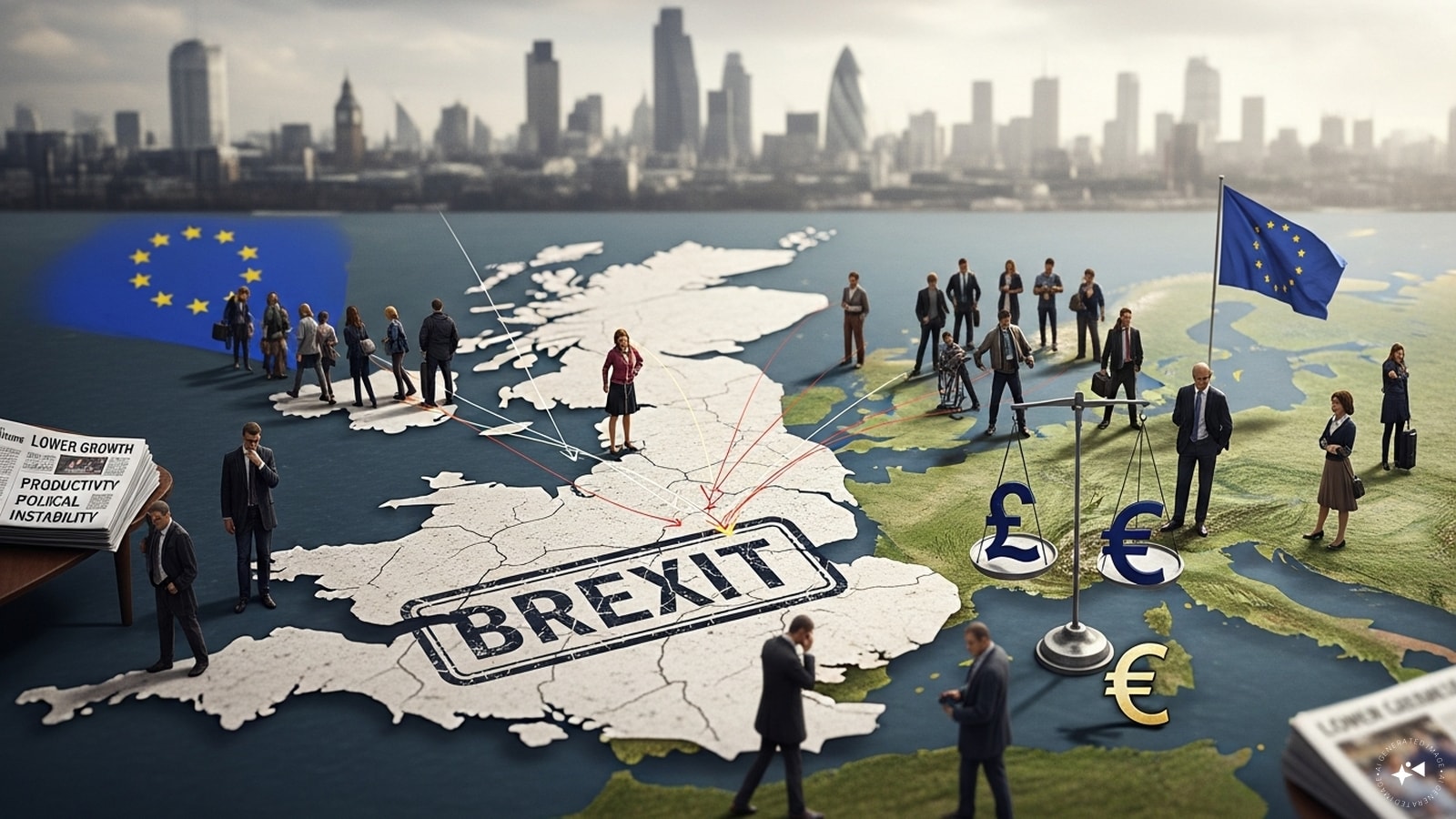
Ten years ago today, Britain made a choice that upended decades of economic integration. People expected immediate chaos. Critics predicted a sudden, terrifying recession that would bring the nation to its knees overnight.
It didn't happen. The sky didn't fall on June 24, 2016. Because of that, a lot of people assumed the warnings were just political scaremongering.
They were wrong.
The economic damage of leaving the European Union wasn't an explosive crash. It's a slow, quiet leak. It's the steady drip of friction draining wealth out of the UK economy year after year. Now, a decade down the line, the numbers have caught up with the rhetoric, and the reality is ugly.
If you want to understand why your grocery bills are stubbornly high, why public services are starving for cash, or why British businesses are throwing their hands up in frustration, you have to look at the structural shift that happened when the UK walked out of the single market.
The Missing Billions in the National Pocketbook
Let's talk about the big picture first. The Office for Budget Responsibility estimates that Brexit has shaved about 4% off the UK's potential gross domestic product. Some independent researchers, like those at Stanford’s Institute for Economic Policy Research, put that number even higher, between 6% and 8%.
Numbers like 4% sound abstract. They sound like bureaucratic rounding errors.
They aren't.
To put it in context, the UK economy is worth around £3,100 billion. A 4% permanent reduction means the economy is roughly £124 billion smaller than it would have been if Britain had stayed in the EU.
Think about what that means for public finances. The UK government collects about 36% of GDP in taxes. When you wipe out £124 billion of economic activity, you automatically wipe out around £48 billion in annual tax revenue.
That is massive.
To give you an idea of scale, the controversial move to cut the winter fuel allowance saved the Treasury about £1.3 billion. A extra £48 billion flowing into the exchequer every single year could fundamentally transform the National Health Service. It could fund defense upgrades without blinking. Instead, chancellors are left scraping the bottom of the barrel, raising taxes just to keep essential services from collapsing. You are paying more tax for worse public services, and Brexit is a direct driver of that squeeze.
Red Tape is Suffocating Small Business
The Leave campaign promised that exiting the EU would cut red tape. They told us British businesses would be liberated from the chains of Brussels bureaucracy.
The opposite happened.
For large multinational corporations, the new post-Brexit rules are an expensive nuisance. They hire compliance teams, fill out the endless paperwork, and absorb the fees. It hurts their profit margins, but they survive.
For small businesses, it's a death sentence for trade.
Estimated data shows that between 16,000 and 20,000 small UK businesses have completely stopped exporting to the EU. Why? Because the paperwork is an absolute nightmare. Dealing with complex rules, customs declarations, and shifting VAT regulations requires time and money that a ten-person company simply doesn't have.
Consider the border checks. Up to 2024, HSBC Global Investment Research calculated that new border checks cost the UK £4.7 billion. Sanitary controls on food trade alone suck away £54 million every single year.
Imagine running a boutique cheese business or a small specialized engineering firm. Before, you could ship a box to Paris as easily as you could ship it to Manchester. Now, you need health certificates, customs brokers, and hours of administrative work. Many business owners looked at the costs and simply gave up on the European market entirely. Britain didn't cut red tape; it built a giant bureaucratic wall between itself and its biggest trading partner.
The Supermarket Squeeze and Your Daily Expenses
You don't need to be an economist or a business owner to feel this impact. You just need to look at your weekly shopping receipt.
Food prices have skyrocketed over the last few years. While global factors like energy shocks and supply chain disruptions played a huge part, Brexit added a specific, localized penalty to British consumers.
Researchers at the London School of Economics tracked the impact of trade barriers on food imports from the EU. They found that these barriers caused the cost of food to jump by 12% between 2019 and 2023. That added about £400 to the average family's grocery bills over that period.
This hits low-income households the hardest. Wealthy families can absorb an extra few hundred pounds a year on food without changing their lifestyle. For a family living on the edge, that 12% bump means making hard choices at the supermarket checkout.
The government hopes to ease this specific pain with a new food export agreement planned for 2027, which aims to eliminate physical checks on dairy, fish, and meat. But that's tomorrow's promise. Today, British shoppers are paying a literal premium for a political decision made ten years ago.
The Great Investment Stagnation
A healthy economy relies on businesses investing in the future. They buy new machinery, build factories, upgrade their software, and train their staff. This investment drives productivity, which in turn drives higher wages.
Britain's business investment went off a cliff after the 2016 vote.
When the referendum passed, it opened up a multi-year void of absolute uncertainty. Companies had no idea what the UK's trading relationship with Europe would look like. They didn't know what tariffs they would face, what regulations would change, or if their supply chains would remain legal.
So, they did the logical thing. They paused.
Studies show that UK business investment fell between 12% and 18% short of where it would have been under a non-Brexit path. Years of waiting for clarity meant that British companies fell behind their international peers in automation and modernization.
When you don't invest, your productivity stalls. When productivity stalls, wages flatline. Britain’s decade-long stagnation in living standards isn't a mystery. It's the predictable result of a business community that was forced to spend a decade managing political risk instead of growing their operations.
The Immigration Plot Twist
One of the most powerful arguments for Brexit was "taking back control" of Britain’s borders. The goal was to end the free movement of people from the EU and reduce net migration numbers.
The system changed, but the numbers didn't do what people expected.
Net migration didn't plummet. It actually hit record highs.
While EU migration dropped significantly—with many European workers in hospitality, agriculture, and healthcare leaving the country—the UK economy still desperately needed workers. To fill the gaps, successive governments opened up visa routes for non-EU countries.
The result? Total net migration surged to historic peaks in 2023, driven heavily by arrivals from outside Europe. The immigration debate didn't disappear; it just shifted focus. Britain traded European workers, who had seamless reciprocal rights to live and work across the channel, for a complex, state-managed visa system that is expensive for businesses to navigate and highly politicized.
Moving Past the Rhetoric
Public opinion has clearly turned. Recent YouGov polling shows that 57% of Britons now think leaving the EU was the wrong choice, compared to just 30% who think it was right. A separate Ipsos poll found over half the country wants to apply to rejoin.
But rejoining isn't a quick fix, and it's not on the table anytime soon. Europe won't just let the UK walk back in without massive concessions, and the political appetite for another decade of constitutional warfare is non-existent.
Instead of waiting for a magical political reversal, businesses and individuals have to deal with the economic reality on the ground.
If you are running an enterprise or managing your career in this environment, stop waiting for the old rules to return. Focus heavily on expanding services trade, which has actually grown by 48% since 2016 because it faces fewer physical border barriers than manufactured goods. Automate aggressively to bypass local labor shortages. If you export goods, establish a physical or legal foothold inside the EU single market—such as a third-party logistics hub in the Netherlands or Ireland—to bypass the border friction that kills small-scale shipping. The macroeconomy is sluggish, but individual agility is still entirely within your control.