Carl Jung spent a massive chunk of his life obsessed with an ancient Chinese book of hexagrams. When Richard Wilhelm published his German translation of the I Ching in 1924, Jung pounced on it. He thought he found the ultimate validation for his theories on the human mind. He even invented a whole new concept called synchronicity to explain why throwing coins or counting yarrow stalks could somehow reveal your deepest secrets.
He was wrong.
Jung was a brilliant psychologist, but he looked at the Book of Changes through a hyper-individualistic Western lens. He saw a mirror for the personal subconscious. Most people today do the exact same thing. They treat it like a mystical tarot card deck or a cosmic therapy session. They think it predicts the future or uncovers hidden desires.
That completely misses the point.
The I Ching is not a book of magic tricks. It is a manual for survival. It is an ancient, brutal, and highly practical guide to understanding systems, power, and the absolute certainty of change. If you are using it to find out if your crush likes you back, you are doing it wrong.
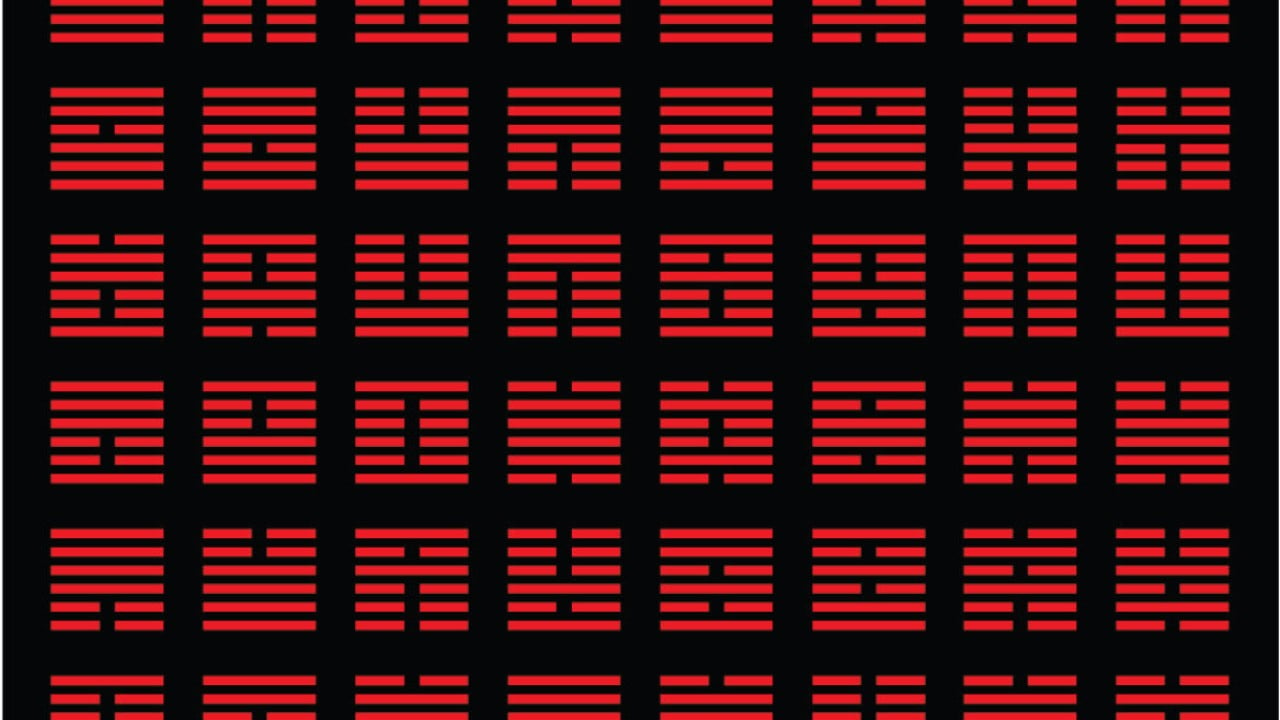
[Image of I Ching hexagram chart]
The Problem with Synchronicity
Jung believed that when you cast a hexagram, the random configuration of the coins lines up with your psychological state at that exact micro-second. He called this a meaningful coincidence. It sounds beautiful. It makes you feel like the center of the universe.
It is also an accidental distortion of Chinese philosophy.
The authors of the ancient text did not care about your personal identity crises. They did not have a concept of the individual subconscious. The original text emerged roughly three thousand years ago during the transition from the Shang Dynasty to the Zhou Dynasty. This was a time of bloody warfare, political betrayal, and constant environmental instability.
Rulers needed to know one thing. Will my kingdom survive the winter?
The book was built as a situational map, not a psychological profile. It assumes that the universe operates in predictable, rhythmic waves. When you throw the coins, you are not tapping into your inner child. You are dropping a plumb line into the current momentum of the world around you. The result tells you where you stand in the grand cycle of growth and decay. It does not care about your feelings. It cares about your position.
A Mathematical Map of Reality
Strip away the incense, the velvet pouches, and the New Age mysticism. What do you actually have? You have a clean, binary code.
Long before Gottfried Wilhelm Leibniz helped invent modern computer computing, he looked at the structure of the hexagrams and realized someone had beaten him to the punch by a few millennia. The system relies on two fundamental building blocks. A solid line represents Yang. It is active, aggressive, light, and giving. A broken line represents Yin. It is passive, receptive, dark, and taking.
- Yang: Solid line ($-$)
- Yin: Broken line ($-\ -$)
You stack three of these lines together to get a trigram. There are eight basic trigrams, representing elemental forces like fire, water, thunder, and mountains. Stack two trigrams together, and you get a hexagram. Six lines total.
Mathematically, that gives you exactly 64 permutations.
Each hexagram is a snapshot of a specific moment in time. The text analyzes how these forces interact. Is the fire burning underneath the water? That means conflict is brewing. Is the mountain sitting on top of the earth? That means stability and stillness. It is a cold, calculated, structural breakdown of how energy moves through a system. It is much closer to physics than fortune-telling.
The Myth of Predicting the Future
You cannot use the I Ching to find out what happens tomorrow. Anyone who tells you otherwise is selling something.
The book assumes that the future does not exist yet because it is constantly being manufactured by your choices in the present. Instead of telling you what will happen, the text tells you what is happening right now and what the natural consequence of that momentum will be if you do nothing.
Think of it like a weather report. A meteorologist does not look into a crystal ball to see rain. They look at atmospheric pressure, wind velocity, and cloud formations. They tell you there is an eighty percent chance of a downpour. The I Ching does the same thing for human situations. It tells you the structural pressure of your current situation.
If you get Hexagram 44, which warns of an aggressive, destabilizing force entering your life, it is not a curse. It is a warning that you are letting something toxic slip through the cracks. You have the agency to change your path. The book rewards action, caution, and timing. It does not dictate destiny.
The Strategy of the Underdog
We get a lot of our modern ideas about the text from the commentary tracks added centuries later, specifically by Confucian scholars who wanted to turn it into a moral textbook. But if you dig down to the oldest layers of the text—the King Wen descriptions and the Duke of Zhou line readings—the tone is vastly different.
It reads like a military briefing.
Take Hexagram 1, named Qian, which represents pure active energy. The very first line says something that shocks people who expect endless positivity: "Hidden dragon. Do not act."
Why? Because even if you have the power of a dragon, if you are at the bottom of the structure, acting too early will get you destroyed. You have to wait. You have to watch. You have to build your strength in secret while the current shifts.
The text is obsessed with the concept of the underdog. It understands that the people at the top of the wheel always get arrogant. They stop paying attention to the small changes. They ignore the tiny, broken lines creeping into their foundation. Eventually, the wheel turns, and the top becomes the bottom. The I Ching teaches you how to survive the bottom and how to behave when you inevitably reach the top so you don't fall off immediately.
How to Actually Read a Hexagram
If you want to understand the system without the fluff, you have to look at the anatomy of a hexagram. It is read from the bottom line up to the top line. This is crucial. It represents development over time.
- Line 1 (Bottom): The inception. The idea is just forming. You have no real power yet.
- Line 2: The internal manifestation. You are starting to see results in your immediate environment.
- Line 3: The transition point. This line is always dangerous. You are stepping out of your private space into the public eye. Mistakes here are costly.
- Line 4: The upper sphere. You have entered the room where decisions are made. You are close to the center of power.
- Line 5: The peak position. This is the ruler's line. It represents maximum influence and balance.
- Line 6 (Top): The extreme. You went too far. The energy is exhausted. Decay is about to start.
When you look at it this way, you realize the book is mapping out a universal lifecycle. Businesses go through this. Relationships go through this. Empires go through this. By identifying which line is active, you know exactly what strategy to deploy. If you are at line two, don't act like you are at line five. You will look ridiculous and get crushed. If you are at line six, stop pushing forward. It is time to retreat and conserve your energy.
The Western Obsession with the Occult
So why did the West turn this cold, strategic manual into a hippie playground in the 1960s? You can blame the translation choices.
Richard Wilhelm was a Christian missionary living in China during a period of massive upheaval. He loved the culture, but he viewed it through a romantic, spiritualized lens. He translated terms using heavy, theological words like "The Judgement" or "The Supreme Cultural Hero." When the English version hit the shelves with a foreword by Jung, the counterculture movement went wild.
They saw it as an escape from Western rationality. They used it alongside psychedelic drugs to chase mystical experiences.
They wanted magic. They did not want the boring, disciplined reality of ancient Chinese statecraft. They ignored the fact that the book calls for constant self-examination, strict discipline, and an awareness of social hierarchies. It is ironic. A text designed to help rulers maintain social stability became the soundtrack for a generation trying to tear down social stability.
Pragmatism Over Poetry
If you want to use the book today in a way that actually honors its roots, throw away the guidebooks that talk about cosmic alignment and spiritual vibrations. Look at the text as a framing device.
The human brain is terrible at making objective decisions when emotions are running high. We suffer from confirmation bias. We panic. We double down on bad ideas because of the sunk-cost fallacy.
The 64 hexagrams act as an adversarial thinking tool. They force you to look at your situation from an angle you completely ignored.
If you are trying to scale a business and you get Hexagram 36, which translates to "Darkening of the Light," a New Age interpretation will tell you that your aura is blocked. A pragmatic interpretation tells you something much more useful: Hide your intelligence. Do not show your hand to your competitors right now. Play dumb while you regroup.
That is not mysticism. That is classic corporate or political strategy.
Your Next Steps
Stop treating the Book of Changes like a party trick. If you want to engage with it seriously, change your approach completely.
Get a translation that strips out the theological baggage. Look for versions that focus on the historical context of the Zhou Dynasty, such as translations by scholars who prioritize the bronze inscriptions over later medieval commentaries.
When you consult the text, stop asking vague, lazy questions like "What does my future look like?" Ask specific, structural questions. "What is the hidden risk in this partnership?" or "What dynamic am I ignoring in this project?"
Look at the hexagram you receive as a logical grid. Read the lines from the bottom up. Figure out where you are on the timeline of growth and decay. Then, stop thinking, stop meditating, and go do the real-world work required to adjust your position. The universe is moving, and it will not wait for you to catch up.