You think you're just watching a soccer match, but walk outside the stadium in Los Angeles and the air smells like a revolution.
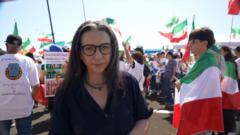
On Monday night, Team Iran stepped onto the pitch at the 2026 World Cup to play New Zealand. But the real battle wasn't happening under the stadium lights. It was happening right on the asphalt outside, where hundreds of Iranian-Americans gathered in an emotional, high-stakes standoff.
Western media loves a simple script. They show you a few colorful flags, play some audio of passionate chanting, and label it a standard political protest. That completely misses the point. What happened in LA wasn't just a political rally. It was a painful, deeply personal identity crisis spilling out into the open. The largest Iranian diaspora community on earth is completely fractured over a single heartbreaking question: Who actually owns the national team?
The Broken Identity of Team Melli
For decades, the Iranian national soccer team has been known affectionately as Team Melli—literally, the team of the people. It was the one thing that could unite a deeply divided nation. Whether you lived in Tehran or Los Angeles, when those eleven players took the field, you were an Iranian first.
Not anymore.
Tehran’s brutal crackdown on dissidents earlier this January shattered whatever apolitical illusion was left. Thousands of young protesters back home were jailed or killed. For many Iranian-Americans living in "Tehrangeles"—the massive diaspora hub just ten miles from the stadium—the national team has been entirely hijacked by the Islamic Republic.
Look at the raw anger on the ground. Protesters brought the official flag of the current Iranian government, laid it flat on the concrete, and invited passersby to stomp and spit on it. To these demonstrators, cheering for the team means legitimizing a regime that has spent decades executing its own citizens. As 46-year-old Los Angeles resident Rameileh Jaffrey put it outside the gates, "They are not my team. They are a government team."
But cross the security barrier into the stadium, and you see an entirely different side of the same pain. Thousands of fans filed past the protesters with their cheeks painted green, white, and red. They aren't regime sympathizers. Most of them loathe the rulers in Tehran just as much as the people outside. But they view the players as victims, not villains.
Trapped Between a Rock and a Hard Place
It is incredibly easy for western observers to demand that athletes become political martyrs. It costs us nothing. For an Iranian player, a single gesture of defiance carries life-or-death consequences for their families back home.
The regime has made it perfectly clear that any sign of resistance at this World Cup will be met with immediate, brutal retaliation. The federation has already proved how tightly it holds the leash. Star striker Sardar Azmoun was completely left off the World Cup squad this year, a move widely understood to be punishment for a social media post that angered authorities. Back in 2022, prominent former players were literally thrown in prison for speaking out against the leadership.
The players are essentially hostages in jerseys. Team captain Mehdi Taremi tried to walk an impossible tightrope during his press conference, pleading that the squad plays for every Iranian, whether in the diaspora or at home, in an attempt to bring joy. But joy is a rare commodity when your team is being used as a sports-washing machine.
The Battle of the Banned Flags
If you want to understand how deep the division goes, look at the fight over the flags.
Protesters outside lined the streets waving the pre-revolutionary Iranian flag, featuring the traditional golden lion and sun motif. For the diaspora, this flag represents freedom, history, and a homeland that existed before the fundamentalists took over in 1979.
But you won't see it easily inside the stadium. FIFA, hiding behind its rigid rules against political apparel, strictly banned the pre-revolutionary flag from the stands. An Iranian-American non-profit group actually filed a lawsuit in a California court last week to fight the restriction, but a Los Angeles judge upheld FIFA’s ban just hours before kickoff.
That didn't stop people from trying. Some fans, like 42-year-old Ella Bah, tied the lion-and-sun flag around themselves like a dress, hiding it under extra layers of clothing to sneak past security. She didn't buy a ticket to cheer. She bought a ticket to ensure the people inside Iran still had a voice on global television.
The geopolitical tension surrounding this group opener was already suffocating. Because of the recent military conflict involving U.S., Israeli, and Iranian forces, the team had to move its entire training camp to Tijuana, Mexico, after being blocked from training in Arizona. Several team officials were denied U.S. visas entirely. Ironically, just as the team arrived in LA on Sunday, a fragile peace deal was announced to end the war, but the emotional scars in the stadium were wide open.
Moving Past the Pitch
The match ended in a tense 2-2 draw with New Zealand, but the scoreline is the least important data point of the night.
What matters is the ongoing struggle for the soul of Iranian identity. Soccer isn't just a game here; it's a mirror reflecting a traumatized population trying to figure out how to love their culture without supporting the dictators who rule it.
If you want to understand the reality of this community beyond the headlines, stop looking for a simple narrative. Don't look at this as a sports story, and don't look at it as a simple political protest. It's a community mourning a stolen homeland, using a soccer stadium as the only stage they have left to fight for it.
To truly understand the stakes, follow the independent journalists covering the Iranian diaspora inside Southern California, and look directly at the documentation coming from human rights organizations tracking the families of persecuted athletes inside Iran. The real story isn't the 90 minutes on the grass—it's what happens when the cameras turn off.