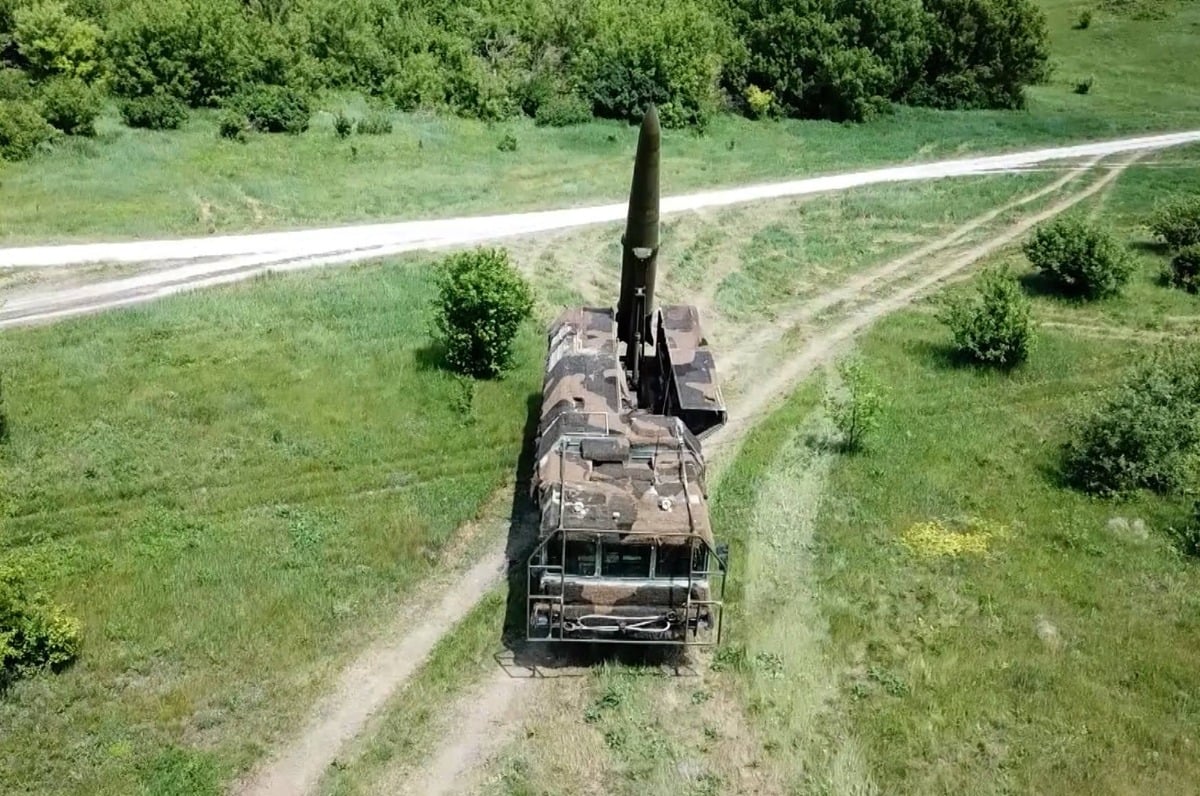
You have probably seen the breathless headlines claiming that high-tech electronic warfare can magically shut down incoming ballistic missiles in mid-air. It sounds like the perfect sci-fi defense. Instead of firing an expensive million-dollar interceptor missile, you turn on a massive jammer, scramble the signal, and watch the threat crash harmlessly into an empty field.
It is a beautiful story. It is also completely wrong.
The reality on the ground in Ukraine has forced military officials to repeatedly push back against this exact misconception. Recently, Ukrainian defense spokespeople had to explicitly clarify that electronic warfare units do not jam Russian ballistic missiles like the Iskander-M or the North Korean KN-23. While local electronic warfare assets are doing incredible work neutralizing Russian reconnaissance drones and attack UAVs, throwing a radio-frequency wrench into a ballistic missile's guidance system during its terminal phase is a totally different ballgame.
Understanding why this is impossible reveals the massive, ongoing challenge of modern air defense.
The Brutal Physics of a Ballistic Trajectory
To understand why you cannot just jam a ballistic missile, look at how these weapons actually fly. Unlike a cruise missile, which is basically a low-flying, uncrewed jet airplane that relies on constant GPS updates and terrain mapping to find its target, a ballistic missile is a rocket.
It gets blasted high into the upper atmosphere, or even the edge of space, before falling back down to Earth at terrifying speeds. By the time an Iskander-M enters its final phase over a city like Kyiv, it is screaming downward at supersonic or hypersonic speeds.
At that moment, the missile does not care about GPS. It does not need a satellite link. Most modern ballistic systems use an Internal Navigation System (INS).
An INS uses onboard gyroscopes and accelerometers to calculate exactly where the missile is based entirely on its starting point, speed, and trajectory. You cannot jam an INS. There is no external radio signal to block, no antenna to saturate, and no wireless data stream to intercept. The missile is essentially a massive, guided anvil falling from the sky. Even if you manage to trick its optical or radar terminal-seeking sensors at the very last second, the weapon's sheer kinetic momentum ensures that hundreds of kilograms of explosives will still slam into the ground somewhere close to the target.
Drones vs. Ballistics: Where Electronic Warfare Actually Works
The confusion usually stems from official military briefings. When the Ukrainian Air Force releases its daily tallies, it often groups various threats together, stating that a certain number of targets were neutralized or "lost via electronic warfare countermeasures".
But you have to look at the fine print.
Those electronic countermeasures work wonders against Shahed-type loitering munitions, Russian tactical reconnaissance drones, and certain types of cruise missiles that rely heavily on satellite navigation. Ukraine’s Pokrova system, for instance, has been highly effective at spoofing GPS signals, causing enemy attack drones to lose their bearings, run out of fuel, or crash off-target.
But when it comes to a coordinated Russian barrage combining hundreds of drones with a dozen Iskander-Ms, the electronic warfare units handle the drones while the kinetic air defense systems take the ballistics.
Why the Shortage of Interceptors Changes the Stakes
Because electronic warfare cannot help against ballistic threats, Ukraine remains entirely dependent on hard-kill interceptors like the U.S.-made Patriot PAC-2 and PAC-3 systems. This has created a massive logistical headache.
During heavy Russian assaults, the sheer volume of incoming ballistic strikes has occasionally overwhelmed local defenses, leading to periods where the interception rate for ballistic missiles dropped drastically due to a severe shortage of interceptor ammunition. Air defense crews face agonizing choices about which targets to protect when their stockpile of physical missiles runs low.
If electronic warfare could solve the ballistic problem, western allies wouldn't be scrambling to secure complex European financial loans or setting up massive international industrial coalitions to build new anti-ballistic platforms. Physical interceptors are the only tool that works against a weapon falling from the cosmos, and they are incredibly hard to manufacture quickly.
The Path Forward for Air Defense Strategy
Relying purely on expensive foreign interceptors is not a sustainable long-term strategy. To counter the ballistic threat, defense forces are shifting focus toward a more active, multi-layered approach.
- Targeting the Launchers: The most effective way to "jam" a ballistic missile is to destroy the mobile Iskander launcher on the ground before it ever fires. This requires deep-strike capabilities and rapid intelligence sharing.
- Domestic Ballistic Development: Ukraine has been aggressively accelerating its own ballistic missile programs, such as the state-backed Sapsan system, to create a credible regular deterrent and hit back at Russian military infrastructure.
- Affordable Hard-Kill Countermeasures: The recent development of specialized anti-ballistic initiatives aims to design and mass-produce cheaper interceptors within a shorter timeframe, reducing the total financial burden of defending airspace against heavy rocket barrages.
Do not fall for the myth of a bloodless electronic shield against heavy rocket attacks. Electronic warfare is reshaping modern combat, but it cannot rewrite the laws of physics. Until defensive lasers or cheap kinetic interceptors are deployed at a massive scale, stopping a ballistic missile will always require hitting a bullet with another bullet in the sky.