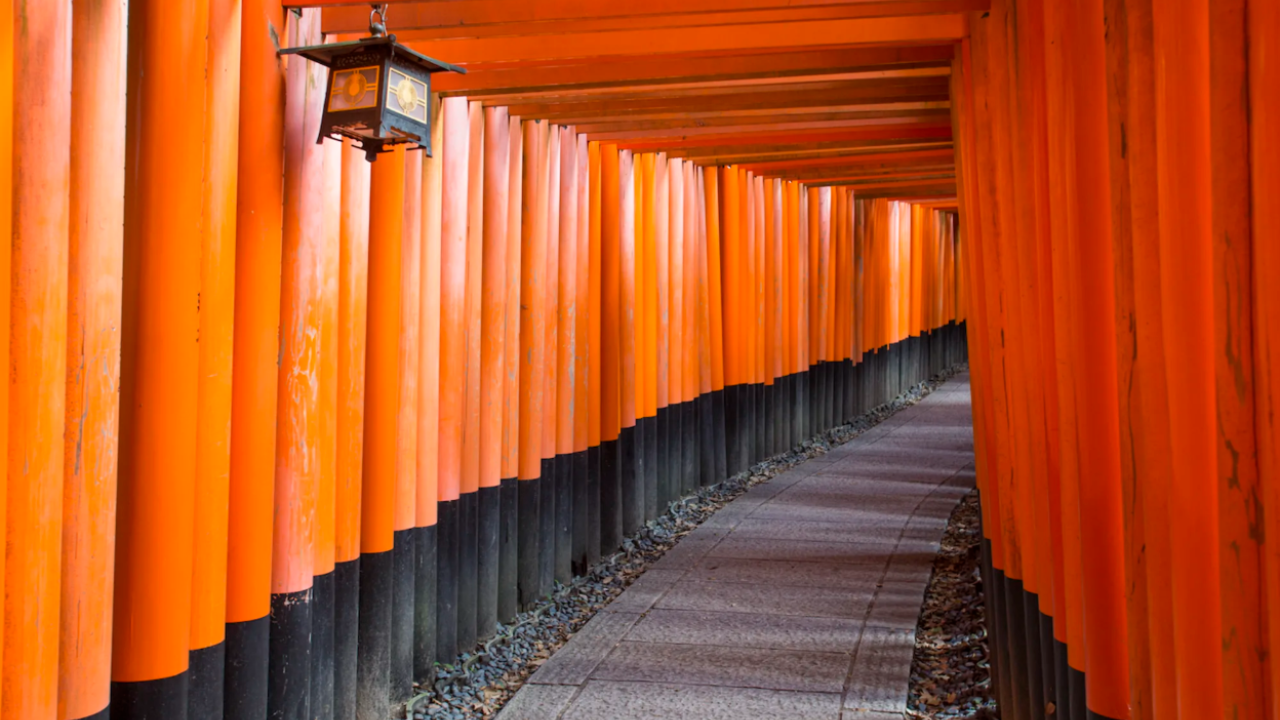
You've seen the photos plastered all over social media. A seemingly endless, hypnotic corridor of vibrant orange-red arches cutting through a dense, green forest. It looks like a mystical movie set or a carefully planned art installation. Most travelers think it's just a beautiful street or a highly aesthetic walkway built all at once to wow tourists.
It's actually Fushimi Inari Taisha, an ancient Shinto shrine sprawling across a mountain in Kyoto. Those arches aren't decorative pillars. They're individual sacred gates called torii. Each one marks a hard boundary between our everyday, ordinary world and the sacred ground of the spirits. If you just walk through them to take a quick selfie, you're missing the entire point of one of the most spiritually significant locations in Japan.
The Reality of Fushimi Inari Taisha
To understand why this mountain path looks like a solid tunnel, you have to look back more than 1,300 years. The shrine was founded in the year 711 AD, long before Kyoto even became the capital of Japan. A powerful local family known as the Hata clan established it to honor Inari Okami, the Shinto deity of rice and agriculture.
In ancient Japan, rice wasn't just dinner. It was currency. It was wealth. If your rice crop failed, your entire community starved or went bankrupt. Fast forward to the Edo period between the 17th and 19th centuries, and Japan's economy shifted. Merchants and business owners rose to prominence. Rice fields gave way to shopfronts and corporate ventures.
The people changed, but their devotion didn't. Inari naturally transformed from a god of agriculture into the ultimate patron of business success, commerce, and manufacturing. Today, the shrine serves as the absolute headquarters for over 30,000 smaller Inari shrines scattered across the country. You can spot mini Inari altars tucked away on the roofs of modern Tokyo skyscrapers, inside manufacturing plants, and behind the curtains of traditional Kyoto restaurants.
Why Thousands of Gates Form a Tunnel
The competitor articles tell you that the path is just a long tunnel built for worshippers. That completely misrepresents how this site grew. This corridor wasn't master-planned by an architect. It grew organically, gate by gate, because of a brilliant piece of Japanese wordplay.
The Japanese verb toru means to pass through. Another word pronounced toru means to accomplish, realize, or get a wish granted. Over time, merchants, corporate CEOs, and ordinary families began making a deal with the deity. They would pray for financial success, and if their business succeeded, they would return to the mountain and purchase a heavy wooden torii gate as a giant, physical thank-you note.
Because thousands of businesses over hundreds of years kept fulfilling their promises, the gates accumulated. They got packed closer and closer together until the spaces between them practically disappeared. The section right at the base of the mountain, known as the Senbon Torii or Thousand Torii Gates, is so tightly compressed that daylight barely filters through. It creates a rhythmic flash of light and shadow as you walk, an architectural optical illusion born out of centuries of pure capitalistic gratitude.
If you look closely at the back of any gate as you hike up, you will see black kanji characters carved into the wood. They aren't religious spells. They're the exact names of the companies, families, or individuals who paid for that specific gate, along with the precise month and year it was erected. You're literally walking through a historical ledger of corporate success.
The Secret Behind the Vibrant Vermilion Color
Everyone calls them red gates, but locals know the color is specifically vermilion, a fiery shade of orange-red called shu-iro. This choice of paint wasn't just about catching the eye of the gods. It had an incredibly practical, material purpose rooted in ancient chemistry.
The original paint pigment was derived from cinnabar, a naturally occurring mineral that contains high levels of mercury sulfide. While mercury is toxic to humans, it turns out to be fantastic for preservation. The mercury in the cinnabar paint acted as a powerful, natural insecticide and antifungal agent. It stopped wood-boring bugs from eating the pillars and prevented moss, mold, and rot from destroying the structures in Kyoto's damp, humid summers.
Spiritually, the color plays a double role. In Shinto belief, vermilion represents the raw force of life, blood, and the sun. It's an aggressive, spiritual barrier that repels evil spirits, misfortune, and pollution. By painting thousands of gates in this heavy cinnabar mix, the shrine created a massive, spiritually sterile corridor climbing up the mountain.
Foxes Are Not the Gods Here
Another massive misconception among travelers is that Fushimi Inari is a temple dedicated to fox worship. Walk around the grounds and you'll see hundreds of stone and ceramic fox statues staring down at you. Some wear red bibs, others hold strange objects in their mouths.
The foxes, or kitsune, are not the deities. They're the messengers. Shinto deities are formless, abstract forces of nature, so they utilize animals to interact with the human world. Inari's chosen messengers are white foxes, which are completely invisible to the human eye. The statues you see are just physical stand-ins for these unseen spiritual guides.
Look closely at what the foxes are holding. One might hold a heavy key in its teeth, which represents the key to a traditional rice granary or wealth. Another might hold a polished, teardrop-shaped jewel, symbolizing the spirit of the deity.
The local food culture around the mountain embraces this fox lore completely. Traditional stalls along the path sell kitsune udon, thick wheat noodles in a hot broth topped with a sweet piece of deep-fried tofu called aburaage. According to Japanese folklore, deep-fried tofu is the absolute favorite food of mythical foxes. You can also buy inari sushi, which consists of vinegared rice stuffed tightly inside a pocket of that same fried tofu. It's a carb-heavy, delicious nod to the agricultural roots of the mountain.
How Much It Costs to Buy a Gate
The tradition of donating gates didn't stop in the Edo period. It's fully alive today. Anyone can buy a gate if they have the cash, but you'll need to join a massive waiting list.
The cost depends entirely on the size of the gate and where it's located on the mountain trail. A small, modest gate placed along the upper ridges of the mountain starts at around 400,000 Japanese yen. If you're a massive multinational corporation looking to place a towering, monumental gate near the main entrance halls at the base, the price tag easily skyrockets to well over 1.3 million yen.
Because wood naturally rots over decades despite the cinnabar paint, the shrine continuously replaces older, decaying gates with fresh ones. The path is a living, breathing organism. It's constantly being repaired, repainted, and expanded. The tunnel you walk through today isn't identical to the one your ancestors saw a century ago, and it won't be the same a decade from now.
Practical Steps for Savoring Your Visit
Most tourists arrive at 10:00 AM, take a few crowded photos at the bottom section, get exhausted by the stairs, and turn around. That's a massive mistake. To actually experience the magic of the mountain, you need a strategy.
First, fix your timing. Arrive either before 7:00 AM or after 8:00 PM. The shrine never closes. It's open 24 hours a day, 365 days a year, and it doesn't cost a single yen to enter. Going at night completely transforms the experience. The crowds vanish. The shadows lengthen. The stone lanterns cast a soft, eerie glow over the vermilion wood, and the deep silence of the forest lets you hear the wind rustling through the trees. It feels genuinely sacred, bordering on supernatural.
Second, hike the full loop. The entire trail up Mount Inari is about four kilometers long and takes around two to three hours to complete. The vast majority of the tourist crowd drops off at the Yotsutsuji intersection, which is roughly halfway up the mountain.
Once you push past that point, the paths clear out dramatically. You'll find quiet, moss-covered stone altars called otsuka, miniature bamboo groves, and hidden waterfalls where practitioners still perform purification rituals.
Skip the tourist traps at the bottom. Put on a solid pair of walking shoes, buy a bottle of water from a vending machine, and commit to climbing the stairs all the way to the summit. Your legs will burn, but you'll see the real, unedited side of Japan's spiritual heart.