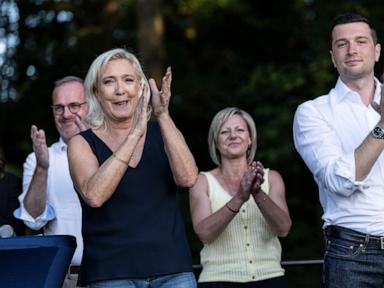
Marine Le Pen did not just inherit a political party. She rebuilt it from the studs up. When a Paris criminal court handed her a five-year ban from public office in March 2025 for embezzling European Parliament funds, commentators rushed to write her political obituary. They assumed the National Rally would collapse without its matriarch. They were wrong.
Understanding Marine Le Pen's political career and the rise of the French far right requires looking past the courtroom drama. The movement she cultivated is no longer just a vehicle for one family's ambitions. It is an electoral juggernaut that has spent fifteen years embedding itself into the fabric of working-class France. You might also find this connected coverage insightful: Why The India Indonesia Strategic Partnership Still Matters In 2026.
If you think a legal verdict will instantly reset French politics to the status quo, you don't know the history of the National Rally. Her career tells a story of calculated reinvention, ruthless family betrayals, and a deep understanding of mainstream political vulnerabilities.
From the shadow of the patriarch
To see how far the French far right has traveled, you have to look back to its inception. Jean-Marie Le Pen, a fiery former paratrooper, co-founded the National Front in 1972. The party began as a fringe coalition of Vichy nostalgists, ultra-nationalists, and anti-communist radicals. For decades, the elder Le Pen treated the party like a personal megaphone. He delighted in provoking the public, famously dismissing Nazi gas chambers as a mere detail of history. He did not want to govern. He wanted to outrage. As extensively documented in latest reports by USA.gov, the implications are notable.
Marine grew up inside this pressure cooker. When she was only eight years old, a bomb tore through her family's Paris apartment building. No one was killed, but the blast shattered her childhood and welded her identity to her father's toxic brand. She studied law, became a public defender, and learned how to fight in rooms that hated her.
By the late 1990s, she joined the National Front's legal team. She realized early on that her father's overt racism kept the party locked in a political ghetto.
The watershed moment came in 2002. Jean-Marie Le Pen shocked the world by beating the Socialist candidate to enter the presidential runoff against Jacques Chirac. The French establishment panicked. Millions of voters across the political spectrum united behind Chirac in a civic firewall, leaving the elder Le Pen with just under 18% of the vote. Marine watched that defeat closely. She saw that raw provocation had a hard ceiling. If the far right ever wanted real power, it needed a complete face-lift.
The blueprint of de-demonization
Marine took the party reins in 2011, defeating old-guard rival Bruno Gollnisch. She immediately initiated a strategy known as dédiabolisation, or de-demonization.
She did not just tweak the party's messaging. She systematically purged the skinheads, the leather-jacketed radicals, and the overt antisemites from party ranks. The most dramatic manifestation of this cleanup happened in 2015. After her father repeated his infamous Holocaust remarks, she expelled him from the very party he founded. It was a brutal public act of political patricide, but it sent a clear signal to the electorate.
Instead of talking about race, she talked about secularism and the French way of life. She stopped attacking the welfare state and started defending it, arguing that globalization and mass immigration were destroying France's social safety net. She traded her father's aggressive posture for tailored blazers and a softer, more maternal public image. She started posting photos of her cats and talking about life as a single mother.
The shift worked brilliantly. In her first presidential run in 2012, she secured 17.9% of the vote, beating her father's historical peaks.
By 2017, she made it to the final runoff against a young centrist upstart named Emmanuel Macron. She lost heavily after a disastrous, overly aggressive debate performance where she stumbled over economic data and threatened to pull France out of the Eurozone. Voters got scared. They saw her as unready for the complexities of global economics.
Rebranding and the normalization of the fringe
True to form, she adapted. She dropped the deeply unpopular plan to abandon the Euro and rebranded the National Front as the National Rally in 2018.
Her third presidential run in 2022 showed the true power of this makeover. She avoided grand ideological fights and focused squarely on inflation, fuel prices, and the cost of living. Macron won reelection, but the gap closed significantly. Le Pen captured 41.5% of the vote. Millions of mainstream French citizens no longer feared voting for her.
The ultimate proof of her normalization arrived during the snap parliamentary elections of 2024. Macron called the elections hoping to force voters into making a choice against the far right. The gamble backfired. The National Rally won the largest share of votes in the initial round. While a tactical alliance between leftist and centrist parties blocked them from securing an outright majority in the National Assembly, Le Pen's party emerged as the single largest cohesive faction in parliament.
National Rally Presidential Election Progress:
2002 (Jean-Marie Le Pen): 17.8% (Runoff)
2012 (Marine Le Pen): 17.9% (First Round)
2017 (Marine Le Pen): 33.9% (Runoff)
2022 (Marine Le Pen): 41.5% (Runoff)
The courtroom crisis and the Bardella factor
The momentum came to a sudden halt in March 2025. A Paris court convicted Le Pen and several associates of creating fake assistant jobs in the European Parliament to funnel public money into their party coffers. The sentence was severe: two years of house arrest, a heavy fine, and a five-year ban from public office.
She immediately appealed, blasting the ruling as a political assassination orchestrated by an elite establishment that could not beat her at the ballot box. While the appeal suspends the house arrest, the ban on running for office complicates her plan for a fourth presidential run.
This brings us to the biggest misconception about the current state of French politics. People think Le Pen's sidelining is a fatal blow to the National Rally. They forget she spent years preparing a backup plan.
Jordan Bardella, the party's current president, represents the next iteration of Le Pen's strategy. He is young, incredibly polished, and has millions of followers on TikTok. He does not carry the heavy baggage of the Le Pen name. He did not live through the street brawls of the twentieth-century French right. He grew up in a working-class public housing project in the Paris suburbs, giving him a powerful narrative that resonates with voters who feel abandoned by cosmopolitan elites.
If Le Pen's legal appeals fail, Bardella is poised to step into the vacuum. The machine she built does not depend on her name being on the ballot anymore.
What lies ahead for France
Mainstream political analysts often make the mistake of treating the National Rally as an intellectual anomaly. They assume that if they just expose the party's lack of economic depth or highlight its historical flaws, voters will return to traditional parties. That approach failed for twenty years.
Le Pen succeeded because she capitalized on real structural grievances: declining public services in rural communities, cultural anxieties surrounding integration, and a profound distrust of a highly centralized Parisian political elite.
If you want to track where French politics goes next, stop looking at the courtrooms in Paris and start looking at the shifting coalitions in the National Assembly. Watch how Bardella handles parliamentary pressure. Observe whether the mainstream conservative factions continue to adopt the National Rally's language on immigration and security to survive.
The strategy going forward requires focusing on regional elections and local governance. The far right did not grow overnight, and it will not disappear because of a judicial ruling. Pay close attention to how the party positions itself against an increasingly fragmented left-wing coalition and a leaderless centrist bloc. That is where the next chapter of French political power will be written.
This video breaks down how Marine Le Pen transformed the party platform and shifted public perception across France, providing deep context on her strategy.