You stand in the center of Barcelona's most famous building, look up at the stone forest of pillars, and think you've seen it. You haven't. Most tourists treat the Sagrada Familia like a massive, glorious photo op. They snap a selfie under the neon-bright stained glass, marvel at the sandcastle spires, and move on to get tapas.
That's a huge mistake.
Antoni Gaudí didn't design a passive tourist attraction. He built a massive, multi-dimensional puzzle packed with secrets that ninety percent of visitors walk right past. Josep Turull, the basilica's rector, spends every single day walking these halls and admits he still finds fresh details hidden in plain sight. If you look closely, you realize the entire structure acts as a physical riddle.
Let's break down the actual enigmas built into the bedrock of this masterpiece, including the bizarre details that ordinary tour groups completely miss.
Codebreaking on the Passion Facade
Most people spend their time looking at the Nativity Facade because it looks like a living, breathing stone jungle. It's soft and hopeful. But the real mind-bending puzzles hide on the western side, along the brutalist Passion Facade.
Gaudí wanted this side to look harsh and cruel, almost like it was constructed out of bleached skeletons. It represents Christ's final hours, and sculptor Josep Subirachs carried out that grim vision while inserting some cryptic mental games of his own.
The Cryptic Grid next to Judas
Right next to the statue depicting Judas betraying Jesus with a kiss, you'll spot a stone grid filled with numbers. It looks exactly like a modern Sudoku or a math puzzle.
This is a classic magic square.
No matter which direction you add up the numbers—horizontally, vertically, or diagonally—the sum always equals 33. That isn't a random calculation. It represents the exact age of Jesus Christ at his crucifixion. Subirachs placed it there to symbolize the strict inevitability of the betrayal and death.
The Hidden Labyrinth
Drift your eyes slightly over to the scene where Peter denies knowing Christ. Look closer at the stone block underneath. There's a tiny, square-shaped labyrinth carved directly into the surface.
It's easy to miss if you aren't hunting for it. Rector Turull notes that this maze represents the internal confusion of human error, a physical metaphor for feeling totally lost but needing to maintain faith to find your way out.
Apex Predators in the Spires
Look up at the dizzying heights of the spires. You'll see massive stone carvings of fruit, cornucopias, and reptiles acting as functional gargoyles. But look closer at the Tower of Saint James, and you might see something move.
Those aren't statues. They are real, flesh-and-blood peregrine falcons.
For over twenty years, a family of these hyper-fast birds of prey has nested deep inside the high stone structures. Barcelona officials chose Gaudí’s masterpiece as an ideal reintroduction site because falcons historically nested in the area before urban sprawl wiped them out in the 1970s.
They aren't just there for show. The church actually relies on them. The falcons hunt local pigeons, naturally protecting the delicate stone facades from being destroyed by corrosive bird droppings. It fits perfectly with Gaudí’s core philosophy: using the raw cycles of natural life to sustain human design.
The Saint Hidden Underground
While thousands of tourists scramble across the main floor, the actual spiritual heart of the building sits directly beneath their feet. If you slip away to a modest side entrance and walk down a quiet staircase, the tourist chaos vanishes.
You enter the crypt.
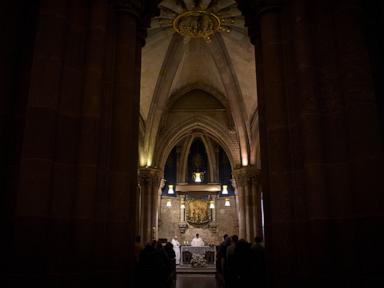
It is a small, quiet, shadow-filled chapel where locals actually come to pray. Right inside a small stone nook lies a flat, simple tomb interred in the floor. This is where Antoni Gaudí rests. He died exactly a century ago after tragically getting struck by a Barcelona streetcar. Locals didn't even recognize him at first because he dressed so simply; they mistook the architectural genius for a homeless man.
[Gaudí's Crypt: Located directly below the main altar, accessible via a separate side entrance.]
Today, his grave is continuously ringed with glowing candles. People flock here to ask for his spiritual intercession. The Vatican named Gaudí "venerable" in 2025, which means he is now officially on the slow, bureaucratic path toward sainthood. The church is currently hunting for documented miracles tied directly to prayers made at this exact underground tomb.
Giant Oceans in a House of Stone
Gaudí famously argued that original design means returning to the origin of things, which meant looking directly at nature. He hated straight lines because they didn't exist in the wild.
Before you start climbing up toward the towers, stop at the columns near the entrance. Fixed to the stone via custom wrought-iron brackets are massive, genuine seashells.
They aren't replicas or stone carvings.
These are actual giant bivalve shells brought over from the Philippines. Gaudí repurposes them as holy water basins. When you dip your fingers into the water, you're interacting with a raw piece of the ocean embedded inside an architectural forest. It's a reminder that every piece of the church connects back to the natural world.
The Secret Vestry Room
High up a narrow, winding staircase sits a private room flooded with Mediterranean sunlight. Regular ticket holders can't get anywhere near it. Inside this secure room sit two massive freestanding oak cabinets covered in intricate iron scrollwork, entirely designed by Gaudí himself.
This is the hidden treasury.
It stores the basilica's most sacred relics and historic garments. Tucked away inside is the exact embroidered white chasuble worn by Pope Benedict XVI when he formally consecrated the church back in 2010. The workshop on-site keeps this room highly secure because they use it to prepare custom vestments for visiting dignitaries, weaving symbols of the church's newly raised Tower of Jesus Christ directly into the fabric.
How to Actually Experience the Space
If you want to see these details yourself instead of just walking past them, you need to change your strategy.
- Ditch the midday rush: Book your entry ticket for either early morning or late afternoon. The morning sun shoots cool blues and greens through the eastern Nativity windows. The afternoon sun hits the western Passion side, bleeding deep reds and fiery oranges across the stone pillars.
- Download the official app before you arrive: Use the digital map to locate the "What you don't see" augmented reality toggle. It uses your phone's camera to reveal hidden structural elements and architectural models that aren't visible to the naked eye.
- Pack light: Security checks at the gate are strict and mimic airport protocols. Big backpacks will get you pulled out of line and slow you down.
Buy your tickets online at least three weeks in advance through the official basilica portal. Do not buy from third-party resellers on the street; they upcharge drastically and often sell invalid entry times. Select the specific ticket option that includes the towers if you want to see the high spires up close, but make sure you're comfortable walking down 500 narrow, winding spiral stairs on the way back down.