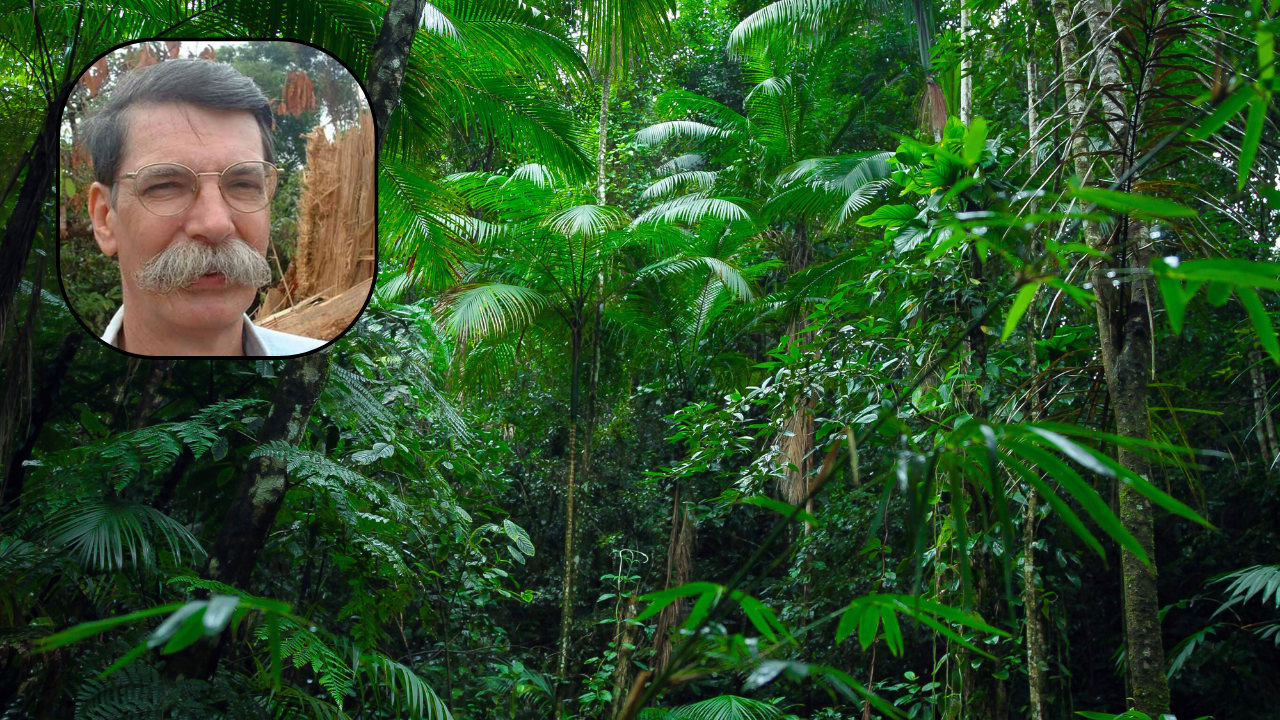
You can't talk about the true cost of destroying the Amazon without mentioning Philip Fearnside. While corporate PR teams and politicians love to talk about economic growth and infrastructure projects, Fearnside spent fifty years living in the mud, crunching numbers, and proving that short-term profits always lead to long-term ecological bankruptcy.
Back in the 1970s, when Brazil was pushing hard to colonize the rainforest through the Trans-Amazonian Highway, Fearnside didn't just look at maps from an air-conditioned office. He actually packed up and lived in the agricultural settlements around Altamira, Pará. He watched firsthand how government incentives, land speculation, and poorly planned roads triggered a domino effect of destruction. That ground-level perspective changed how scientists look at tropical ecosystems forever.
Most people think deforestation happens because a few loggers cut down random trees. That is completely wrong.
Fearnside’s decades of research at Brazil’s National Institute for Amazonian Research (INPA) exposed a much more insidious mechanism. It starts with a single major highway. Once a road cuts through pristine forest, it opens the floodgates for secondary roads, illegal loggers, cattle ranchers, and land grabbers. The initial path of destruction multiplies exponentially.
This exact mechanism is why Fearnside spent years fiercely opposing the rebuilding and paving of the BR-319 highway connecting Manaus and Porto Velho. When politicians argue that a paved road will just help local communities trade goods, they ignore the vast spiderweb of unauthorized side roads that inevitably follow. You can't pave the middle of the world's largest rainforest without inviting its systematic unravelling.
We also have a massive blind spot when it comes to hydroelectric dams.
For years, greenwashed energy campaigns marketed big dams as clean energy solutions. Fearnside tore that argument apart by calculating the hidden bills attached to these mega-projects. When massive rivers get blocked, immense areas of forest flood. Those submerged trees rot slowly under water, releasing massive quantities of methane and carbon dioxide into the atmosphere. Sometimes, a tropical dam emits more greenhouse gases than a fossil fuel plant of a similar capacity.
Worse yet, satellite data analyzed in recent years shows that smaller hydropower plants can actually pack a worse punch per megawatt generated than massive dams, clearing disproportionately larger chunks of surrounding forest for construction and maintenance grids. When you factor in the blocked fish migrations, displaced indigenous communities, and destroyed river ecosystems, the math behind hydropower stops looking green real quick.
Fearnside's greatest contribution wasn't just pointing out these horrors. It was putting a real economic value on things economists usually ignore.
Traditional market calculations treat a standing forest as wasted space until you cut it down or build a dam over it. Fearnside flipped that logic on its head. He calculated the literal carbon storage value, water-cycling power, and biodiversity loss tied to every acre cleared. When you price in the climate services a healthy rainforest provides for the entire planet, cattle ranching and soy farming don't look profitable anymore. They look like a terrible trade.
If you want to understand how environmental science actually changes policy, look at Fearnside's contributions to the Intergovernmental Panel on Climate Change (IPCC). He forced global leaders to stop treating local deforestation as an isolated Brazilian problem and start seeing it as a planetary emergency.
Fifty years of fieldwork taught him a hard truth: governments rarely listen to abstract warnings. They only listen when the hidden costs are calculated so clearly that ignoring them becomes politically impossible. The rainforest isn't just timber waiting to be harvested. It's a complex, living shield holding our global climate together, and fifty years of data prove we are running out of time to protect it.