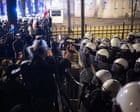
Riot police standing guard outside a locked government building isn't normal. Yet that's exactly what happened in Warsaw when Poland deployed security forces around the Constitutional Tribunal.
If you're wondering how a judicial suspension turned a European capital into a flashpoint overnight, you aren't alone. Prime Minister Donald Tusk’s centrist government and the nationalist right have officially collided. The stakes are massive, the legal arguments are flying, and nobody is backing down. In other news, take a look at: Why Polish President Karol Nawrocki Abandoned His African Tour Mid Flight.
The Spark That Lit the Fire
The chaos erupted after the suspension of the tribunal's chief justice, Bogdan Święczkowski. Issued by judge Anna Korwin-Piotrowska, the move instantly blew the lid off long-simmering tensions.
Supporters of the opposition Law and Justice party (PiS) swarmed the tribunal headquarters. Fences were breached, objects flew through the air, and police moved in to secure the perimeter. Three people got detained. Al Jazeera has analyzed this critical topic in extensive detail.
Meanwhile, the tribunal's official social media accounts didn't mince words. They labeled the government's actions a "coup d'état". Former Justice Minister Zbigniew Ziobro called it a "blatant, criminal attack" on the constitutional order.
President Turns Back Mid-Flight
When major political crises break out, presidents usually rush home. President Karol Nawrocki took that literally.
Nawrocki was mid-flight on an official trip to Senegal when the news hit. He immediately ordered his plane to turn around and flew straight back to Warsaw. His quick return highlighted just how volatile the situation had become. Since taking office in mid-2025, Nawrocki has frequently clashed with Tusk's administration, notably refusing to swear in several judges nominated by parliament.
This isn't a sudden accident. It's the continuation of a multi-year war over who controls Poland's legal system.
A Decade of Judicial Tug-of-War
To understand why riot police are guarding a court today, you have to look back at the PiS years from 2015 to 2023.
During that period, the European Union repeatedly accused Warsaw of politicizing the country's highest court. The tribunal routinely favored domestic legislation over EU law, creating a massive standoff with Brussels. When Tusk won the 2023 election, he promised to repair relations with the European Union and purge the courts of political appointees.
Critics argue that the current government's tactics are just as heavy-handed. They claim that suspending a chief justice crosses a dangerous line. Supporters of the government argue that cleaning up a compromised judiciary requires drastic steps.
What Happens Next
Right now, Poland is caught in a legal paradox. The tribunal claims its leadership is intact, the government insists the suspension is legal, and the president is back on the ground trying to manage the fallout.
Diplomatic ripples are already spreading. Even ambassadors are feeling the pressure, with Poland's ambassador to China resigning over the unfolding events.
If you're tracking European politics, keep your eyes on Warsaw. This clash is setting a harsh precedent for how fractured democracies try to reset their highest legal institutions after a change of power. The battle lines are drawn, and the fallout is far from over.