The ground in northeastern Poland doesn’t look like a high-tech fortress. It’s mostly rolling hills, thick pine forests, and marshy bottlenecks. But if you watch the treeline during the latest allied military drills, you won’t just see flesh-and-blood soldiers. You'll see low-slung, heavily armed machines tracking targets silently through the brush.
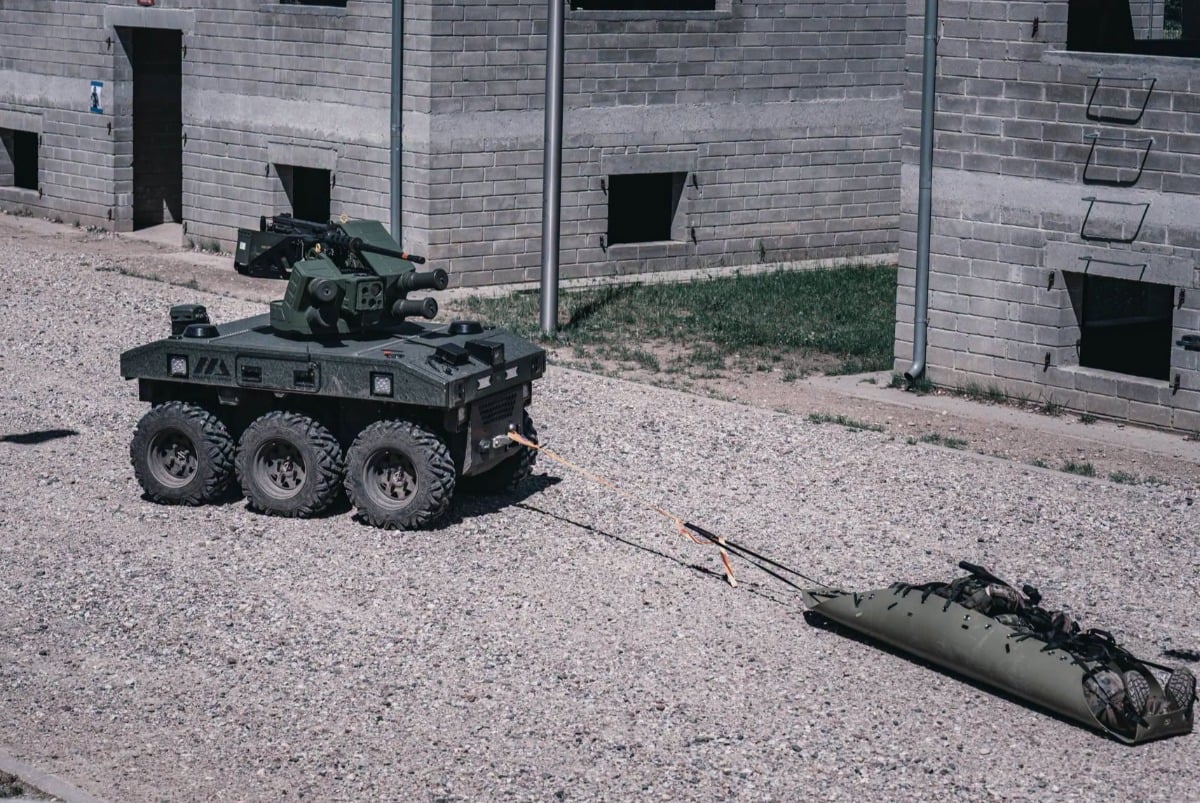
Poland isn't just buying foreign hardware to fortify its borders anymore. The country is putting its own autonomous, uncrewed armor directly onto the frontline. During the Gallant Boar 2026 exercises, Polish forces rolled out autonomous combat robots alongside conventional forces. They aren't futuristic toys; they're an aggressive response to a real-world nightmare scenario.
The target area is the Suwałki Gap. It's a narrow, 100-kilometer strip of land connecting Poland and Lithuania. To its northwest sits the heavily militarized Russian exclave of Kaliningrad; to its southeast lies Belarus, a staunch Moscow ally. If a conflict breaks out, this bottleneck is exactly where the pressure hits first. If Russia closes this gap, the Baltic states get entirely cut off from the rest of NATO.
That’s why the deployment of Polish unmanned ground vehicles (UGVs) like the Perun changes the equation entirely.
Trading silicon for blood in the bottleneck
Military planners worry about the Suwałki Gap for a simple reason: geography. It's a logistical choke point with limited heavy infrastructure, meaning a defensive force can easily find itself outflanked or overwhelmed by rapid armored thrusts. You can't just park a line of heavy tanks in an open field and hope for the best.
That is where autonomous platforms come in. During the Gallant Boar 2026 maneuvers, which brought together 6,500 Polish troops alongside Lithuanian and French forces, the primary focus shifted toward survivability and troop mobility in brutal terrain. The strategy relies heavily on a high-tech vanguard to handle the initial, most lethal contact.
Consider the Perun UGV, an autonomous wheeled machine developed by a Polish consortium including Zakłady Mechaniczne Tarnów and the Military University of Technology. Weighing in at 900 kilograms, this four-wheeled robotic platform acts as a scout, sentry, and heavy weapon platform rolled into one. It operates silently on electric power for up to 10 hours, carrying a payload that can make a main battle tank think twice.
Perun UGV Combat Specifications:
- Total Weight: 900 kg
- Power Supply: Electric (10+ hours operational time)
- Range: Up to 50 kilometers
- Core Armament: 7.62mm UKM 2000C or 12.7mm WKM-B heavy machine gun
- Anti-Tank Capability: Pirat Anti-Tank Guided Missile (ATGM) launcher
- Guidance Method: Semi-active laser tracking (Top-attack mode)
Instead of sending human scouts into a contested treeline where an artillery strike could wipe them out, commanders send a Perun. If the robot detects an enemy vehicle, it doesn't just report back. It can fire a Polish-Ukrainian Pirat anti-tank guided missile, which climbs high into the air and strikes targets from the upper hemisphere where armor is weakest. The missile hits targets up to 2.5 kilometers away in less than six seconds. If the robot gets destroyed, you lose steel and microchips, not human lives.
Deep integration over standalone novelties
The biggest mistake people make when thinking about military robotics is imagining an army of isolated terminators acting on their own. That's a fantasy. In real combat, an uncrewed platform is only as useful as the network it connects to.
Poland’s defense modernization isn't just about scattering a few remote-controlled guns in the woods. The uncrewed systems are tied tightly into the broader tactical network of the 16th Pomeranian Mechanized Division. During the latest exercises, these robots functioned as a collaborative layer underneath Poland’s heavy hitters, including newly acquired South Korean K2 Black Panther tanks and domestic Borsuk infantry fighting vehicles.
The workflow is straightforward but devastatingly effective:
- High-endurance aerial reconnaissance drones detect approaching hostile formations from miles away.
- The coordinates feed directly into the automated fire-control networks of Polish units.
- Hidden, silent UGVs parked along avenues of approach activate their laser target designators or open fire with heavy machine guns to disrupt the advance.
- As the enemy deploys to deal with the robotic threat, heavy artillery or K2 tanks finish the job from miles behind the frontline.
This approach turns a liability—the narrow, densely forested geography of the Suwałki Corridor—into a defensive asset. The dense terrain makes it incredibly easy to hide a one-meter-tall electric vehicle armed with anti-tank missiles. It forces an invading force to move slowly, clear every thicket, and bleed resources against an enemy that doesn't breathe.
Dealing with the electronic warfare threat
Let’s be realistic: autonomous weapons sound great until the enemy turns on heavy electronic warfare (EW) jamming. Russia’s capabilities in EW are well-documented, particularly out of the Kaliningrad region, where they routinely disrupt civilian GPS signals across the Baltic sea. If a robot loses its data link with its operator, it quickly becomes an expensive paperweight.
Polish engineers designed these platforms with that exact problem in mind. The systems aren't just remote-controlled cars relying on a basic radio frequency. They rely on an array of optical cameras, thermal imaging, and lidar sensors coupled with localized artificial intelligence.
If the jamming gets severe, the onboard AI handles basic navigation, pathfinding, and target tracking autonomously. The machine can navigate a preset patrol route, recognize human shapes or vehicular profiles, and maneuver through dense forest terrain without an active steering command from a human base station. While humans still retain command over the actual decision to fire a lethal weapon, the robot's physical survival and scouting capabilities don't depend on a fragile wireless connection.
Furthermore, Poland is actively pairing these ground platforms with unmanned scatterable mine-laying systems like the Bluszcz, which can be mounted onto heavy uncrewed chassis to rapidly seal off roads and clearings without putting engineers in danger.
What happens next on the eastern flank
The transition from testing prototypes to deploying functional combat robots in tactical drills means the era of experimental military robotics is over. On the modern battlefield, uncrewed platforms are standard kit.
If you are tracking the security environment along NATO's eastern frontier, the message out of the Gallant Boar exercises is clear. Mass matters, but intelligent, distributed mass matters more. Poland is building a defense architecture designed to make any attempt at seizing the Suwałki Gap far too costly to contemplate.
To stay ahead of these developments, your tactical next steps are to track the industrial scaling of these platforms. Watch the upcoming MSPO defense exhibition in Kielce and keep tabs on production contracts from Huta Stalowa Wola and Zakłady Mechaniczne Tarnów. The real test isn't whether a robot can work in an exercise—it's how fast the defense industrial base can build hundreds of them to line the border.