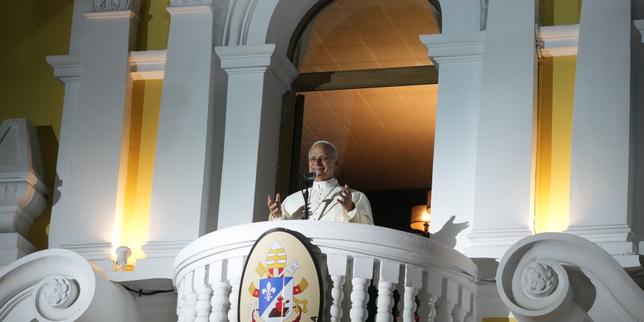
Landing back in a country where he spent decades as a missionary and bishop, Pope Leon XIV didn't mince words upon his return to Peru. Addressing political authorities and civil society leaders at the Grand National Theater in Lima, he openly declared, "I return... to my homeland." But behind the emotional homecoming lies a pointed political message. The pontiff, who received Peruvian citizenship back in 2015 following his years serving in Chiclayo, pushed the nation's leadership to confront past traumas with genuine integrity rather than sweeping them under the rug.
Navigating Deep Institutional Tensions
Peru's political reality is exhausting. Over the past decade, the country has burned through leadership at a dizzying pace, cycling through nine heads of state in ten years. Out of the last fourteen national leaders, six have faced prison time or house arrest. Meeting with President Keiko Fujimori at the Government Palace, Leon XIV stepped straight into this volatile landscape.
The legacy of Alberto Fujimori's 1990-2000 administration continues to polarize the population. Human rights violations from that era still fracture communities. Without directly naming specific historical flashpoints, the Pope urged the government to handle these sensitive historical events with both justice and emotional intelligence, prioritizing dialogue over lingering vengeance.
The Real Struggles of Everyday Peruvians
While international observers focus strictly on high-level political drama, everyday citizens face completely different pressures. Peru has experienced a sharp rise in organized crime and extortion, alongside the disruptive impacts of climate phenomena like El Niño. Homicides and extortion complaints have spiked dramatically over recent years, leaving families terrified in their own neighborhoods.
During his address, the pontiff hit on these exact pain points. He reminded authorities that ordinary citizens simply want the right to go to work without fear, protect their kids, and return home safely at night. He also drew attention to the exploitation of natural resources and the plight of vulnerable communities, particularly in regions like the Amazon and Cusco, where local populations bear the brunt of illegal mining and environmental degradation.
A Call for National Reconciliation
Reconciliation in Peru isn't just an abstract theological concept; it's a desperate operational necessity. The country's ongoing instability makes economic growth and youth employment harder to secure. By demanding honesty, institutional droiture, and a genuine disposition toward public meeting, Leon XIV challenged both the ruling class and the civil opposition to break the cycle of corruption and mistrust.
As his six-day apostolic journey continues across Chiclayo, Cusco, and Pucallpa, the stakes remain high. Millions of faithful have turned out to catch a glimpse of a religious leader who speaks their language and knows their streets. Whether the nation's fragile political institutions will actually heed his call for justice and sensitivity is another question entirely. The framework for healing has been laid out clearly. Now the execution depends entirely on Lima's leaders.