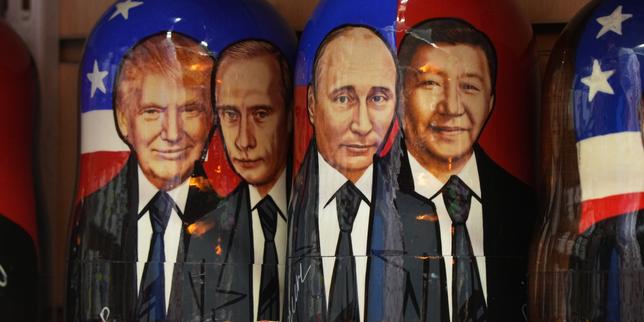
Diplomacy is moving behind closed doors faster than standard news cycles can track. Right now, Beijing confirms active diplomatic communications with both Washington and Moscow to arrange a high-stakes trilateral summit. The backdrop is the upcoming Asia-Pacific Economic Cooperation meeting scheduled for November 18 and 19 in Shenzhen, China. If this meeting materializes, it brings Vladimir Putin, Donald Trump, and Xi Jinping to the same negotiating table for the first time regarding the ongoing war in Ukraine.
You shouldn't expect immediate peace treaties from this setup, but ignoring the signals coming out of Beijing, Washington, and the Kremlin is a mistake. Let's break down what is actually happening behind the diplomatic posturing and why this potential three-way meeting changes the strategic calculus entirely.
Behind the Diplomatic Scramble for a Trilateral Meeting
The concept of a summit between the world's most influential heavyweights isn't born out of sudden altruism. It stems from shifting political realities and fatigue across major capitals. Moscow has made clear through official channels that preparations are underway, leveraging the diplomatic bridge provided by China's expanding role as a mediator and economic anchor for Russia.
When Russian Defense Minister Andrei Belousov met with senior Chinese military leadership in Beijing recently, both sides emphasized that their bilateral partnership has reached an unprecedented level. This close alignment gives Beijing significant leverage. China isn't just watching the conflict from the sidelines; it is actively positioning itself as an indispensable power broker capable of bringing Washington and Moscow into the same room.
Donald Trump has repeatedly voiced a desire to see the conflict in Ukraine draw to a close quickly, maintaining an open stance toward direct talks. Meanwhile, US Secretary of State Marco Rubio has remained measured, noting that while final logistics and absolute certainties are still being ironed out, the overarching goal from the White House hasn't changed.
What Kiev and Europe Fear Most
Whenever great powers start discussing regional conflicts over the heads of local actors, alarm bells ring in European capitals and, most acutely, in Kiev. Past history shows that major powers carving out spheres of influence rarely prioritize the sovereign interests of smaller nations.
Ukrainian leadership maintains a firm red line: any final arrangement or settlement that moves forward without direct participation from Kiev representatives ready to assume responsibility is fundamentally unworkable. Ukraine relies heavily on Western intelligence sharing, anti-air defense systems like US-built Patriots, and continuous material support to counter ongoing Russian aerial campaigns.
If Washington and Moscow bypass European security frameworks to cut a deal mediated by Beijing, the entire security architecture of the continent could fracture. European leaders are scrambling to ensure they aren't sidelined as the contours of a post-war reality are sketched out in Shenzhen.
Why Beijing Wants to Play Peacemaker
Pekin's calculus involves much more than altruistic diplomacy. By acting as the host and central facilitator for a summit between Trump and Putin, China projects global leadership and stability. It contrasts sharply with an unstable and polarized West.
Furthermore, trade and sanctions pressures have forced Russia into a deep economic dependence on Chinese markets. By steering the conversation toward a negotiated outcome, Beijing can cement its status as the ultimate arbiter of Eurasian security. At the same time, it protects its own economic lanes from secondary Western sanctions.
The real question is whether Trump is willing to grant Beijing this diplomatic victory in exchange for a tangible, rapid de-escalation in Eastern Europe. Trump has always favored direct personal diplomacy with authoritarian leaders over multilateral institutional processes, making the Shenzhen summit an ideal venue for his preferred style of deal-making.
Anticipating the Fallout
If these three leaders share a stage later this month, expect grand declarations followed by intense, gritty behind-the-scenes bargaining. Even if formal peace agreements are out of reach, setting up a permanent channel of communication between the US, Russia, and China fundamentally alters how international crises are managed.
Keep an eye on how quickly European capitals respond to these preliminary announcements. The next few weeks will determine whether this trilateral push becomes a breakthrough moment or another false start in a devastating war.