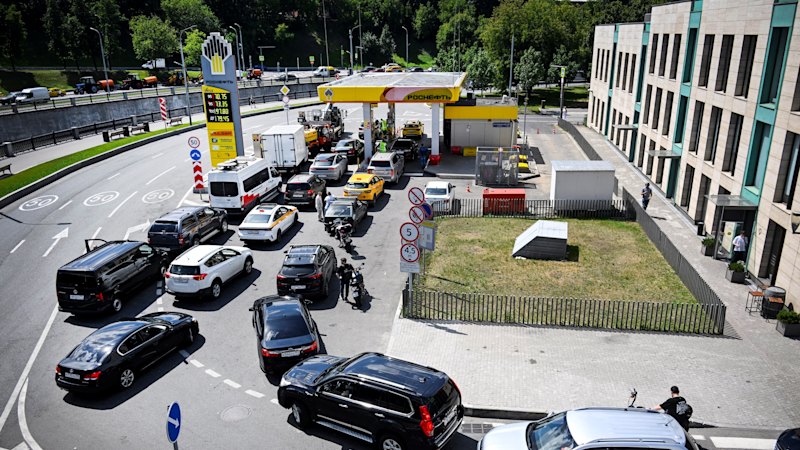
Imagine pulling into a petrol station late at night, only to find yourself trapped in a line of cars stretching down the highway for miles. You aren't going anywhere. You shut off the engine, roll down the windows, and prepare to spend the next 18 hours watching the sun rise and set from your driver's seat.
This isn't a hypothetical scenario. It's the current reality for motorists across Russia. You might also find this similar article interesting: Why The India Indonesia Strategic Partnership Still Matters In 2026.
Alyona Sadovnikova, a 26-year-old social media worker from the Siberian city of Irkutsk, lived through this exact nightmare. She joined a fuel line with her husband and their 18-month-old baby at 11 p.m. They didn't get served until 5 p.m. the next day. The shock wasn't just the grueling wait. It was the realization that Russia, the world's third-largest oil producer, can no longer guarantee fuel for its own citizens.
The illusion of a normal life away from the frontlines is shattering. People are genuinely panicking, sharing crowdsourced maps to find working pumps, and getting into physical fights over remaining supplies. As discussed in detailed articles by Wikipedia, the results are widespread.
If you're trying to make sense of how a global energy superpower ends up rationing fuel by QR codes and coupons, the answer comes down to a highly targeted, relentless campaign happening thousands of miles away from Siberia.
The Numbers Behind the Shortage
You can't understand the scale of this crisis without looking at what happened to Russia's domestic oil refineries over the last few months.
According to data from the Ukrainian General Staff and independent energy analysts, a massive wave of long-range drone strikes has systematically disabled roughly 42% of Russia's total oil refining capacity as of early July 2026. This isn't a minor setback. It's a structural disaster.
- Production Drop: Daily refined oil output fell sharply through spring. By the time mid-June hits, the structural daily shortfall reached approximately 25,000 tonnes of petrol.
- The Supply Gap: Operating facilities are managing to churn out around 85,000 tonnes a day, but peak summer demand sits at 110,000 tonnes.
- Targeted Giants: Eight of Russia’s ten largest refineries have sustained heavy damage. The three critical plants that feed Moscow via direct pipeline—Yaroslavl, Ryazan, and Kstovo—have all been knocked offline or severely crippled.
The most damning blow happened right in the capital’s backyard. Ukraine targeted Moscow’s Kapotnya refinery twice in mid-June, completely shutting down the facility until at least the end of the year. Kapotnya was supposed to be protected by the densest air defense networks in the country. The fact that cheap, long-range drones easily penetrated that shield sent a clear signal to the Kremlin: no energy asset inside Russian borders is safe anymore.
Why an Energy Superpower Is Forced to Import Gasoline
It sounds backward. How does a country that pumps roughly nine million barrels of crude oil every single day run out of petrol at the pump?
The problem is that crude oil straight from the ground doesn't run a Lada or a delivery truck. It has to be cracked, treated, and refined into gasoline and diesel. Russia has plenty of raw crude, but its ability to turn that crude into usable fuel has been broken.
To keep things from descending into complete chaos, Moscow is taking desperate measures they haven't used in decades. They are actively trying to import gasoline from anyone willing to sell it.
Contracts are being negotiated with Kazakhstan and Belarus, though their smaller refineries at Mozyr and Novopolotsk simply lack the capacity to fill a 25,000-tonne daily deficit. The Kremlin is even trying to arrange complex, reverse-logistics deals with India. The plan involves shipping Russian crude to Indian refiners, who then process it and ship the finished petrol back across the ocean to Russian ports. It's expensive, highly inefficient, and logistically fragile.
To make matters worse for the average driver, the government recently amended the tax code to subsidize these emergency imports, draining state finances that are already stretched to the limit by military spending.
Lowering Standards Just to Keep Cars Moving
If you live in one of the 55 Russian regions currently reporting severe supply issues, the fuel you actually manage to buy isn't what it used to be.
Behind closed doors, the Kremlin quietly loosened environmental and quality regulations to keep the country moving. Refineries are now legally allowed to distribute lower-grade, 1990s-standard fuel. They're literally slapping a modern "Euro-5" label onto what is actually dirty "Euro-3" petrol, which contains up to 15 times the legally permitted sulfur content.
If you drive a modern car, burning this low-grade fuel over several weeks risks destroying your catalytic converter and fouling your fuel injectors. But Russian motorists don't have the luxury of choice. You either pump the dirty gasoline or you don't drive at all.
In regions like Crimea, the situation is even more extreme. Local authorities declared a state of emergency, effectively banning civilian fuel sales to preserve remaining stocks for military logistics and essential services. The move immediately killed the regional summer tourism industry, leaving empty beaches and abandoned resorts.
The Real Economic Toll at Home
This crisis isn't just about long lines and angry drivers. It is actively driving up the cost of living for everyone, whether they own a car or not.
The Bank of Russia explicitly warned that skyrocketing petrol prices are now the biggest threat to controlling domestic inflation. By the end of June 2026, inflation climbed to 6%, soaring past the central bank’s official 4% target.
When fuel prices jump 10% in a matter of weeks, that cost gets added to everything else. Groceries, consumer goods, and public transit fares are all ticking upward because the trucks distributing them are paying double or triple for fuel on the black market.
An alternative fuel economy has exploded across Telegram channels. Speculators buy up ration coupons or use insider connections at state-run stations to hoard petrol, then flip it to desperate commuters at massive markups.
What the Kremlin Gets Wrong About the Air War
President Vladimir Putin publicly downplayed the shortages, calling the situation "not critical." State media figures have even tried to claim the lines are artificial, blaming "hostile online channels" for creating panic and suggesting the best fix is to block citizen access to VPNs.
In Irkutsk, where Alyona Sadovnikova waited 18 hours, local officials took a more pragmatic—and depressing—approach. Recognizing that the miles-long lines weren't going away anytime soon, they promised to install portable chemical toilets along the main roads so drivers wouldn't have to abandon their spots to find a bathroom.
This highlights a fundamental strategic miscalculation by Moscow. The Kremlin assumed time was on its side, believing they could outlast Western sanctions and Ukrainian resistance. Instead, they gave Ukraine the time it needed to build a massive, domestic drone industry capable of launching dozens of coordinated deep strikes every week.
According to data from Rochan Consulting, a Polish analytical group, Russian refineries were hit at least 194 times in the first half of 2026 alone. That is an 11-fold increase compared to the same period last year. Russia's defense ministry claims it intercepts the vast majority of these attacks, but the math doesn't work in their favor. When Ukraine launches hundreds of cheap drones simultaneously, it only takes one or two getting through to ignite a multi-million-dollar distillation column that takes six months to replace.
Your Practical Next Steps If You Trace Global Energy Markets
If you're an investor, an energy analyst, or simply someone trying to track how this crisis alters global economics, don't rely on official Russian statistics. The Kremlin completely classified crude oil production data in 2023 and petroleum product data in 2024. Rosstat just announced it will stop publishing regional retail petrol prices entirely.
To see what's actually happening on the ground, you need to look at alternative indicators.
First, track the volume of refined product shipments coming out of Belarus and India. Spikes in these specific trade routes will tell you exactly how desperate Moscow is getting for finished fuel.
Second, monitor corporate announcements from major Russian agricultural and logistics firms. While the state guarantees fuel priority for the military and farms, independent transport companies are getting squeezed out. If regional supply chains start breaking down, it will show up first in delayed agricultural shipments and rising food commodity prices across Eastern Europe.
The fuel crisis inside Russia isn't an accidental side effect of the war. It's a calculated, structural bottleneck that is successfully draining the Kremlin's domestic stability and financial reserves. Unless Russia can suddenly find a way to mass-produce advanced anti-drone systems for hundreds of civilian facilities, those 18-hour lines are only going to get longer.