For more than four decades, the world's most famous twisted puzzle has been manufactured far away from its birthplace. That era is officially over.
Production of the Rubik's Cube has returned to Hungary.
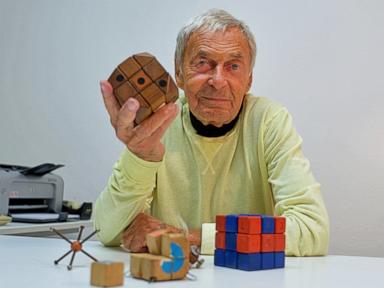
If you grew up twisting colored squares until your thumbs hurt, you probably never wondered where the physical plastic pieces were actually cast. For most of us, the puzzle was just a ubiquitous object, a plastic box of geometric frustration sitting in a junk drawer or solved in under three seconds by a teenager on TikTok. But to Ernő Rubik, the architecture professor who built the first clumsy wooden prototype in 1974, the object has always been something much more profound. It is a transformable sculpture. It is an intersection of art and mathematics. And now, it is once again being built right where it started.
Inside the New Hungarian Production Line
In the industrial city of Jászberény, a state-of-the-art, fully automated manufacturing line just went live at the Jász-Plasztik Kft. plant.
This isn't a nostalgic nod to old-school manufacturing methods. The new facility relies on advanced robotics to assemble the miniature plastic cubies, test their mechanical durability, and ensure that every turn feels crisp right out of the box. The facility aims to churn out roughly one million cubes annually.
Local manufacturing of the Magic Cube, as it was originally known, ground to a halt in Hungary back in the early 1980s. After the toy exploded into an unexpected global phenomenon—selling millions of units and capturing the cultural zeitgeist during the Cold War—production shifted overseas to meet staggering international demand. For forty years, the physical roots of the invention were detached from its geographic origin. Bringing the assembly lines back to Jászberény feels less like a corporate supply chain adjustment and more like a homecoming.
How a Classroom Teaching Aid Conquered the World
It is easy to forget how accidental the success of the Rubik's Cube really was. Ernő Rubik didn't set out to build a global toy empire. He was an architecture professor trying to explain three-dimensional geometry to his students in Budapest.
He needed a mechanism that could move independently without falling apart. When he built that initial wooden block held together by rubber bands and internal axes, he spent weeks trying to solve his own creation after scrambling it the first time. He worried it might be permanently broken.
When the puzzle finally launched internationally as the Rubik's Cube in 1980, experts doubted it would survive. Industry skeptics argued the toy was too complex, assuming everyday consumers wouldn't buy a puzzle they couldn't solve. They missed the mark entirely. Over half a billion cubes have been sold worldwide since, making it the bestselling puzzle game in history.
Speedcubing and the Modern Cultural Revival
The obsession never really died; it simply evolved. While casual owners still peel off the stickers in desperation, a hardcore global subculture has turned solving the puzzle into an extreme sport known as speedcubing.
Competitions governed by the World Cube Association draw thousands of participants. Human ingenuity keeps pushing boundaries downward. Just last month, a nine-year-old competitor named Xuanyi Geng set a fresh world record by solving a standard 3x3 cube in a blistering 2.51 seconds.
Yet, Ernő Rubik looks at these robotic-speed fingertip sprints with a philosopher's eye. Now 82 years old, he has noted that speed is only one facet of the cube's appeal. For him, the true value lies in the creative act, the mental journey, and the tactile satisfaction of bringing order out of chaos.
What This Means for the Future of the Iconic Toy
With toy giant Spin Master now holding the brand rights and partnering with high-tech European manufacturers, the Rubik's Cube is navigating a modern identity. Newer versions lean into sustainability, including editions forged entirely from recycled plastics and recycling initiatives designed to keep plastic waste out of landfills.
Yet, the physical craft remains anchored to its core simplicity. No screens, no batteries, just six faces and fifty-four colored squares.
The very first cube off the new automated line in Jászberény isn't heading to a retail shelf. It's being auctioned off for charity to benefit a local hospital, sealing a circle that began over fifty years ago in a Budapest apartment.
The puzzle is home. Now go find your old one and see if you can still solve the white cross.