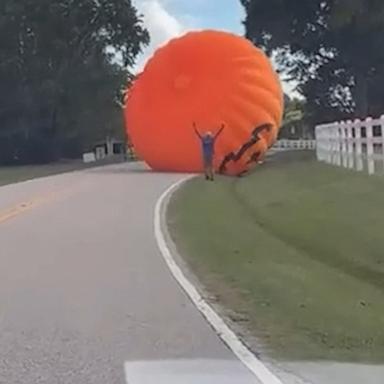
You have probably seen the viral footage by now. A two-story-high orange jack-o'-lantern breaks free from its moorings at Phillips Farms in Cary, North Carolina, and goes rolling down the road like a runaway boulder. It looks like a scene straight out of a cartoon. Naturally, people started posting it online with captions invoking Linus waiting in the patch for the Great Pumpkin.
When sudden 35 to 40 mile-per-hour wind gusts hit the area—following a nearby twister touchdown just a quarter-mile away—farm owner Michael Phillips and his team watched their massive holiday display catch air. The pumpkin tumbled past a post-and-rail fence, rolled past a local church, and gave morning commuters a sight they definitely didn't expect on their drive.
Behind the viral laughs and internet memes, however, is a very real operational headache that commercial farms and homeowners face every autumn. Giant inflatables look festive, but they act like high-powered sails in unexpected weather. If you've ever tried to anchor a massive nylon structure during a storm front, you know that standard plastic stakes and flimsy tether lines are completely useless.
The Physics of Runaway Holiday Inflatables
Inflatables rely on constant internal air pressure combined with exterior anchoring to stay put. When Mother Nature steps in with severe wind gusts, the physics change instantly. A two-story fabric structure catches an enormous amount of drag. If the ground is softened by rain—which frequently accompanies the severe weather systems passing through October—stakes simply pull right out of the soil.
Once an anchor point fails, the internal blower fans can only do so much. In the Cary incident, farm workers managed to corral the escaped squash in about a minute, ensuring no one got hurt and traffic wasn't seriously disrupted. But the event serves as a stark reminder of what happens when autumn storm cells catch outdoor event operators off guard.
How to Actually Anchor a Giant Yard Display
If you are putting up large holiday decorations, you cannot rely on the basic gear that comes in the box. Those thin metal stakes bend the moment the wind kicks up.
Phillips and his team learned this lesson the hard time, but they upgraded their setup immediately. To keep the wayward squash from taking another flight, they locked it down using a heavy-duty combination of paracord, baling twine, and corkscrew spikes, tying the entire framework off directly to two farm tractors. As Phillips put it, unless the tractors decide to fly away, that pumpkin isn't going anywhere.
If you don't have a couple of tractors lying around your backyard, you still have solid options for heavy-duty wind mitigation:
- Use Spiral Ground Anchors: Swap standard straight stakes for steel corkscrew anchors that twist deep into the earth and resist upward pull.
- Distribute the Load: Never tie all your tension lines to a single point on the inflatable. Spread the load across multiple reinforced loops using climbing-grade webbing or heavy nylon straps.
- Monitor the Weather Locally: Don't wait for gusts to start tossing your display. If local meteorologists call for high wind warnings, deflate the decoration proactively. Leaving a blower running into a gale is asking for trouble.
The Silver Lining of Viral Chaos
While chasing a runaway inflatable down a public road isn't on anyone's checklist for a fun Sunday morning, it turned out to be an accidental marketing masterclass. Phillips noted that the videos generated a massive online reaction, leaving him with dozens of daily notifications and millions of amused viewers sharing the clips across social media platforms.
People love a bit of harmless, quirky chaos, especially when it involves classic seasonal nostalgia. Linus van Pelt might still be waiting for his mythical gourd, but North Carolina's runaway pumpkin proved that reality can be just as entertaining as fiction.
Next time you see a massive holiday display inflating on a breezy October afternoon, spare a thought for the anchors holding it down. Better yet, check the wind speed before you plug in the fan.


