Sending an advanced multi-million dollar attack helicopter to hunt down a fiberglass drone packed with lawnmower parts sounds like an absolute logistical nightmare. Yet, that's exactly what the Russian Air Force is doing.
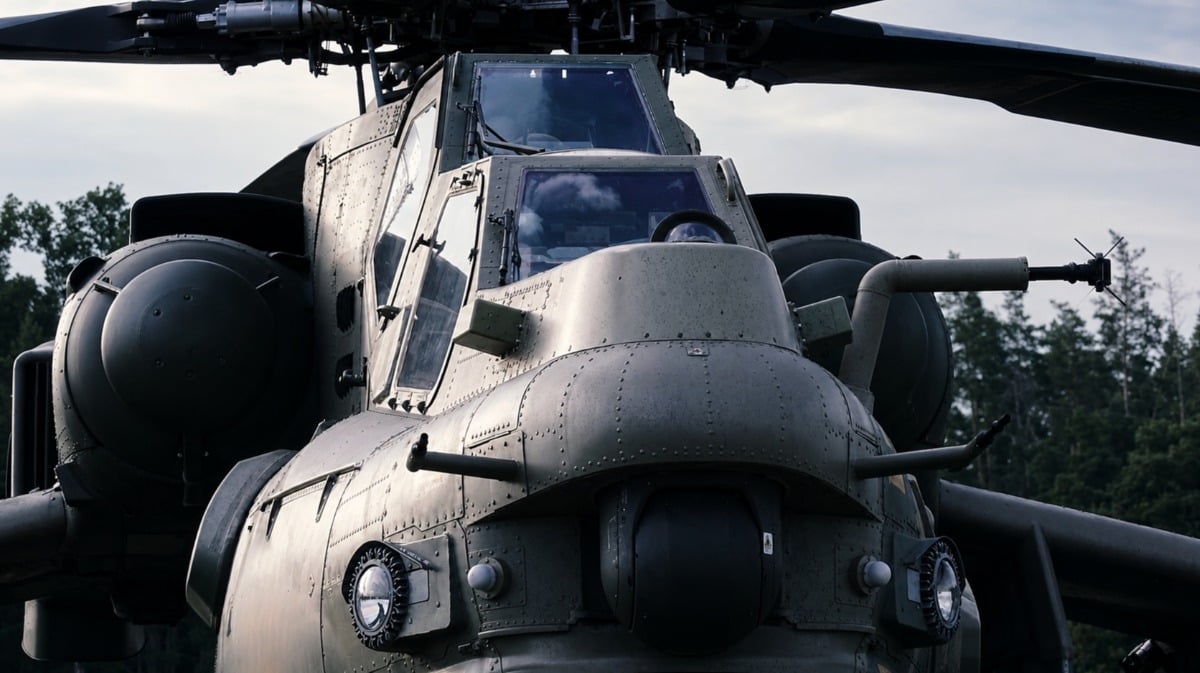
Faced with relentless Ukrainian long-range drone strikes hitting targets deep inside its borders, Moscow had to pivot fast. Traditional ground-based air defenses like the Pantsir or S-400 are struggling to manage the sheer volume of low-flying, slow-moving targets. To patch the holes, Russia turned to its heavily armored Mil Mi-28NM "Super Hunter" attack helicopter, converting a platform built to destroy main battle tanks into a specialized drone interceptor. For another perspective, read: this related article.
The desperate geometry of anti-drone warfare
Modern air defense systems aren't designed to hit plastic objects cruising at 120 miles per hour just above the tree line. Ground-based radar networks frequently lose these small profiles in terrain clutter. When a radar system actually catches one, firing an anti-aircraft missile worth half a million dollars to destroy an improvised kamikaze drone is a financial losing strategy. Further reporting on this matter has been shared by USA.gov.
That's where the Mi-28NM enters the frame.
Russian commanders realized that helicopters can fly at the exact same altitudes as these incoming strike drones. By establishing dedicated patrol fields, like the newly refitted aerodrome in Orel near Moscow, Russian pilots are acting as mobile, airborne gun platforms. They chase down slow targets on a vector that ground units simply can't match.
Weapons of choice for the new aerial guard
Hunting a small, cold-running drone requires precision over raw explosive power. The Mi-28NM brings two primary tools to this fight.
The 30mm Shipunov autocannon
The centerpiece of the helicopter's anti-drone toolkit is the chin-mounted NPPU-28 turret. It holds a 30mm Shipunov 2A42 automatic cannon, which works in a synchronized loop with the crew's main optical sighting systems.
- Range: Effective up to 2,500 meters against airborne targets.
- Flexibility: The turret moves 110 degrees to either side, swinging 13 degrees up and 40 degrees down.
- Ammunition: Loaded with 250 rounds, alternating between high-explosive incendiary and armor-piercing shells.
Because the gun follows the crosshairs of the crew's target designator, hitting a slow-moving drone traveling under 200 kilometers per hour becomes a straightforward target practice exercise for an experienced pilot.
The Strelets launch system
When the autocannon isn't enough, or the target is moving too erratically, pilots rely on the Strelets system. This wing-mounted configuration fires Igla-S short-range anti-aircraft missiles. These heat-seeking munitions lock onto the tiny thermal signatures generated by the internal combustion engines found on long-range drones.
Networked links and kamikaze controls
Russia didn't just tell its pilots to look out the window. The newest Mi-28NM variants feature structural redesigns focused entirely on data management and electronic warfare.
The nose section includes a dedicated interface module designed to talk directly with reconnaissance drones like the Korsar or Forpost-R. Instead of burning fuel searching blindly, the helicopter receives real-time coordinate updates from forward surveillance assets through automated command networks.
Engineers at the Mil and Kamov National Helicopter Center have even experimented with deploying small kamikaze drones directly from the helicopter's underwing hardpoints. The helicopter crew flies outside the danger zone, launches a loitering munition, and guides it directly into the path of an enemy threat.
Real risks behind the tactical pivot
While Russian state media frames this as a brilliant triumph of engineering, the reality is far more complicated. Using an attack helicopter as a border guard exposes glaring gaps in static air defenses.
Helicopter frames age fast under constant patrol wear. Vibrations from the twin Klimov VK-2500P turboshaft engines stress the airframe during prolonged flight times. Every hour spent idling on an apron or scanning the horizon for cheap foam drones steals precious lifespan from parts that are increasingly difficult for Moscow to replace under global trade sanctions.
It is a high-stakes compromise. Russia is burning through its most advanced rotary-wing assets to preserve critical infrastructure on the ground, trading flight hours for domestic security.
Active next steps for defense tracking
To evaluate how these tactics are altering regional air dynamics, keep a close watch on these key operational signals.
- Monitor satellite imagery changes around regional Russian airfields like Orel and Kursk to see if forward-deployed helicopter counts are expanding.
- Track Ukrainian strike reports to observe whether drone flight profiles are dropping even lower to exploit the blind spots of patrolling crews.
- Watch export marketing adjustments for the civilian-grade Mi-28NME variant in Southeast Asia, where Russia is pitching the platform primarily as a counter-UAV tool rather than a tank hunter.