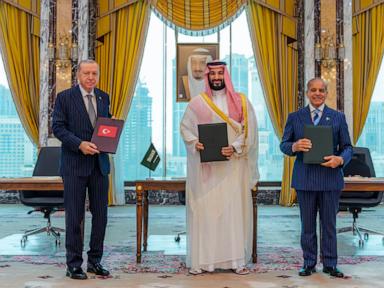
Three major powers just redrew the security map of the Middle East and South Asia. In the holy city of Mecca, Saudi Crown Prince Mohammed bin Salman, Turkish President Recep Tayyip Erdogan, and Pakistani Prime Minister Shehbaz Sharif signed the Mecca Joint Defense Agreement.
The core clause is simple and heavy: an armed attack on any of the three nations is treated as an attack on all of them. It is a classic collective-defense commitment. Naturally, official channels in Ankara and Riyadh are insisting the treaty is purely defensive and not directed at neighboring Iran.
Nobody in international politics believes that part. But the real story is much bigger than Tehran.
What the Mecca Agreement Actually Says
The wording of the pact borrows heavily from cold war deterrence logic. Saudi Arabia brings deep financial backing and critical energy infrastructure. Turkey offers NATO's second-largest standing army, advanced drone technology, and a surging defense manufacturing sector. Pakistan contributes a battle-hardened military and the Muslim world's only operational nuclear deterrent.
This is not a traditional treaty. It lacks the permanent joint command structure and integrated institutional bureaucracy that define NATO. Instead, it is a high-level political alignment. It formalizes a strategic triangle that has been developing behind closed doors for months.
Saudi Arabia felt vulnerable. Years of drone and missile strikes targeting oil facilities, combined with erratic shifts in American security guarantees, left Riyadh searching for self-reliance. By expanding on a bilateral defense framework signed with Pakistan last September and bringing Turkey into the fold, Saudi leadership is diversifying its insurance policy.
The Tehran Factor and the Denials
Ankara's insistence that the pact is not aimed at Iran is diplomatic theater. Both Turkey and Pakistan maintain complex economic and political relationships with Iran and want to avoid a direct border conflict. They do not want to become active combatants in proxy fights stretching from Yemen to the Strait of Hormuz.
Yet, the geopolitical gravity of the pact points squarely at containing Iranian influence. Gulf states have faced continuous pressure from regional militias and Houthi threats to vital shipping lanes like the Bab al-Mandeb. When Saudi Arabia participates in coalition strikes or builds Red Sea maritime security coalitions, it needs heavy diplomatic and military weight behind it.
This pact provides that weight. It signals to Tehran that pushing too hard against Riyadh now carries the risk of a broader response involving Turkish air power and Pakistani strategic capabilities.
Why This Changes Regional Dynamics
For decades, Gulf security relied almost entirely on Washington. That model is breaking down. Washington wants regional allies to share the security burden, and this alliance is the ultimate expression of that shift.
Israel is watching closely too. Turkey is the only member of this new trilateral group that formally recognizes the Israeli government, and relations between Ankara and Jerusalem have grown tense over regional conflicts. A hardline Sunni security bloc changes the calculus for every capital from Tel Aviv to Tehran.
Can these three nations actually deliver on a mutual defense promise if a crisis explodes? That remains untested. Past regional organizations like the Gulf Cooperation Council often struggled to present a unified military front against shared threats. Economic incentives for Turkey and Pakistan, paired with Saudi capital investments, create strong glue, but battlefield coordination is an entirely different challenge.
Watch how these countries conduct joint military exercises over the next twelve months. Pay attention to whether naval assets from Turkey deploy to Red Sea ports. That will tell you whether this is real deterrence or just expensive paper.