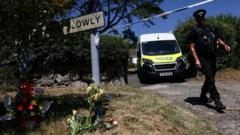
The concept of absolute rural safety is a myth we like to tell ourselves. We buy into the idea that a village tucked inside Dartmoor National Park, surrounded by granite outcrops and rolling hills, is entirely insulated from the brutality of the modern world. Then something happens that shatters the illusion completely.
The violent death of former MP Ann Widdecombe at her home in Haytor Vale has done exactly that. When police sirens echoed through the moorland on Thursday morning, locals assumed a hiker had taken a tumble or a car had swerved off a narrow lane. Nobody expected a murder investigation. The 78-year-old political figure was found dead with serious injuries inside her 1970s bungalow, "Widdecombe's Rest."
It's a brutal reality check for a community where people famously leave their ground-floor windows open for days during a heatwave and never bother locking their front doors.
The Illusion of the Dartmoor Safe Haven
Haytor Vale is tiny. We're talking about a cluster of roughly 25 well-maintained, mostly detached houses. It's the kind of place where everyone recognizes your face and neighbors chat with total strangers as a matter of course. For decades, it represented the ultimate escape from the hyper-vigilance of urban life.
When prominent figures retire to places like this, they're looking for peace. Widdecombe moved here to get away from the political grind of Westminster and the media circus of her later celebrity life. She wanted to set herself up for the rest of her days in total tranquillity. Instead, Devon and Cornwall Police are now treating her home as a major crime scene.
The psychological impact on a small village like this can't be understated. It changes how you look at a quiet lane. It makes you double-check the lock on a door you haven't locked in ten years. The immediate assumption in rural areas is always that danger comes from the outside, but the sudden disruption of peace leaves a community feeling exposed and deeply vulnerable.
Inside the Rapidly Shifting Investigation
The timeline of the investigation has already taken several sharp turns, keeping the local community on edge.
- Thursday, July 9, 11:40 AM: Ambulance crews arrive at the property in Haytor Vale and discover Widdecombe's body. Police are immediately called to the scene.
- Friday, July 10: Detectives officially launch a murder inquiry. Later that afternoon, armed police arrest a 26-year-old white British man in Newton Abbot, less than 10 miles away.
- Saturday, July 11: In a sudden development, police release the 26-year-old man from custody, stating he is no longer part of the investigation.
Assistant Chief Constable Matt Longman revealed a chilling update. Police now believe the attack actually took place around 12:30 PM on Wednesday, July 8. That means she lay undiscovered in her home for nearly 24 hours.
The authorities have actively looked into several angles. They consulted with counter-terrorism officers early on but have officially ruled out any terrorist motive. They also state they are open-minded but don't currently believe the killing was politically motivated. Instead, the hunt continues for a suspect described simply as a white male.
What Rural Communities Need to Face Right Now
If you live in an isolated village, you've probably fallen into the habit of situational complacency. It's easy to do. You think the natural geography of the moors acts as a shield. But high-profile tragedies in remote areas show that isolation can just as easily mean vulnerability.
We often rely on the social fabric of a village for security—the idea that "someone would notice if a stranger was walking around." But when an attack happens behind closed doors, during the middle of a quiet weekday, that social fabric isn't enough.
The investigation has seen officers searching rural lanes near the Moorland Hotel, combing through ditches and fields. Detective Chief Inspector Ilona Rosson has made an urgent appeal for anyone with doorbell cameras, dashcam footage, or CCTV in the vicinity of Haytor Vale to come forward. In 2026, even the most traditional country villages have to rely on digital footprints to solve horrific crimes.
Practical Security Steps for Isolated Properties
You shouldn't panic, but you absolutely should audit your security if you live in a remote area. Hoping for the best isn't a strategy anymore.
Secure the Perimeter Digitally
Don't rely on the fact that your house is hidden from the main road. If anything, that gives an intruder cover. Install high-definition smart cameras at the entry points of your property. Ensure they have cloud storage backup so the footage can't be destroyed on-site.
Rethink Daytime Security
Most people lock up at night but leave everything wide open during the day. As this case shows, horrific incidents can happen in broad daylight. Get into the habit of locking side gates and back doors even when you're at home.
Establish a Daily Check-In System
If you live alone or have elderly relatives living in isolated areas, set up a strict daily contact routine. A simple text message or a quick phone call every morning and evening ensures that if something goes wrong, the alarm is raised within hours, not days.



.jpg)