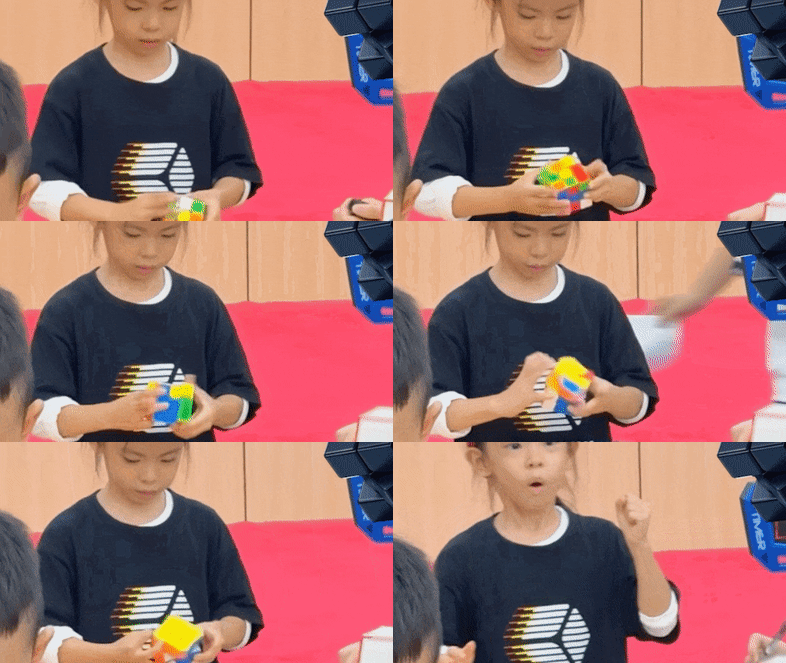
Most adults struggle to solve a standard Rubik's Cube in under five minutes, let alone five seconds. Yet six-year-old Lian Yunzhi from Chengdu, China, just shattered the women's world record for the 3x3x3 Rubik's Cube by averaging an astonishing 4.27 seconds per solve. If you think speedcubing is just a quirky childhood hobby, think again. It is a grueling mental sport that requires intense spatial awareness, lightning-fast reflexes, and thousands of hours of pattern recognition.
Yunzhi didn't just break a record once; she smashed the milestone twice in three days across competitions in Wuhan and Guangzhou. Her performance dropped her average down to 4.27 seconds, making her the only female speedcuber globally to slip under the 4.5-second average threshold.
The Numbers Behind A Record Breaking Solve
How fast is 4.27 seconds? Honestly, it's hard for the human eye to track. When you watch elite speedcubers, their fingers blur across the plastic faces. They aren't thinking about individual turns. They are executing muscle memory built through thousands of repetitions.
According to World Cube Association data, Yunzhi has already participated in 33 official competitions and logged 569 official solves. Her personal single-solve best for a 3x3x3 cube sits at a blistering 3.54 seconds, while her 2x2x2 single solve drops down to 2.15 seconds.
To reach this level, the young prodigy spent the past year practicing two to three hours every single day. She has memorized more than 1,300 cube algorithms. That is an intellectual workload that would overwhelm most high school students, mastered by a child who barely knows how to tie her own shoes.
Breaking Previous Records
The previous benchmark belonged to Qixian Cao, another young prodigy who set a 5.97-second average back in 2023 at age six, before improving to a 4.98-second average earlier in 2026. The rapid succession of younger and faster record-breakers highlights how the sport of speedcubing is evolving. Modern training methods, video sharing, and accessible local competitions mean today's kids are learning advanced CFOP (Fridrich method) techniques years earlier than previous generations.
Her mother, Lin Yangxi, initially enrolled Yunzhi in standard extracurricular classes like music and dance. But once she noticed her daughter's affinity for the puzzle, they shifted focus. Lin notes that the cube is much more than a toy. It builds focus, sharpens memory, and teaches emotional regulation regarding winning and losing.
What Speedcubing Teaches Us About Cognitive Growth
People assume prodigies are born with magic brains. The truth is far more mundane and much harder work. Yunzhi's success is built on deliberate practice.
When you break down what happens during a sub-five-second solve, the cognitive load is immense:
- Inspection Phase: The cuber gets 15 seconds to look at the scrambled puzzle and plan their first several moves blind.
- Cross and F2L: They solve the bottom cross and first two layers simultaneously using advanced lookahead techniques.
- Last Layer: They execute rapid algorithmic triggers to orient and permute the final pieces without looking back.
It's basically a high-speed logic puzzle executed under extreme adrenaline. You can't fake it with raw talent alone. If you stutter for a fraction of a second, your average is ruined.
How To Start Speedcubing Today
If watching a six-year-old dominate international competitions inspires you to pick up a cube, don't start by trying to break records. Most beginners make the mistake of buying a cheap, stiff toy from a grocery store checkout aisle. Get a modern, adjustable speedcube with magnetic positioning—brands like MoYu or Gan dominate the market for a reason.
Learn the layer-by-layer method first. Ignore the complex 1,300 algorithms Yunzhi uses. Master the basics, build finger dexterity, and accept that your first solves will take minutes, not seconds. Speed comes later. Consistency comes first.