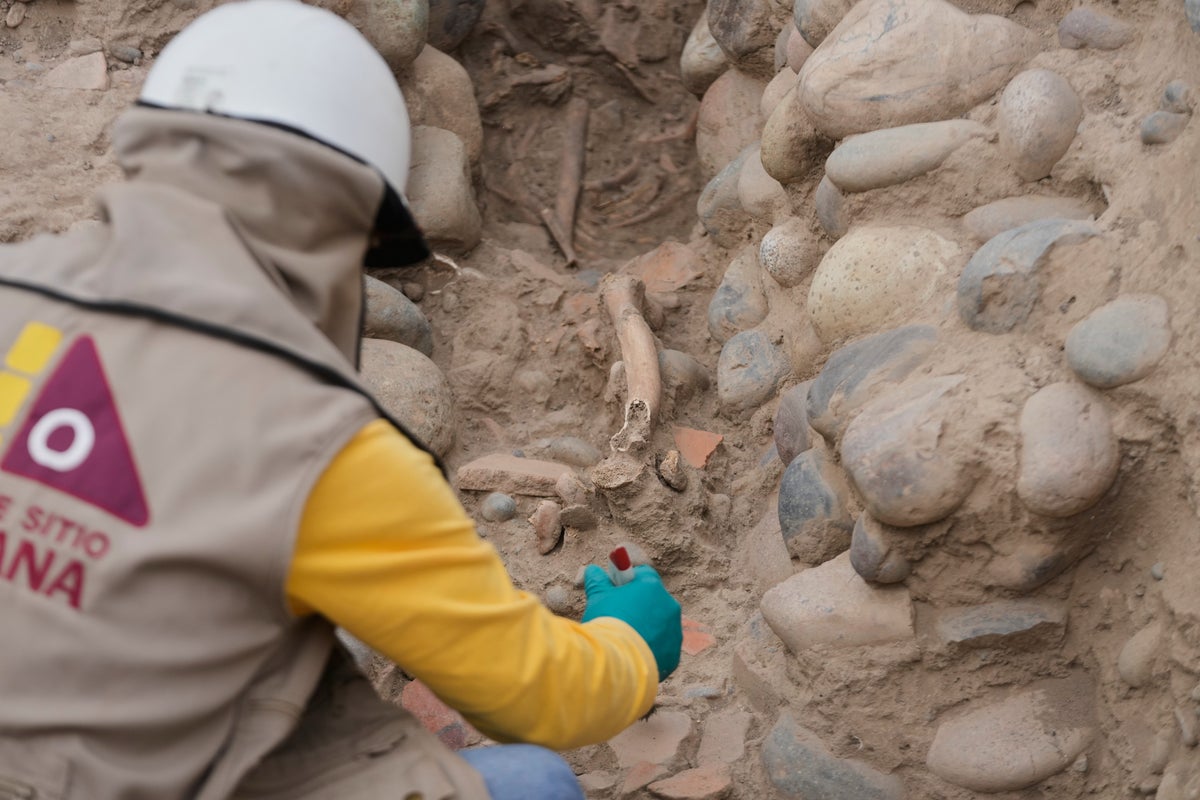
Archaeology often feels like a slow, dusty pursuit. We imagine quiet researchers brushing dirt off potsherds. But every now and then, a find hits differently. A skeleton recently pulled from the base of the Huaca Pucllana pyramid in Lima is one of those moments. It isn't just an old bone. It is a loud, chaotic signal from a civilization that refused to stay buried.
People keep getting human sacrifice wrong. We love the dramatic Hollywood version. We picture stone altars and terrified crowds. This new evidence forces us to look at the messier, more practical side of these rituals.
The reality of Lima culture burials
The site is Huaca Pucllana. It sits right in the middle of modern Lima. You have high-end residential streets on one side and a 1,500-year-old adobe pyramid on the other. It is a wild juxtaposition. You can eat ceviche at a nearby restaurant while literal human history sits meters away.
When archaeologists found this adult male skeleton, they didn't just see a body. They saw context. He was placed on his left side. His skull pointed toward the pyramid and the Pacific Ocean. He was tucked into a canal—a place meant for water, not for people.
This placement matters. It suggests he was an offering. He likely wasn't just tossed aside. He was integrated into the structural life of the pyramid. The ritual coincided with the sealing of a canal. This wasn't a random act of violence. It was a calculated engineering move, wrapped in deep religious significance.
Beyond the Inca myths
Most people assume all ancient Peruvian history belongs to the Inca. That is lazy history. The Inca were impressive, sure, but they arrived much later. The Lima culture flourished here between the 1st and 7th centuries. That is hundreds of years before the Inca took over.
When we study sites like Huaca Pucllana, we see a society that mastered a dry, unforgiving coast. They didn't have the luxury of waste. Every resource, every ritual, and every life was accounted for. Finding a sacrifice at a functional canal location changes our read on their administrative power. They treated religious sacrifice as a part of infrastructure maintenance. Think about how strange that is. We pay taxes to fix pipes. They offered a human life to seal a canal.
Why this find matters now
You might wonder why we care about a guy who died 1,500 years ago. It’s about the density of history. Metropolitan Lima holds over 400 archaeological sites. You have construction workers in 2025 finding 1,000-year-old mummies just 20 inches below a trench for a gas pipeline. The city is literally built on top of a giant, ancient layer cake of human existence.
This latest find adds a specific piece to the puzzle. It helps researchers reconstruct the social logic of the Lima people. If you want to understand how they functioned as a civilization, you have to look at these moments of transition. Sealing a canal wasn't just a maintenance job. It was a communal event. It required a sacrifice to appease the gods and ensure the stability of the water system.
It is easy to label these actions as primitive. Don't fall for that. It is a mistake to judge the survival strategies of a complex desert society by our modern standards. They weren't struggling to understand their world. They were actively managing it with the tools they had.
Practical lessons for history enthusiasts
If you want to keep up with these discoveries, stop relying on generic news summaries. Look for the raw reports coming out of the National University of San Marcos. Those researchers are the ones doing the heavy lifting in the trenches.
Also, watch the construction projects in Lima. That is where the real history is surfacing. When utility companies dig, they often hit these sites. It is a constant battle between modern development and the preservation of the past.
Here is what you should do if you find yourself in Lima:
- Visit the site properly. Go to Huaca Pucllana. Don't just look at the pyramid. Look at the surrounding landscape. Imagine how that canal worked.
- Support the local archaeologists. They are constantly underfunded and fighting to keep these sites protected from urban sprawl.
- Read the primary archaeology reports. They contain the data that mainstream headlines miss. The details about body positioning, isotope analysis, and soil composition tell the actual story, not the sensational one.
We are still just scratching the surface of what the Lima culture was capable of. This skeleton is a reminder that the past is never really dead. It is just waiting for the next shovel to hit the dirt.
Keep your eyes on the upcoming excavation reports. The more we find, the less we can hide behind our modern assumptions about the ancient world. History is rarely clean. It is usually buried in a canal, waiting for someone to finally see it.