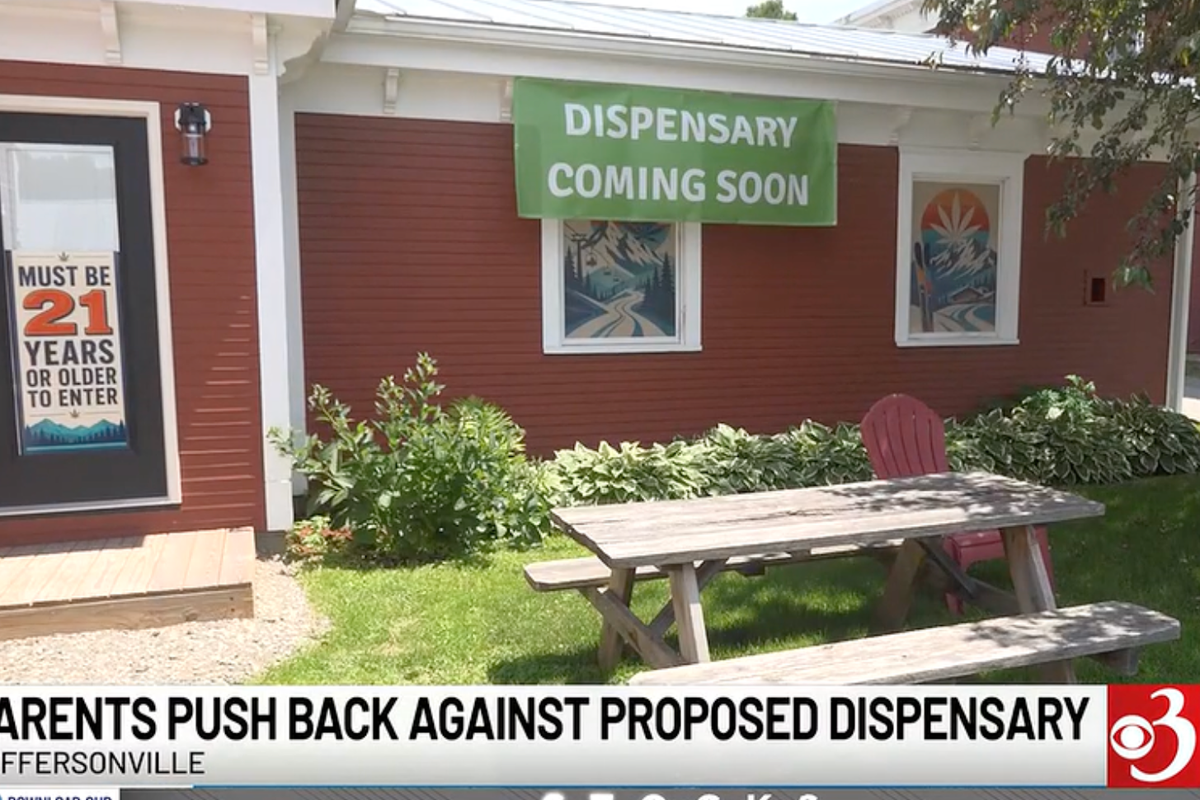
When legal weed comes to town, the rules seem clear-cut on paper. You keep retail pot shops a safe distance away from where kids play, and everyone moves on. But what happens when the legal definitions don't match up with what people actually see on the street?
That's the exact tension boiling over in Jeffersonville, Vermont right now.
A local pot shop, Clean Country Dispensary, wants to move its operations from nearby Johnson over to a building on Main Street in Jeffersonville. There's just one problem. The new storefront sits roughly 80 paces from the edge of the Cambridge Elementary School playground.
For parents watching their kids run around at recess, it feels like an obvious line has been crossed. For the regulators looking at a map, it's a completely different story. It shows how the messy reality of cannabis zoning laws is hitting small-town America.
The Eighty Step Buffer Disconnect
If you ask local parents, the math is simple. Krista Huling, a mom and former teacher in the area, pointed out that the proposed dispensary storefront is clearly visible from the school grounds. She started a petition that gathered nearly 200 signatures in the town of just 750 people. The core argument isn't about blocking the cannabis industry entirely; it's about basic proximity to the heart of where kids gather.
Vermont law generally requires dispensaries to maintain a 500-foot buffer zone from schools. So how is this location even up for debate?
It comes down to a loophole regarding adjacent properties. Cannabis Control Board Chairman James Pepper weighed in on the controversy, explaining that while the storefront physically falls inside that 500-foot radius, it technically complies with state regulations.
Because there's a row of separate businesses sitting between the school and the proposed dispensary, the properties aren't considered adjacent. In the eyes of state regulators, those separate tax parcels act as a legal shield, meaning the strict 500-foot rule doesn't actually trigger.
Local Pushback Meets State Authority
This legal technicality has left community members feeling like state rules ignore the physical layout of their neighborhood. When a child's playground is within a short walk of a retail pot shop, legal arguments about property lines feel incredibly hollow to the people living there.
The local government is stuck in the middle. The Cambridge Selectboard met to vote on approving the dispensary's license transfer, but the board split down the middle, failing to reach a consensus.
While the state's Cannabis Control Board already gave an initial green light back in January, the lack of local agreement complicates things. The state makes its final decision soon, and local boards carry significant weight in the final vetting process.
Why Cannabis Zoning Is Getting Harder
This isn't just a Vermont issue. Towns all over the country are realizing that original legal cannabis frameworks didn't anticipate the weird quirks of small-town geography.
Main streets are tight. Commercial zones are limited. In small rural hubs, the commercial district is often only a few blocks long, and it almost always sits right next to residential zones, parks, and schools. If you enforce massive, sweeping buffer zones without nuance, you effectively ban legal businesses from opening anywhere in town. But if you rely entirely on technical parcel loopholes, you end up with a pot shop eighty steps from a playground.
Finding the middle ground between public safety and a functioning legal market means towns need clearer rules. Relying on whether a business is "technically" on an adjoining lot isn't a strategy that keeps communities happy.
If you are facing similar zoning issues in your own town, you need to look at local ordinances before licenses reach state-level approval. Don't wait for a state board to interpret a map. Push your local selectboard or city council to establish explicit, un-bypassable distance rules based on actual footage rather than parcel ownership lines.