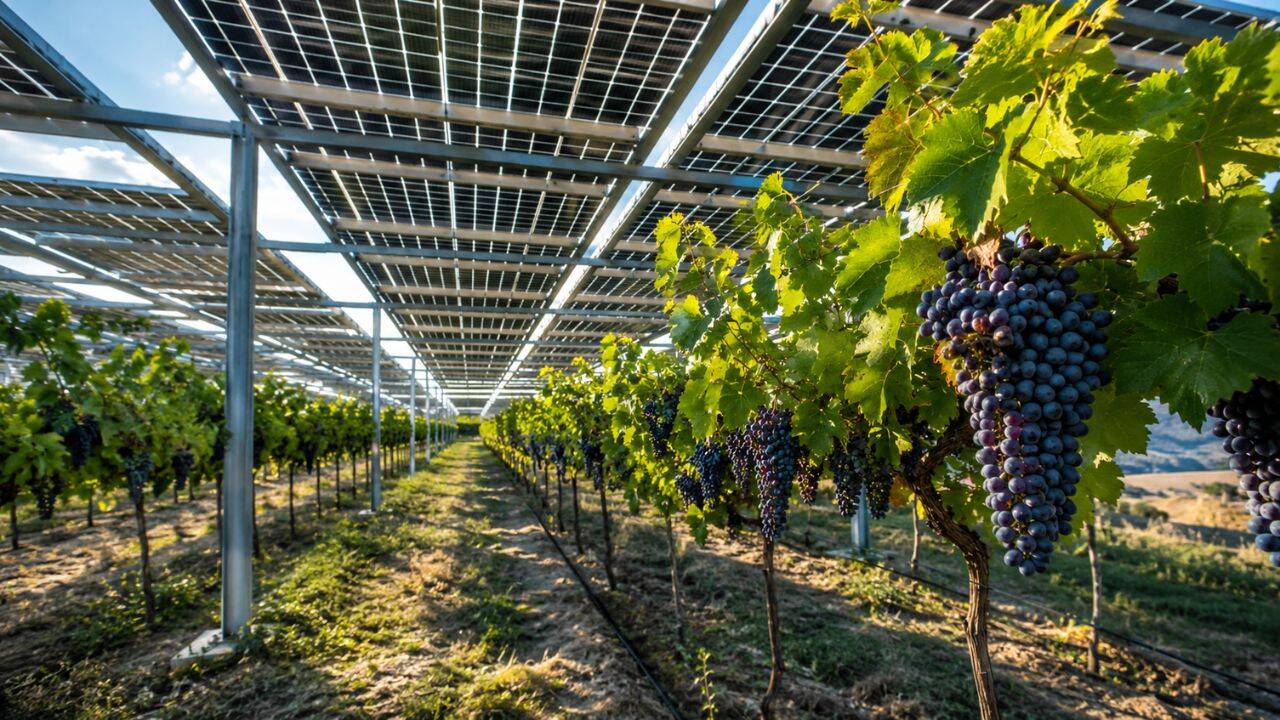
Stop thinking of solar panels as energy-only devices. They aren't just for roofs or empty fields anymore. Recent trials in Italy’s Puglia region prove something radical: you can grow grapes and harvest electricity on the exact same plot of land without killing the crop. Actually, you might just double—or even triple—your output.
It sounds like some tech-bro fantasy, but the data is real. Researchers found that grapevines positioned under photovoltaic panels produced a massive 277% increase in yield compared to vines left in the scorching Mediterranean sun. Forget the "solar vs. agriculture" debate. That battle is over. The future is dual-use.
The Microclimate Reality
People assume shade kills grapes. They think sunlight is the only variable that matters for photosynthesis. That’s a dangerous oversimplification. I’ve spent enough time around agricultural systems to know that a plant’s worst enemy isn't just a lack of sun—it’s heat stress, erratic humidity, and scorched soil.
In Puglia, the solar panels weren't just generating power; they were acting as a protective canopy. They didn't drastically change the ambient air temperature, but they modified the microclimate.
- Wind control: The panels acted as a barrier, reducing wind speeds that would otherwise dry out the soil and the vines.
- Vapour pressure: By reducing the atmospheric pull on moisture, the plants stayed hydrated for longer periods.
- Soil moisture: Shielding the ground from direct radiation meant the earth didn't bake. Water stayed in the root zone where it actually does some good.
Think of it this way: your vines aren't robots. They don't want maximum intensity at all times. They want a steady, manageable environment. When you provide that, the reproductive performance—the "bud fruitfulness"—improves immediately.
Why the Light Composition Matters
You’ll hear skeptics argue that shading will ruin the quality of the grapes because the vines won't get enough "energy." They’re missing the nuance of spectral quality.
The Puglia study revealed that the light reaching the vines beneath the panels wasn't just "dimmer." It was different. The panels filtered the light, resulting in an increase in UV and blue light wavelengths. This shifted the way the vines photosynthesized. It’s not just about how much sun they get; it’s about the quality of that light.
If you are designing an agrivoltaic system, you shouldn't just slap panels on a rack and hope for the best. Height, spacing, and panel tilt determine exactly how that light spectrum hits your rows. If you get it wrong, you get a mess. If you get it right, you get a 277% yield boost.
The Math Behind the Land Use
Most people look at this and only see the wine. You have to look at the land efficiency. The industry uses something called a Land Equivalent Ratio (LER) to measure this. In this trial, the LER hit 3.54.
That number is huge. It means this dual-use system was over three times more productive than separating the two functions. You’re getting your fruit, and you’re getting power from the same square meter. This isn't just "good for the planet"; it's a massive financial efficiency gain for farmers who are tired of fighting droughts and rising energy costs.
What You Should Do Next
If you’re looking at agrivoltaics for your own property or as an investment, stop waiting for "perfect" solar panels. The tech exists. The challenge is in the implementation.
- Focus on the microclimate, not just the energy. Your goal is to moderate the conditions around the crop. If your local climate is dealing with extreme wind or heat, use your panel array as a climate shield.
- Consult with local viticulturists early. Don't design your solar rack in a vacuum. A layout that works for solar won't always work for the tractor or the trellising system.
- Analyze your soil moisture retention before and after. If the panels are actually stressing the crop rather than helping it, you need to adjust the shading density.
- Treat the energy as a second harvest. Agrivoltaics is about a dual-income stream. If your panels aren't generating enough to pay for themselves while keeping your crops healthy, your layout is wrong.
Don't buy into the idea that we have to choose between food and energy. The Puglia experiment shows that when you treat the farm like a complete biological and technological system, you don't have to choose. You just have to design better.