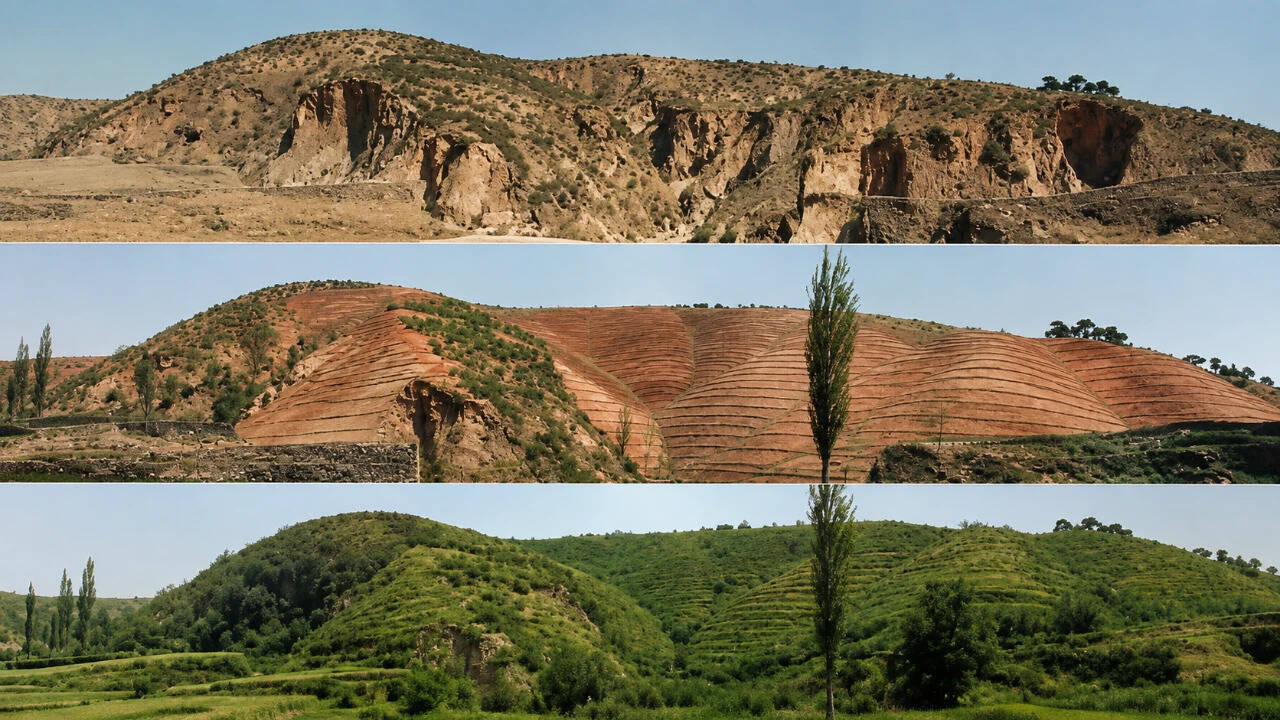
Walk through South Korea today and you see lush, densely wooded mountains stretching as far as the eye can see. It feels ancient. It feels permanent. It is actually an engineered miracle born out of total catastrophe.
In the wake of the Korean War, the country's landscape looked like the moon. Bombings, illegal logging, slash-and-burn farming, and an urgent daily scramble for firewood stripped the hills bare. By the late 1950s, average wood volume dropped to a dismal 10.6 cubic meters per hectare. Monsoons triggered massive landslides, washing away topsoil and threatening communities with starvation.
Then came an audacious national obsession. Over the next few decades, South Korea planted more than 10 billion trees. Today, forests cover roughly 63% of the nation.
Most people assume planting trees is just about putting roots in dirt. That is a naive mistake. South Korea's success proves that ecological restoration fails unless you fix the social and economic engines driving the destruction in the first place.
The Brutal Reality of Post War Degradation
You cannot understand South Korea's green miracle without looking at how desperate things were. Millions of displaced people needed heat and fuel. Coal was scarce and expensive. Wood was the only option. Every living branch on those hills became cooking fuel or timber for rebuilding ruined homes.
Erosion was terrifying. When heavy rains hit naked mountain slopes, mud choked rivers and wiped out villages. The government realized that an entirely green-barren country meant economic death.
Initial attempts struggled. Planting seedlings meant nothing if local villagers walked out the next morning to chop them down for firewood. You cannot grow a canopy when people are freezing.
How the Strategy Actually Worked
The turnaround shifted gears dramatically under President Park Chung-hee, merging strict state planning with grassroots mobilization through the Saemaul Movement.
The government deployed a multi-pronged approach that separated simple planting from true structural reform:
- Energy Substitution: The state aggressively pushed coal briquettes into urban and rural homes. Once households had an alternative fuel source, the daily pressure on local forests plummeted.
- Aggressive Species Selection: Early phases prioritized survival over native biodiversity. They planted fast-growing, resilient species like Japanese larch, pitch pine, and black locust that could claw life out of dead, eroded soil.
- Strict Enforcement: Unauthorized logging met with zero tolerance. Local forest protection associations, staffed by villagers themselves, guarded the hillsides.
This wasn't just environmentalism. It was total social mobilization. Schools, government workers, and citizens were drafted into massive seasonal planting blitzes.
The Hidden Shift From Pine to Oak
Planting 10 billion trees was only chapter one. Nature then took the wheel in ways foresters did not entirely expect.
Early non-native and fast-growing plantations acted as nurse crops. Research highlighted by restoration studies shows that underneath those rows of pitch pine and larch, native species like oak and Korean red pine began to naturally regenerate.
Over decades, human-planted woodlots transitioned into complex, multi-layered ecosystems. Timber volume skyrocketed from that post-war low of roughly 10 cubic meters per hectare to over 160 cubic meters per hectare.
What Modern Conservationists Keep Getting Wrong
Today, nations love launching flashy trillion-tree pledges. Politicians hold press conferences, hand out saplings, and chase headlines. Almost all of them miss the core lesson of South Korea.
Trees do not survive because you plant them. Trees survive because the surrounding community stops needing to destroy them. If local populations lack economic alternatives or cheap energy, your saplings become firewood by winter.
South Korea's model is now being shared globally through initiatives like the SAFE Initiative with the United Nations Environment Programme, helping countries in Southeast Asia replicate those exact frameworks.
The Next Crisis on the Horizon
The job isn't finished. Modern South Korean forestry faces an entirely new set of threats.
The vast majority of those restored trees were planted during a tight window in the 1970s and 1980s. That means the country's forests are essentially the same age. Aging stands, combined with rising global temperatures, make the landscape vulnerable to devastating wildfires and pine wilt disease. Native red pines are currently retreating under intense climate pressure.
Managing a mature forest requires a totally different playbook than brute-force planting on a barren hill. Thinning, biodiversity promotion, and active climate adaptation must replace simple conservation laws.
Look at those green mountains next time you visit Seoul. Remember that human grit turned a lunar wasteland into a global template for survival. Protecting it now takes the same fierce dedication.