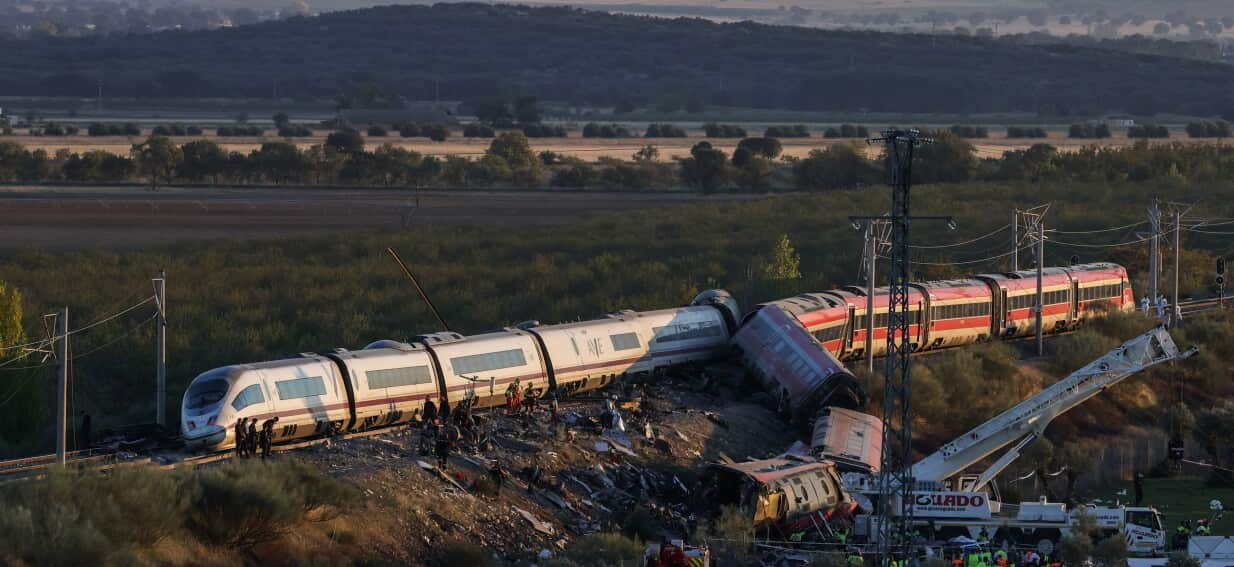
A massive roar shattered the morning quiet in Toledo province, turning what should have been a standard high-speed commute into a national catastrophe. At least 68 people lost their lives when a Renfe passenger service slammed directly into the tail of a stationary Iryo train on the vital line connecting Madrid to Seville.
Right now, Spain is in deep mourning. Prime Minister Pedro Sánchez declared three days of national mourning, while King Felipe VI visited the crash site to witness the carnage firsthand. But behind the grief lies a boiling wave of public anger and hard questions. This isn't just an isolated tragedy. It marks the second catastrophic high-speed rail accident in Spain this year, dragging long-standing infrastructure concerns back into the spotlight.
If you are following the crisis, you want to know what actually went wrong on the tracks, how a modern rail network managed to fail twice in a single year, and what officials are doing about it. Let's look at the facts.
The Sequence of Disaster on the Tracks
The disaster unfolded just after 9:00 AM on a busy stretch of the Madrid-Seville high-speed line. A total of 544 passengers were on board the two trains.
An Iryo private consortium train carrying 147 passengers came to a halt near Toledo because of an unexpected signal fault, acting on instructions from infrastructure manager Adif. Shortly after, a Renfe train carrying 397 passengers plowed into the rear of the stationary train at high speed.
The impact tore through the carriages. Two wagons on the tail of the Iryo service and the front of the Renfe train derailed immediately, tumbling down an embankment. Survivors recounted scenes of absolute terror. Luggage, cell phones, and passengers flew through the air as the train violently buckled.
Rescue teams rushed to the scene within minutes, deploying helicopters, ambulances, and military emergency brigades. They found blood-spattered passengers climbing out of shattered windows, while volunteers handed out water along nearby roads. Health Minister Mónica García launched an urgent public appeal for blood donations as regional hospitals scrambled to treat dozens of injured survivors.
Pointing Fingers and Questioning Infrastructure Safety
Public trust in Spain's world-class rail system has taken a severe hit. Transport Minister Óscar Puente pointed to an inexplicable decision to authorize the Renfe train to keep moving despite a prior signaling failure, suggesting human error played a critical role.
Yet, public frustration goes deeper than a single dispatcher's mistake. Back in January, another high-speed collision near Córdoba killed 46 people. That incident prompted intense debates over mounting maintenance issues and underfunded upgrades across the network. Preliminary investigations into January's crash pointed toward track defects and rail welds, though several theories remained open.
Now, citizens are demanding accountability. Sánchez insisted his government will investigate the incident with absolute firmness and rebuild confidence in the infrastructure. But critics argue that rapid network expansion and soaring passenger volumes have outpaced safety maintenance protocols. Spain has long taken immense pride in having one of the largest high-speed rail networks in Europe. That pride has now turned into a grim national reckoning.
What Happens Next for Spain's Rail Network
Political fallout has been swift. Major political parties suspended campaigning activities ahead of upcoming parliamentary elections, reflecting the somber mood of the country. International leaders, including European Commission President Ursula von der Leyen, sent messages of condolence as Europe watched the crisis unfold.
Moving forward, investigators from civil guard and transport safety boards face the grueling task of downloading black boxes, analyzing dispatch logs, and reconstructing the exact seconds before the impact. For commuters and regular travelers, the immediate future brings heightened anxiety about network safety and calls for independent safety audits across every major corridor.
The physical wreckage in Toledo will eventually be cleared away, but the pressure on transport authorities to prove the rails are safe to ride will linger for years.