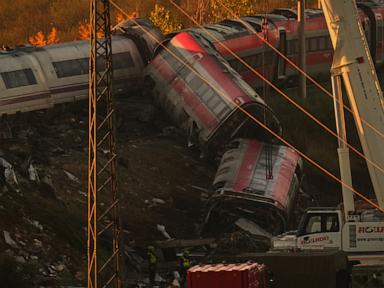
Spain's high-speed rail network used to be the gold standard for European transit. People bragged about how fast you could slide from Madrid down to Andalusia. That reputation shattered on October 28, 2026, when a catastrophic collision near Urda killed 69 people and injured over a hundred more.
When authorities released the final breakdown of the victims, the global scale of the tragedy became starkly clear. Out of 66 officially identified bodies at the time, 54 were Spanish nationals, while 12 were foreign citizens. Among the dead were four Americans and one Canadian, alongside travelers from Japan, Argentina, Mexico, Portugal, Tunisia, and the Czech Republic. This wasn't just a local transit failure. It became an international tragedy that exposed deep vulnerabilities in a system carrying tens of millions of passengers every year. For an alternative perspective, check out: this related article.
How the Tragedy Unfolded Outside Urda
The crash happened just outside the central village of Urda, roughly 80 miles south of Madrid. A state-operated Renfe high-speed service plowed directly into the rear of a stationary train run by a private operator, Iryo.
The sequence of events reads like a worst-case scenario. An automatic safety system failure had originally halted all trains on a 63-kilometer stretch of track. That safety protocol is supposed to prevent any two trains from occupying the same danger zone. But somewhere in the chain of command, human intervention overrode the tech. A control center in Madrid instructed the driver of the halted Renfe service to proceed under normal operations—known locally as con marcha normal—even though the Iryo train was still stalled right in front of it. Similar reporting on the subject has been published by The Washington Post.
The front carriages of the Renfe train and the rear of the Iryo train were completely crushed. Survivors spoke of a violent impact that happened in a split second, turning an ordinary morning commute or tourist trip into a disaster zone.
A Second Deadly Strike on the Same Line
What makes this disaster so alarming isn't just the high death toll. It is part of a worsening pattern. This was the second fatal accident on the Madrid-Seville line in 2026 alone. Earlier in January, another horrific collision near Adamuz killed 46 people and left dozens hospitalized.
Two major fatal crashes on the same flagship high-speed corridor within ten months destroy any argument that these are isolated freak incidents. Public trust in Spanish rail infrastructure has taken a massive hit. Prime Minister Pedro Sánchez admitted openly that trust in the transit system had broken, landing right as his government faces intense political pressure ahead of a general election.
Critics and railway unions point to chronic under-investment, overworked control center staff, and questions surrounding the reliability of automated signaling backups. When high-speed rail relies on a fragile mix of complex digital tech and manual overrides, small communication breakdowns turn deadly fast.
The Global Aftermath and Consular Support
For families across North America, the news brought unimaginable grief. Consular officials from the United States and Canada mobilized immediately to provide emergency assistance to the relatives of the American and Canadian victims. Canadian and U.S. representatives coordinated with Spanish authorities as repatriation and identification processes dragged through a painstaking verification phase.
With citizens from nearly two dozen countries affected, embassies in Madrid became crisis hubs. Governments worldwide are now quietly re-evaluating travel advisories for high-speed rail corridors in Southern Europe, forcing tourists and business travelers to look closer at safety records they once took for granted.
What Needs to Change Right Now
If high-speed rail is going to remain the backbone of green, continental transit, the industry has to fix its blind spots. You cannot scale up passenger capacity while cutting corners on maintenance or leaning on manual overrides when automated systems throw error codes.
Transport ministries need to mandate independent oversight for all software disconnections and signaling glitches. Control centers must strip away ambiguous clearance commands that tell drivers to resume normal speeds when track clearance hasn't been visually or digitally verified beyond a shadow of a doubt.
Spain faces a long road to rebuild its infrastructure credibility. For the families of the four Americans, the single Canadian, and the dozens of other souls lost in Urda, accountability cannot come soon enough.


