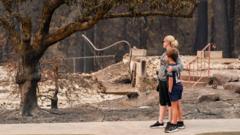
Sixty thousand people running for safety changes a city overnight. When ferocious wildfires erupted around Spokane, Washington, the sheer speed of the disaster caught entire neighborhoods off guard. You're looking at a massive emergency that turned skies pitch black, forced emergency evacuations—including patients from the local U.S. Veterans Affairs hospital—and left behind neighborhoods reduced to smoking chimneys.
If you want to understand what's actually happening on the ground in the Pacific Northwest right now, you have to look past the basic headlines. Let's break down the reality of the crisis, why the terrain makes fighting these blazes a nightmare, and what comes next.
The Scale of the Washington State Wildfires
The numbers coming out of eastern Washington are staggering. Over the weekend, multiple blazes—identified by authorities as the Old Trails Fire, the Fairview Fire, and the Meadowview Fire—ripped through roughly 8.2 square miles in and around Spokane alone. But zoom out, and the broader picture is even more terrifying. A total of roughly 390 square miles have scorched across the state.
At least 600 structures, including residential homes and local businesses, have been completely destroyed. Evacuees scrambled to find safety, with about 400 people packing into the city's main convention center to sleep on cots while authorities scrambled to coordinate relief.
Spokane County Commissioner Chris Jordan put the personal horror into perspective after speaking with relatives who had to flee. They jumped into their cars with smoke blinding their view, completely unsure if their home would survive the night. Stories like that are playing out across thousands of households.
Why Spokane is So Vulnerable to Fast Moving Blazes
Wildfires don't just happen randomly; they exploit local geography. Benjamin Cossel, a public information officer for an incoming federal response team, pointed out the brutal combination working against firefighters: weather and terrain.
Spokane features steep canyons and very hilly slopes cut through by the Spokane River. These natural formations act like wind tunnels.
"They push the fire through the canyons, up, up the slopes, and then outside the slopes and around," Cossel explained. "It's very, very hilly, very, very steep slopes, a lot of canyons that create really turbulent, really challenging sort of wind scenarios."
When afternoon temperatures rise, they break down the cooler air hugging the ground. That shift lets intense wind gusts—ranging from 35 mph to 45 mph—barrel straight through the canyons. Fire crews using bulldozers and helicopters find themselves entirely outmatched when the wind changes direction in a matter of seconds.
A Wider Crisis Across the American West
Washington isn't burning in isolation. The entire western half of the country is currently facing a punishing gauntlet of extreme weather and explosive fire growth.
Look south and east, and you'll see similar catastrophes unfolding:
- Idaho and Oregon: Crews have spent over a week battling a massive grassland fire consuming nearly 525 square miles, threatening hundreds of remote cattle ranches and homes.
- Utah: A fast-moving blaze in the central part of the state more than doubled in size over a single weekend, destroying livestock and forcing mandatory evacuations for towns like Fillmore.
Washington Governor Bob Ferguson declared a state of emergency as the National Weather Service slapped the region with a "particularly dangerous situation" red flag alert. Dry conditions, low humidity, and high heat are combining to create an environment where a single spark can trigger total chaos.
What Happens Next for Evacuees
Right now, local and federal agencies are prioritizing life safety above all else. Miraculously, despite the scale of the destruction, authorities reported zero deaths or missing persons immediately following the worst of the weekend rush, though officials emphasize the assessment is still in its earliest stages.
senador Maria Cantwell warned residents during a joint press briefing that the region is far from safe. With dry weather forecasted to persist and temperatures climbing, containment lines remain fragile.
If you or someone you know is in an affected zone in eastern Washington, stay glued to local emergency alerts, keep your gas tank full, and obey mandatory evacuation orders immediately. Do not wait until the smoke is at your front door.