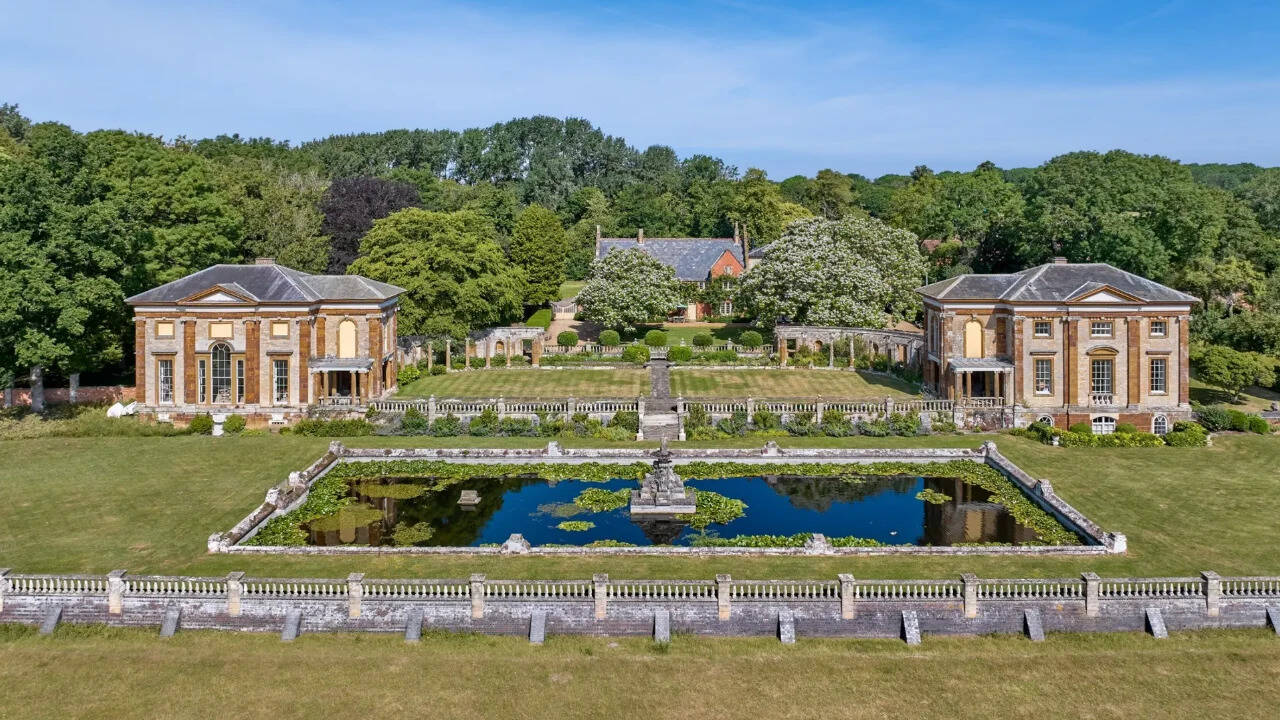
Buying a historic English estate sounds romantic until you realize the main house burned down in 1886 and you're actually buying the surviving wings and 113 acres of Northamptonshire land. Yet that exact reality is why Stoke Park in Stoke Bruerne, listed for sale at £5.25 million through Strutt & Parker, fascinates architectural historians and countryside buyers alike.
If you only read quick property roundups, you'll get a tidy list of trivia. Henry VIII took the manor in 1541. A fire wrecked the grand house in 1886. The Chancellor family stepped in during the 1950s and saved the historic pavilions. True enough, all of it. Still, those bullet points flatten five centuries of English politics, architectural shifts, and rural land management into a neat little bow.
Let's look closely at what's actually on the table at Stoke Park, why the pavilions carry outsized architectural weight, and what a buyer today really steps into when taking on a property with this kind of pedigree.
Why This Former Royal Hunting Estate Draws Attention
Most people searching for a £5.25 million property with Tudor ties want two things straight away. They want to know if the Tudor history is real or stretched marketing, and they want to know what buildings you actually get to live in.
Here's the honest breakdown. Stoke Park sits near Towcester in Northamptonshire, just south of Stoke Bruerne village and close enough to the A508 to reach Northampton or Milton Keynes without feeling stuck in the middle of nowhere. The estate came under Crown control in 1541 after the Longueville family surrendered the manor to Henry VIII, turning a medieval hunting landscape into royal territory. Tradition links Henry VIII with hunting in the deer park alongside Anne Boleyn, and later centuries brought other heavyweight names across the grounds, including Charles I, Sir Francis Crane, and Isaac Newton, who spent an extended stay there in 1672.
What you won't find on the 113-acre holding today is a standing Tudor palace or the central block of the seventeenth-century house. Instead, the estate centers on the surviving historic pavilions, a Grade II-listed coach house with three bedrooms, roughly 86 acres of parkland, and around 20 acres of woodland stretching toward the River Tove, with an amenity lake tucked into the trees.
For some buyers, no intact central mansion is a dealbreaker. Honestly, I get that. A sprawling ruined or rebuilt main block often means endless maintenance headaches with lower day-to-day charm. For others, paying over five million pounds for wings rather than a single monolithic hall feels counterintuitive. Whether that feels like a quirk or a gift depends entirely on how you value architectural origins over sheer square footage.
The Architectural Twist Most Headlines Miss
Here's the detail that makes Stoke Park far more interesting than a standard "old house for sale" story. Around 1630, after Charles I granted around 400 acres at Stoke Bruerne to Sir Francis Crane, director of the Mortlake Tapestry Works, a grand house was built that is generally attributed to Inigo Jones.
Why does that matter? Because Palladian architecture—the classical Italian style built around proportion, symmetry, and a central block linked by colonnades or quadrant walls to flanking pavilions—is widely associated in Britain with the eighteenth-century revival led by figures like Lord Burlington. Stoke Park appeared roughly eighty years earlier, making it an early landmark in introducing that layout to England. Even architectural historians note nuances around attribution and exact surviving fabric, so treating Inigo Jones as a scholarly attribution rather than a scribbled signature on a napkin keeps things grounded.
When the 1886 fire destroyed the main house, a replacement house followed in the 1890s, was used by the military during the Second World War, and was largely demolished in the late 1940s, leaving the service wing and the two seventeenth-century pavilions as the standout survivors. Those two pavilions weren't just spare garden sheds. Historically, one served as a chapel and the other as a library.
Today, the pavilions play very different roles:
- The West Pavilion, once a library and later a ballroom, spans around 1,613 square feet with tall ceilings, a stone fireplace, and wide parkland views, making it suited to entertaining and events.
- The East Pavilion, historically linked with chapel use, offers a more intimate two-floor layout with two bedrooms, reception space, and updates completed in 2024 that keep period character intact.
Look at how that works in practice. You don't get a cavernous, drafty 25-bedroom pile where half the rooms stay shut all winter. You get distinct spaces with real character, plus a separate coach house currently let under an Assured Periodic Tenancy agreement.
Rescue, Stewardship, and Real-World Constraints
A lot of historic properties only survive because someone stubborn refused to let them rot. In 1954, publisher Robin Chancellor bought the pavilions and set about rescuing them—demolishing the 1891 house with grant support and restoring the pavilions—before the estate passed within the family, including to the late journalist and former Spectator editor Alexander Chancellor. Now the family is selling the estate as a whole by private treaty.
Having lived around listed buildings and rural land management in the UK, I can tell you that heritage status changes the math on everything. Both the pavilions and the broader historic park and garden carry listed protections, and the land includes environmental and agricultural agreements—such as a Sustainable Farming Incentive agreement running from June 2024 to May 2027—alongside existing tenancies.
That means a buyer can't treat 113 acres like a blank canvas for motocross tracks or unapproved extensions. Every alteration, tree work decision, or land-use change has to be weighed against conservation rules, existing agreements, and practical upkeep. Some people find that restrictive. Fair enough. Others see it as built-in protection that keeps the landscape quiet, green, and intact long after trends shift.
You also have to factor in public access and privacy. Historic parks and gardens often carry public footpaths or limited open days, and views from nearby roads or higher ground can remind you that you're part of a living Northamptonshire landscape rather than a fortress on a deserted island. That's normal for English countryside estates, though buyers moving from gated compounds sometimes find it surprising.
Who Actually Buys a Place Like This?
At a £5.25 million guide price—roughly US$6.8 million depending on exchange rates—Stoke Park sits in rarefied territory for Northamptonshire. It isn't a weekend cottage, and it isn't a turnkey modern glass box either.
The buyer who thrives here usually fits one of three profiles:
- The history-minded country dweller who cares more about seventeenth-century Palladian bones, woodland walks toward the River Tove, and quiet parkland than having a gleaming spa complex.
- The stewardship-focused family looking for multi-building flexibility—combining main living quarters, guest or event space in the pavilions, and rental or staff potential via the coach house—with the patience for historic upkeep.
- The rural land and conservation buyer drawn to combining roughly 86 acres of grassland and 20 acres of woodland with active countryside management.
If you want zero rules, ultra-low running costs, or a single unified mansion built in one era, walk past this listing. If you love layered English history and want space you can genuinely breathe in, it's hard to ignore.
Practical Next Steps If You're Serious
If you're looking at Stoke Park as more than a daydream, don't start with guesswork. Take these concrete steps before booking a trip:
- Request the full sales particulars and tenancy/land schedules through Strutt & Parker, checking exact boundaries, the Assured Periodic Tenancy terms on the coach house, and the dates and obligations of the Sustainable Farming Incentive agreement.
- Review the Historic England listing records for Stoke Park and the pavilions early so you understand what internal and external works require listed building consent.
- Walk the wider surroundings and access routes around Stoke Bruerne and the A508 corridor at different times of day to judge road noise, footpath activity, and privacy on the ground.
- Bring a specialist heritage architect or land agent to your viewing if you plan to reconfigure interiors or manage the parkland and woodland long term.